
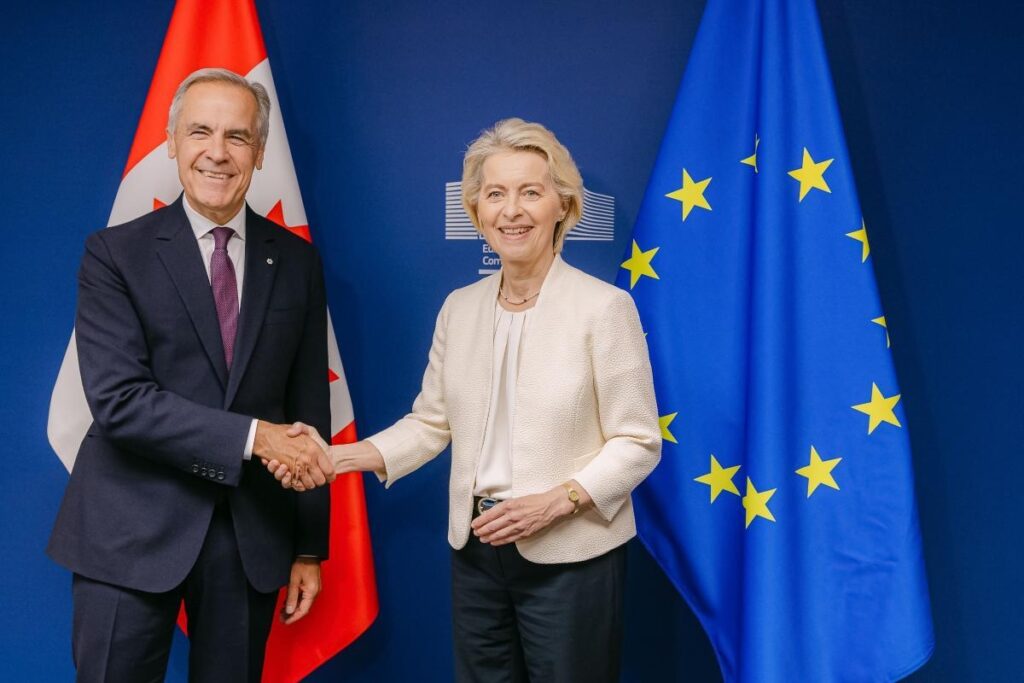
European Union Commission President Ursula von der Leyen backed the idea of associate membership for Canada during her annual address yesterday. But what could that new form of relationship look like?
Earlier this week, Canadian Prime Minister Mark Carney teased the prospect of a “unique alliance” with the EU, seemingly making good on The Brussels Times’ own satirical take on the story from early last year.
Ursula von der Leyen followed that up by mentioning the idea of associate membership during her State of the European Union speech, saying this would not be "a partnership against anyone else, but for our common strength".
Reading between the lines, it is clear that the “anyone” there is the United States and its current leader Donald Trump, with whom Carney has repeatedly clashed, particularly on the issue of trade.
So what would this associate membership look like? Von der Leyen did not flesh out the idea during the speech, limiting herself to name-checking manufacturing, AI, technology, defence, energy, critical materials and economic security as priority areas for cooperation.
Full EU membership is almost certainly not on the cards for a variety of reasons. A poll conducted last year showed that although 44% of Canadians backed exploring the idea, 34% said the government should not. Hardly a ringing endorsement.
That is not to say that the EU is not popular or valued in Canada. The same survey revealed that most people believe the country’s most important partner over the next five years will be the bloc.
As a disclaimer, those numbers were crunched before the United States launched its tariffs in 2025, meaning it is likely that everyday Canadians’ perceptions of the EU have likely improved.
The idea of a new form of membership is not a new one. German Chancellor Friedrich Merz suggested earlier this year that Ukraine could be granted something similar, although nothing has yet come of that proposal.
Association agreements rather than membership exist already and the EU has them in place with lots of countries, including those nations applying to join the bloc. Other groups include the Central American countries and African, Caribbean and Pacific states.
But the kind of partnership being teased here sounds like something that goes beyond this kind of arrangement.
Associate membership exists within the EU framework though, namely in the Horizon Europe research programme. Canada itself has that status, along with other countries like Korea, New Zealand and Switzerland.
Horizon associates can participate in all programmes depending on the scope of their membership, but they can be restricted from politically-sensitive projects, they have to pay membership fees and they typically do not have voting rights.
It is possible that if the idea of associate membership for the EU itself is taken up, the Horizon model might be taken as some sort of template.
Whether that would then interest countries like the United Kingdom, which left in 2020, or Iceland, which opted not to reopen membership talks last month, would be an interesting dynamic to follow.
Horizon is not the only programme with associated non-EU countries. Erasmus, the EU's student exchange programme, also has that feature, which was notably extended to the UK recently, meaning British students will be able to rejoin the scheme as of January next year.
As one of the most symbolic illustrations of EU success over the years, allowing Canada to join Erasmus could be a part of this membership plan and would require very little compromising or risk-taking on the part of the Union.
Ultimately though, all this will be decided by what the EU’s current 27 members want. Although many are sympathetic to Canada’s increasing isolation due to its fractious relationship with the US, that might not be enough to welcome the country into the fold in some form.
After all, the most tangible example of EU-Canada relations is the comprehensive trade deal that exists between the two, CETA. Ten of the EU’s members are yet to ratify that deal, despite the fact it was signed nearly a decade ago.
Given that it would take years to plan, negotiate and execute whatever form this membership idea would take, it is likely that many European governments would simply count on a new US president mending fences with Ottawa, which would make the plan less necessary.
Carney addresses MEPs later today, maybe he will spell out how he sees this one playing out.
