
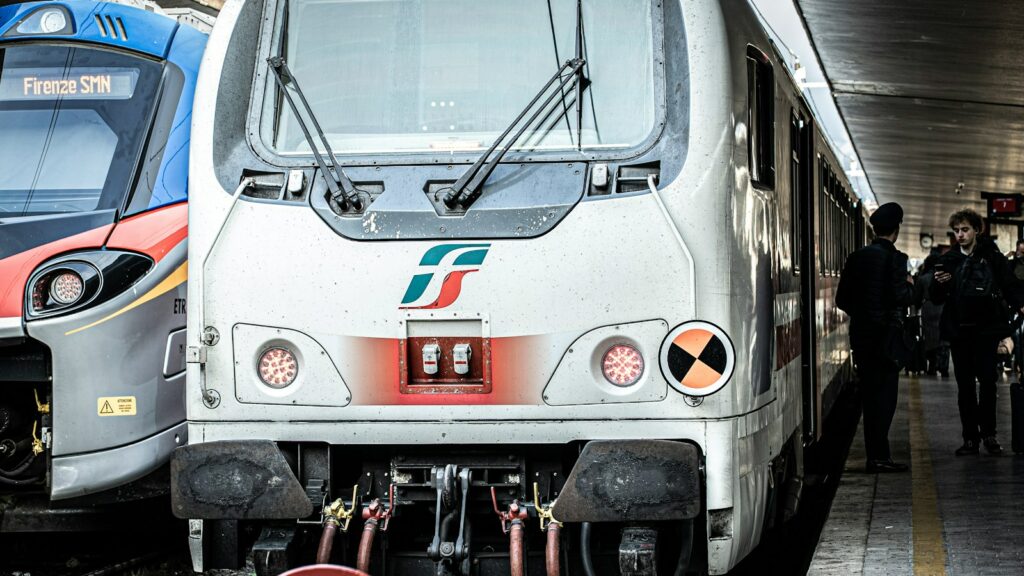
Cars accounted for just over two-thirds of travel in the EU in 2024, while trains edged ahead of buses for the first time in a decade.
Passenger cars made up 69.2% of total passenger-kilometres — a measure of travel that combines the number of passengers and the distance travelled — out of an estimated 6,130 billion passenger-kilometres across the bloc, Eurostat reported on Friday.
That was down by 1.0 percentage point from 2023.
Air travel represented 15.8% of passenger-kilometres in 2024, up 1.0 percentage point compared with the previous year.
Trains accounted for 7.5% — up 0.3 points — while buses, coaches and trolleybuses fell to 7.3%, down 0.2 points.
The rail share exceeded buses, coaches and trolleybuses in 2024 for the first time since 2014.
Differences across EU countries
Compared with 2014, the share of travel by car fell by 2.9 percentage points by 2024, while buses, coaches and trolleybuses declined by 1.3 points, Eurostat said.
Over the same period, trains rose by 0.9 points and air travel increased by 3.6 points.
Lithuania recorded the highest share of passenger-car travel in 2024 at 83.7% of passenger-kilometres, followed by the Netherlands at 77.0% and Finland at 75.4%.
Croatia had the largest air-travel share at 45.6% of passenger-kilometres, followed by Bulgaria at 30.3% and Cyprus at 25.3%.
Malta recorded the highest share for buses, coaches or trolleybuses at 17.0%, followed by Ireland at 16.6% and Hungary at 15.3%.
Hungary had the highest rail share at 11.3% of passenger-kilometres, ahead of Austria at 10.4% and the Netherlands at 9.8%.
For sea travel, Estonia recorded the largest share at 2.7%, followed by Malta at 2.4% and Croatia at 2.3%.
