
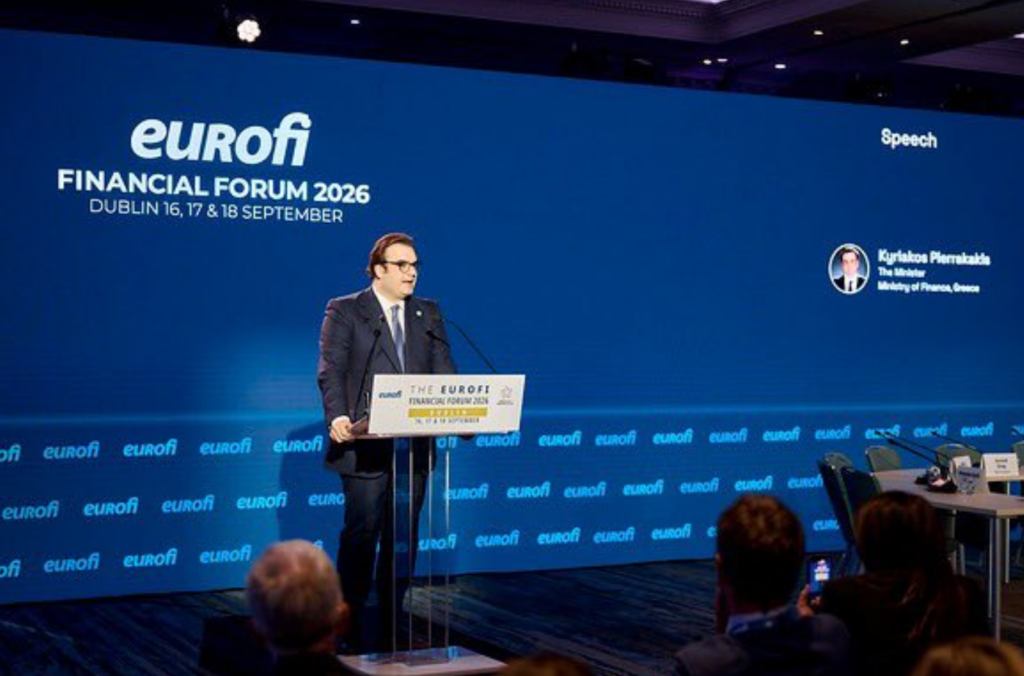
Europe needs to complete its Banking Union and build a “Savings and Investments Union” to mobilise private savings for investment, Eurogroup President Kyriakos Pierrakakis said in a speech in Dublin.
Speaking at the Eurofi Financial Forum on Thursday, Pierrakakis said Europe was facing a period of intensifying strategic competition in which technology, energy, trade, finance and currencies were increasingly used as tools of influence.
He stated that Europe was “not growing fast enough”, with weak productivity and a widening competitiveness gap, while investment needs were rising in areas including defence, energy, artificial intelligence, digital infrastructure, innovation and the green transition.
Pierrakakis cited a figure of €800 billion a year in additional investment needs, attributed to former European Central Bank president Mario Draghi.
Public finances “remain the foundation of lasting economic strength”, he said, but national budgets could not meet investment needs on that scale alone.
Focus on cross-border banking and simpler rules
Europe has the savings but lacks a financial system that can channel them effectively into companies and innovation across the bloc, he said, describing the objective of the Savings and Investments Union as linking savings more directly to investment through deeper, more integrated financial markets.
Banks provide about 70% of financing to the European economy, meaning the project would not work without a more integrated and competitive banking sector, he added.
European banks have become “resilient, well-capitalised and profitable” over the past 15 years and acted as “shock absorbers” during the pandemic and the energy shock that followed Russia’s invasion of Ukraine, according to Pierrakakis.
He pointed to European Commission analysis saying the banking sector remains fragmented along national lines, lacks scale, and faces regulatory and supervisory complexity.
Only around 16% of euro-area corporate lending is cross-border, he said, adding that cross-border banking groups still face constraints on moving capital and liquidity between countries.
Removing some of those constraints could unlock about €230 billion in high-quality liquid assets, while supervisory compliance and reporting costs are estimated at about €24 billion, he said, citing Commission estimates.
Pierrakakis also emphasised scale was increasingly tied to banks’ ability to invest in technology, noting that the largest US banks invest more than two-and-a-half times as much in IT relative to their assets as European peers, with a similar comparison to Chinese banks.
He backed the Commission’s direction and said progress was needed on three fronts — removing cross-border barriers and enabling consolidation; building trust through crisis management, resolution liquidity and deposit insurance; and simplifying rules while maintaining resilience.
