
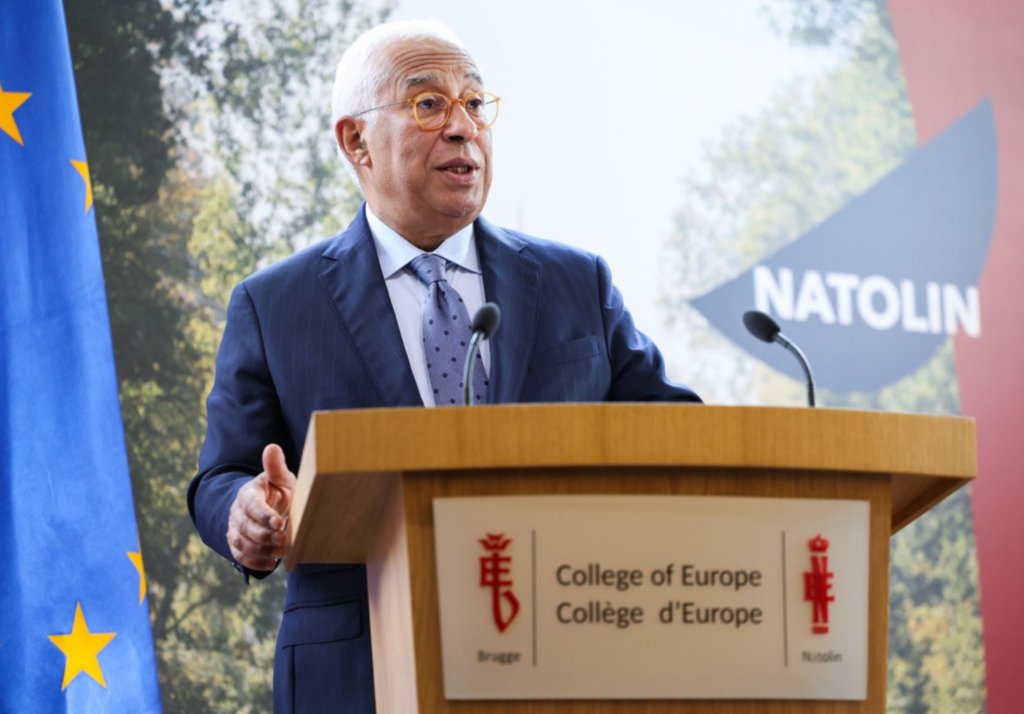
European Council President António Costa used a speech at the College of Europe in Natolin, Poland, to link European Union enlargement, defence spending and economic integration to Europe’s security and prosperity.
Speaking at the opening ceremony of the academic year at the Natolin campus on Monday, Costa said the institution was founded in 1992 as Europe emerged from the Cold War, with a mission to help overcome the East–West divide, cited by the European Council.
He pointed to Poland’s economic changes since the end of communism, saying the country’s GDP per inhabitant was “about one tenth” of today’s level at the time, and that Poland is now the EU’s sixth largest economy after more than two decades of membership.
Costa said economic studies estimate Poland’s GDP per inhabitant is around 40% higher than it would have been without EU accession, supported by export growth and integration into European supply chains.
He added that around 2.5 million Polish citizens have used EU freedom of movement to live and work in other member states, and that Poland has increasingly become a destination for workers as wages rose.
Defence spending and enlargement timetable
Costa also referred to Poland’s military position, saying that in 1992 about 50,000 Russian troops were still stationed in Poland and that the country was not then a NATO member, while Poland now has the third largest army by headcount in NATO and the largest in the EU.
Russia’s full-scale invasion of Ukraine was cited as a driver of higher defence spending across the bloc, with member states making “unprecedented investments.”
The European Defence Agency projects combined EU member state defence expenditure will reach about €454 billion in 2026 and could rise to €547 billion by 2029, according to the speech.
On EU enlargement, Costa said Ukraine’s application has increased momentum in the accession process and that this extends to Moldova and the Western Balkans, with progress assessed on a “merit-based” basis.
He noted that Montenegro aims to conclude its accession negotiations by the end of this year if conditions are met, and that the EU should work towards opening all “accession clusters” — groups of policy areas negotiated during membership talks — for Ukraine and Moldova by the end of this year, in line with required conditions.
Costa also set out economic priorities, including completing the EU Single Market — the bloc’s internal trading area — by 2028, including further integration in telecoms, energy and capital markets.
He said the EU and partners including Australia, Barbados, Brazil, Canada, India and Kenya launched a “Partners for Multilateralism, International Law, Peace and Prosperity” initiative at the United Nations, described as a network for dialogue and cooperation on areas including artificial intelligence and climate action.
Costa also said the EU’s network of trade agreements now covers 84 countries worldwide, and that over the past 12 months negotiations were concluded or agreements were signed with partners including India, Australia, the Philippines, Indonesia, Mercosur and Mexico.
