
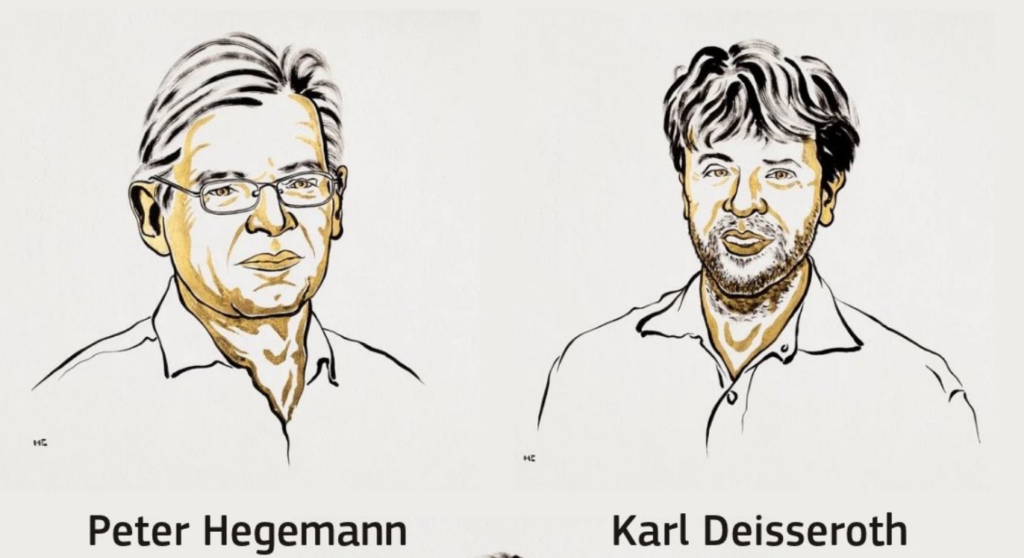
Peter Hegemann of Humboldt University of Berlin has been awarded the 2026 Nobel Prize in Physiology or Medicine alongside Karl Deisseroth and Georg Nagel for discoveries on light-gated ion channels and optogenetics.
Optogenetics is a technique that uses light to control the activity of nerve cells, and the work by Hegemann, Deisseroth and Nagel made that possible, the European Commission said in a release on Monday.
Hegemann previously received €2.4 million in EU funding through a European Research Council (ERC) Advanced Grant for the MERA project, which ran from 2016 to 2021 and studied how a light-sensitive protein functions and how it could be used in optogenetics.
He is also part of an ongoing ERC Synergy Grant project, SOL — Switchable rhodOpsins in Life Sciences — which runs from 2022 to 2028 and has almost €8 million in total EU funding, with the project working on light-controlled molecular switches for studying cellular functions.
EU-funded projects linked to Nobel laureate
Hegemann also contributed to the STARDUST project, which ran from 2017 to 2022 and received €3.8 million in EU funding shared among 10 participants, to investigate an ultrasonically powered implant that combines optogenetics, electrophysiology and pharmacology for potential applications in Parkinson’s disease.
All three projects were funded under Horizon 2020, the predecessor to the EU’s current research and innovation programme, Horizon Europe.
EU Commissioner for Startups, Research and Innovation Ekaterina Zaharieva congratulated the three laureates and said the European Union was “proud to have supported Professor Hegemann.”
At least 33 Nobel Prize laureates have benefited from EU research and innovation funding, including 16 ERC-funded researchers who later won a Nobel Prize when counting Hegemann.
