

The European Court of Auditors (ECA) has issued a clean opinion on the reliability of the EU accounts and on the legality and regularity of revenue for 2025, according to its annual report published on Thursday. Hower, the EU financial watch dog warns that the level of error in EU spending remains too high.
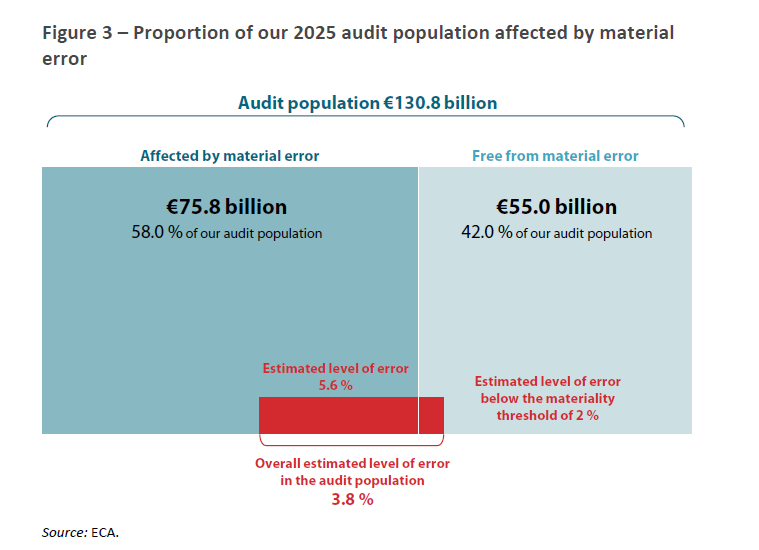
The estimated level of error in EU spending rose to 3.8 % in 2025, from 3.6 % in 2024. As in last year’s annual report, ECA also found irregularities in the €45.4 billion spent under the Recovery and Resilience Facility (RRF), the main pillar of the EU’s pandemic recovery package.
ECA therefore issued an ‘adverse’ opinion on EU spending for the seventh year in a row and a ‘qualified’ opinion on the RRF. An ‘adverse’ opinion means that the auditors found widespread problems, while a ‘qualified’ opinion means that problems were identified but were not pervasive.
The auditors measure the estimated level of error against a 2 % threshold, above which irregular spending is considered material. The use of different methodologies for estimating the error rate remains a constant sticking point between ECA and the European Commission and results in different estimates. ECA uses a random sample and considers the Commission’s estimates minimum figures.
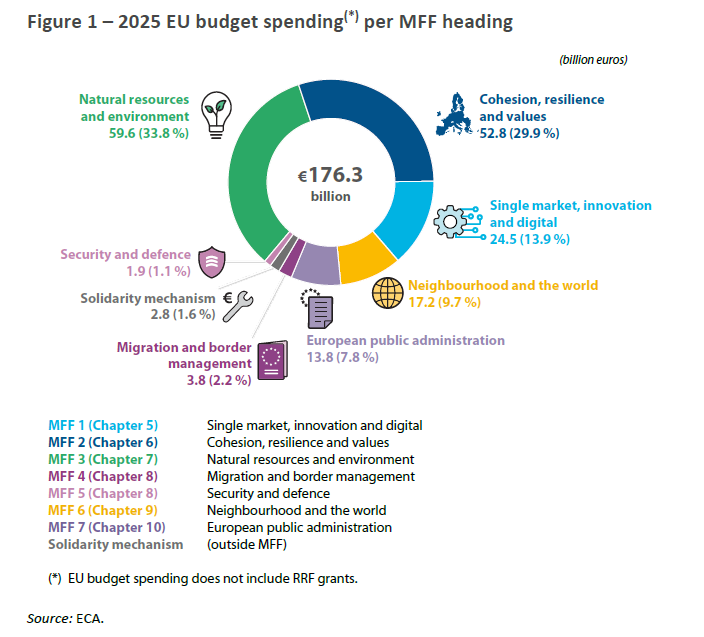
The highest error rates were in cohesion funding, which supports jobs, growth and regional development, and in spending on agriculture and the environment. Together these two spending areas accounts for almost two thirds of our audit population of €130.8 billion.
The error rate for cohesion funding rose from 5.7 % in 2024 to 6.6 % in 2025, while the rate for agriculture and the environment increased from 2.6 % to 3.9 %. The most common errors in the EU budget are eligibility issues, such as ineligible costs, projects, activities or beneficiaries, along with breaches of public procurement and grant award procedures and missing supporting documentation.
“Ambitious budgets demand equally ambitious safeguards”, said ECA President Tony Murphy who presented the annual report at an on-line press briefing (7 October). “If the EU moves to a new budget model where financing is no longer linked to costs, we must learn from experience and address what has not worked before, so that EU funds deliver the intended outcomes for citizens.”
In payments to nine member states, ECA identified instances of milestones and targets that had not been satisfactorily fulfilled, as well as issues related to double funding and the RRF eligibility period, he explained. Additionally, ECA found weaknesses in the Commission’s assessments of member states’ payment requests and that member state control systems are still insufficiently effective.
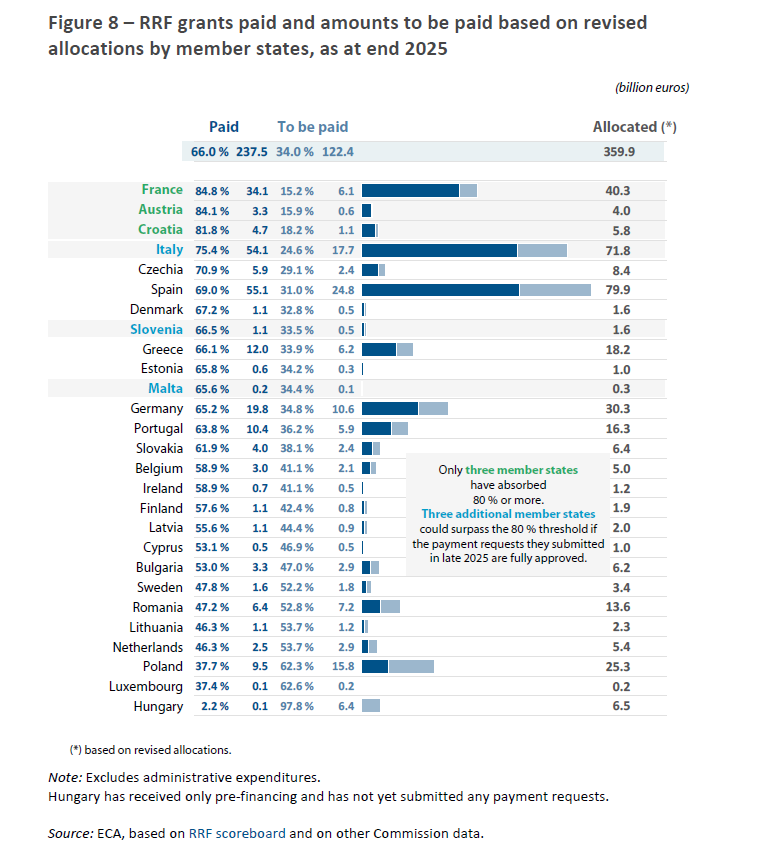
Under the RRF, EU countries receive funds for achieving predefined milestones or targets and not based on actually incurred costs. By the end of 2025, €237.5 billion of the €359.9 billion committed under the RRF had been disbursed, leaving a third of available grant funds, i.e. over €122 billion, to be paid out in the RRF’s final year.
Member states differ also significantly in how much of their RRF grant allocation they have used: only three out of 27 had drawn down at least 80 % of the funds. According to the EU auditors, the RRF suffers from several weaknesses in terms of performance, accountability and transparency. In 2025, they found payment requests where the targets had been modified without any explanation.
The Commission’s proposals for the next Multiannual Financial Framework (MFF), the long-term EU budget for 2028 - 2034, suggest that EU funding would shift toward a model that would largely replicate the RRF. “We therefore reiterate our call for co-legislators to address the issues and lessons set out in our opinions on the MFF proposals and our recent work on the RRF,” the ECA president said.
“In the RRV, actual cost have become less relevant,” he said, “and Member States may gain a ‘liquidity bonus’ because of the delivery mechanism. Everything is about striking the right balance. Costs should be accurately estimated and validated.” He warned that, “the devil lies in the details”.
He was cautious when asked by The Brussels Times if ECA has reason to believe that the weaknesses identified in the RRF will be repeated in the new MFF. “We still have issues and see a risk with the delivery mechanism in the RRF but we’ll have to wait to see how much of our recommendations is actually taken on board.”
“We'll be definitely looking at how Commission has performed the assessment, whether it was based on sufficient data from Member States and done in sufficient level of detail. And, of course, the other issue is the one the changes of the plans in the payments requests.
“If the Commission will continue with this approach of adjusting the targets to the actual progress on spot to enable payments, that's very risky process for the whole Europe,” he concluded. “I think that it lowers the ambition of the plans. It obviously means less value for money if what is paid is the same amount but paid for less.”
