
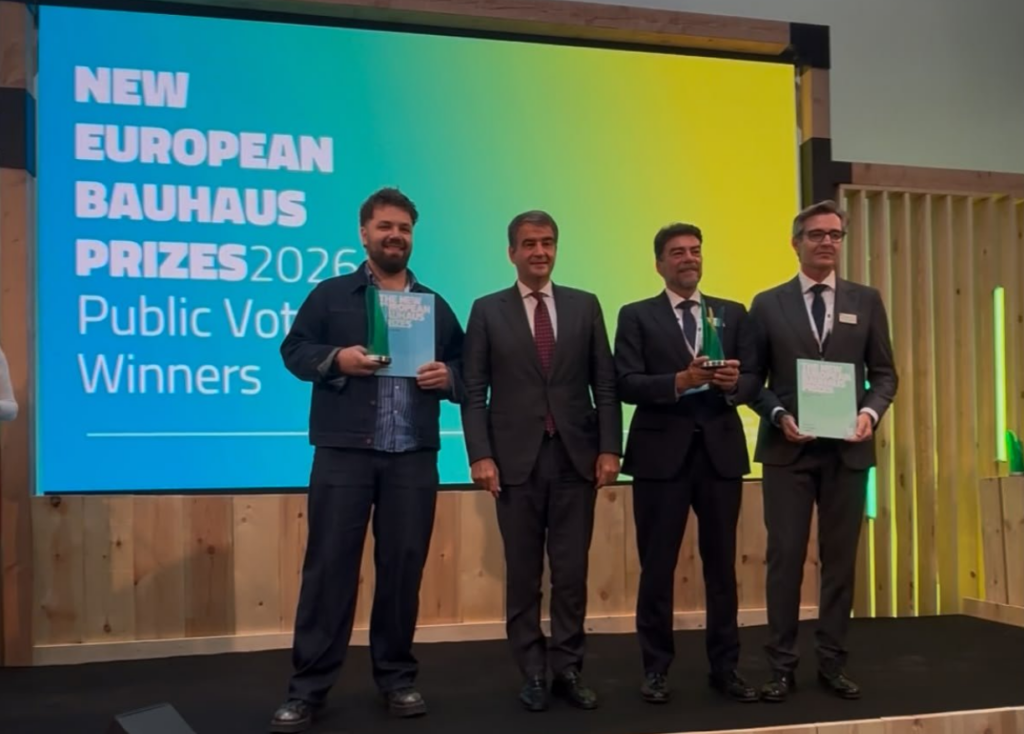
Thirteen projects from Europe and beyond have won the European Commission’s New European Bauhaus (NEB) Prizes 2026, with additional awards going to 20 small municipalities.
The NEB prizes recognise projects and ideas that combine sustainability, inclusion and aesthetics, the Commission noted in a release on Friday.
Winners include entries from several EU countries as well as Ukraine and North Macedonia, plus two international prizes awarded to projects in Japan and Brazil.
The awards were split into two categories — “New European Bauhaus Champions” for established projects and “New European Bauhaus Rising Stars” for initiatives from younger applicants — alongside a special prize for water resilience.
Each winner received up to €20,000, plus a communications package and coaching and mentoring support.
A ceremony was held in Brussels on 15 October, attended by European Commission Executive Vice-President for Cohesion and Reforms Raffaele Fitto and Commissioner for Energy and Housing Dan Jørgensen, among other officials.
Water resilience and international winners
A special prize for water resilience went to ECO H2O from Romania, which the Commission said created the first nature-based wastewater system in rural Romania in the UNESCO heritage village of Viscri.
The public vote in the Champions strand was won by La Marjal Floodable Urban Park in Alicante, Spain, which uses natural wetland systems to absorb stormwater.
The public vote in the Rising Stars strand went to Formform from Romania, a digital process designed to help architects translate ideas into design inputs.
Among other Champions winners were Circular by Nature in France, described as an “urban oasis where nothing is wasted and everyone contributes”, and a therapeutic garden at the VDNG in Ukraine — a public space for defenders, veterans and others seeking recovery.
Another winning project was the Social Impact Generator Hub in Cyprus, which transformed a container in Nicosia into a “living lab for inclusive innovation."
In the Rising Stars category, winners included Coots as Partners in Circular Care in Belgium, which developed floating platforms to help waterbirds breed safely on urban canals.
Other winners included Traviata in Three Acts, which transformed a neighbourhood in Skopje, North Macedonia, and Casa da Azenha in Portugal, which is converting a family olive mill into a “living lab” in Santa Cruz do Douro.
The international prize for Japan went to the Kamikatsu Zero Waste Center “WHY”, described as a public complex dedicated to building a circular society.
The international prize for Brazil went to Urban Community Mini-Forests São Paulo, which is turning underused spaces — including public schools and other public facilities — into “biodiverse climate refuges” co-created with students, educators and local communities.
The New European Bauhaus initiative was launched in 2021 following European Commission President Ursula von der Leyen’s 2020 State of the Union address and now has more than 2,000 members and over 700 supported projects.
Since 2021, more than 6,400 applications have been received and 107 winners have shared more than €2.2 million in EU support.
