
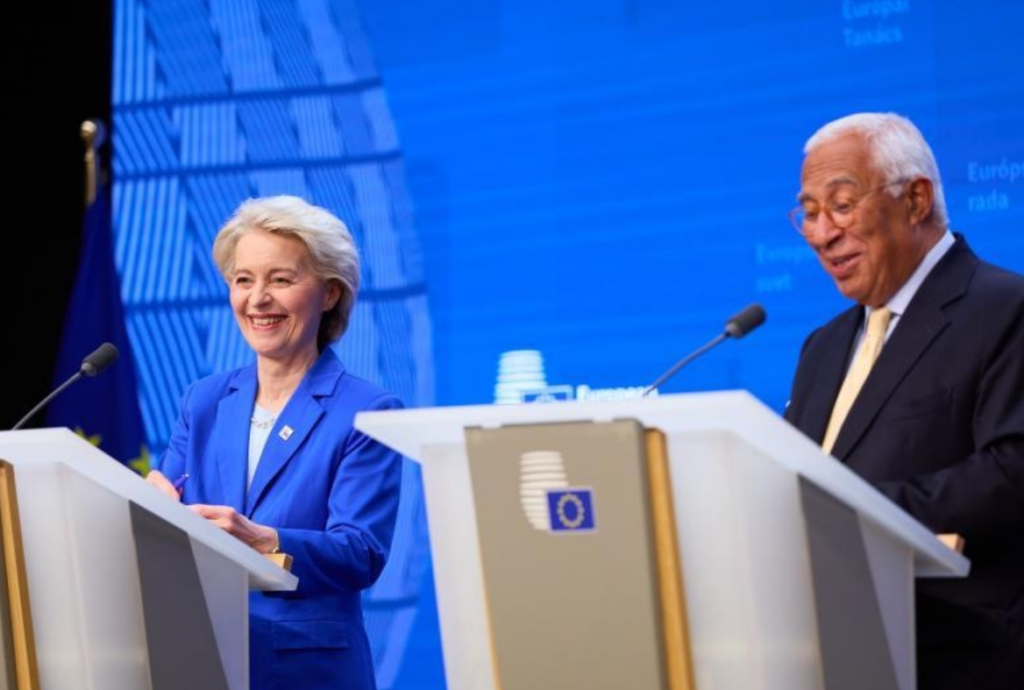
European Commission President Ursula von der Leyen said EU leaders had agreed a series of measures to address surging energy prices, curb trade imbalances with China, and step up work on Ukraine support and migration policy after an European Council meeting in Brussels.
Imported fossil fuel costs have risen by €106 billion since the start of the war in the Middle East “without a single additional molecule of energy”, while gas prices are up about 140% since late February and diesel prices have doubled, Von der Leyen said in a speech after the 15-16 October Council meeting.
She confirmed that the EU would release 100 million barrels of oil and diesel over the next four months, with the International Energy Agency managing the release.
Von der Leyen also announced an extension of the EU’s temporary State Aid Framework, which loosens some limits on national subsidies, and said implementation of the EU Methane Regulation would be postponed by a year.
A “strategic dialogue” on European refineries will be launched, she said, and an EU taskforce that aggregates demand will be upgraded so a market operator can purchase energy supplies on global markets using the bloc’s combined buying power.
She declared that the Commission would continue work on measures to expand and modernise electricity grids, noting that the EU installed 80 gigawatts of renewable energy capacity last year but that “six times more capacity is still waiting to be connected.”
EU — China trade and new proposals on dependencies
EU leaders also discussed trade with China and backed action to address what von der Leyen described as structural imbalances in the relationship.
The EU’s trade deficit with China averaged about €1 billion a day in 2025 and is expected to be higher in 2026.
Von der Leyen said consultations in Beijing had delivered “first results”, including what she described as China’s first agreement to moderate exports of hybrid vehicles, improved market access for some EU industrial and agri-food exports, and greater predictability on export controls for rare earths and magnets.
She stated that leaders supported using existing EU trade instruments, including safeguards, and that the Commission would also work on new tools to reduce dependency on a single supplier.
A new initiative called DiversifyEU will be presented in December, she said, alongside a proposed “Solidarity Mechanism” for cases where an EU country faces coercion or retaliation.
On Ukraine, von der Leyen pointed out that almost €16 billion had been disbursed under the defence leg of the Ukraine Support Loan, and that a further €17 billion could still be paid out for Ukraine’s budget support before the end of the year, provided reforms are delivered.
She added that the EU and its member states account for 80% of external aid to Ukraine, and said discussions were under way with Ukraine and the United States on how to end the war.
On migration, von der Leyen said illegal border crossings had fallen by more than 56% over the past two years and by 34% so far this year, while asylum applications were down 16% so far, with the return rate “now over 30%” under a new Return Regulation.
She informed that the Commission would propose reinforcing Frontex, the EU’s border agency, and would bring forward a new European Emergency Response Framework by the end of the year to help member states respond to “sudden or mass movements of people” at the EU’s external borders.
