
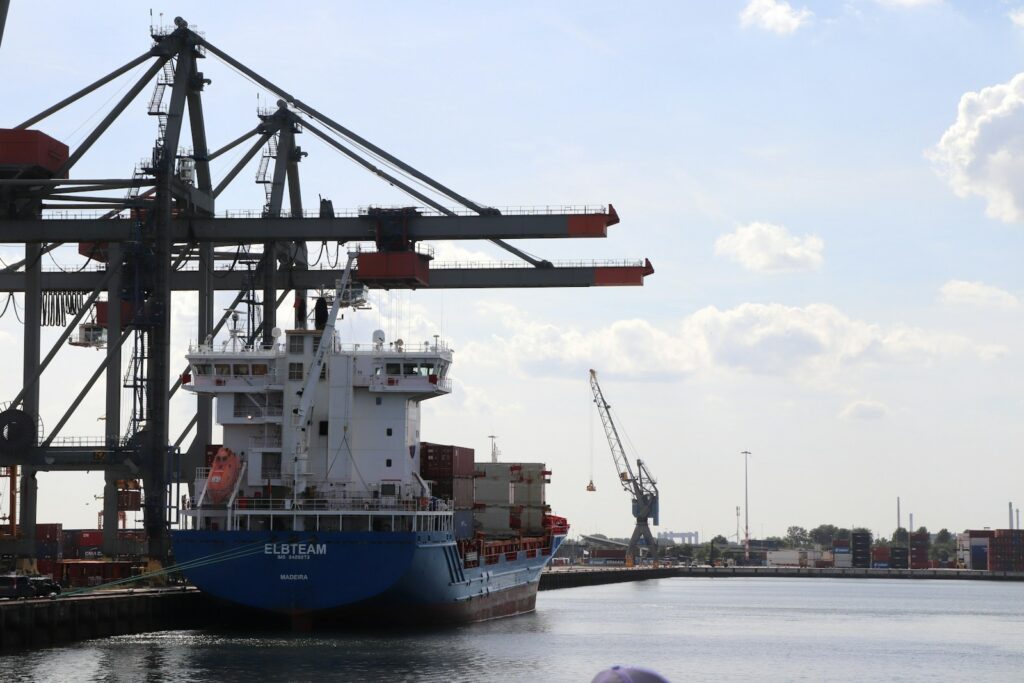
Ports could play a bigger role in building the “blue economy” — the ocean-based economy — as global trade grows and the maritime sector shifts towards lower-emission fuels.
The ocean economy is valued at between $2.6 trillion and $5.1 trillion and supports billions of livelihoods, while more than 80% of global trade by volume is carried by sea, according to figures cited in a release by the EU Blue Economy Observatory.
The global port infrastructure market is forecast to grow by nearly 70%, from $164.5 billion in 2023 to $278.3 billion by 2032, it added.
Asia-Pacific holds about 45% of the port infrastructure market, and ports in developing Asian economies handled 60% of global container port traffic in 2024.
India has almost doubled the number of containers passing through its ports over the past 10 years, based on World Bank data.
Ports are facing climate and nature-related hazards, including sea-level rise, storms and flooding.
In Europe, operational challenges linked to climate change rose from 41% in 2018 to 69% in 2025, based on figures cited from the European Sea Ports Organisation.
Shift to new fuels and port upgrades
The International Maritime Organization has set a target for net zero greenhouse gas emissions from shipping by 2050, and this transition is expected to involve alternative fuels such as green methanol, green ammonia and synthetic e-fuels — fuels made using low-carbon processes, the Observatory said.
Meeting the expected demand for ship retrofits could require more than 1,000 conversions per year at peak, compared with estimated global retrofit capacity of about 465 vessels annually as of 2025.
The investment required to meet the IMO’s 2050 target has been estimated at $1 trillion to $1.4 trillion, with about 87% directed to land-side infrastructure and 13% to ships.
The maritime sector directly employs about 30 million people and indirectly supports 90 million jobs.
The EU Blue Economy Observatory added that a shift to scalable zero-emission marine fuels could create up to 4 million jobs across the energy supply chain by 2050, citing its own analysis.
It also pointed to its Transitioning Industrial Clusters initiative, which it said has brought together more than 40 industrial clusters over five years, and to its ACT Ocean and ACT Ports programmes focused on ocean-related action across sectors.
Decisions taken during a period of rapid port and industrial expansion in Asia will shape maritime infrastructure for decades.
