
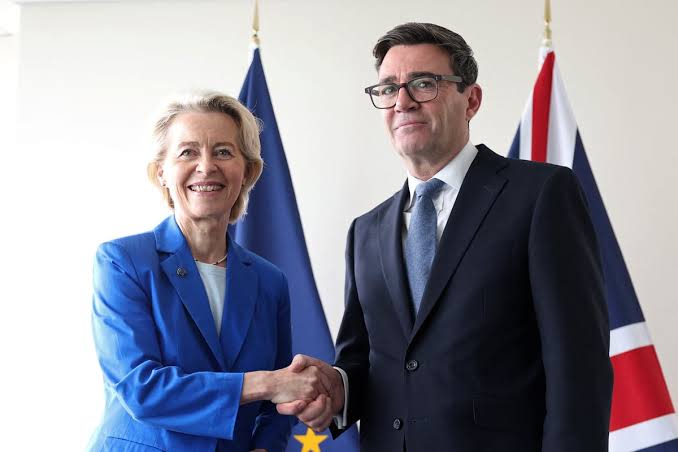
The United Kingdom is officially rejoining the European Union’s Erasmus scheme, one of the bloc’s flagship programmes. But what actually is Erasmus?
The EU established the original Erasmus programme in 1987 to help foster cross-border cooperation between the Union’s higher education institutions.
Named after Dutch Renaissance scholar Erasmus of Rotterdam, the scheme has enabled more than 16 million people to go on student exchanges across the whole continent.
The current iteration of the scheme, Erasmus+, also includes vocational training and adult education opportunities, expanding well beyond the original limited scope of just university exchanges.
Eligible citizens from all 27 EU member countries can participate, as can people from the European Free Trade Area countries and certain EU candidate countries, including Serbia and North Macedonia.
There is a long list of countries around the world that take part in certain aspects of the programme, while the United Kingdom, previously a fully eligible country as part of its EU membership, has now confirmed that it will rejoin the scheme as of 2027.
Young people will be able to submit applications as of next month and the UK government estimates that more than 100,000 people are set to benefit from renewed access to the programme.
Although study and work experience abroad are still the main objectives of the programme, it is the cultural aspect of Erasmus that has granted it the status of 'EU success story'.
Foreign language learning, relationship building and general broadening of horizons are just some of the benefits that Erasmus students have enjoyed over the years.
One of the main support pillars provided by Erasmus+ is financial. Eligible participants receive funding to help cover travel costs and living expenses. How much money depends on where the study or training is taking place.
The current programme is only covered up until 2027 under the EU’s budget. Talks on the new multiannual financial framework (MFF) are still ongoing and Erasmus+’s share of that trillion euro budget still has to be negotiated.
Further changes are planned: Erasmus+ is set to be merged with the European Solidarity Corps (ESC), a separate programme that enables young people to volunteer for social schemes and undertake humanitarian work.
The combined programmes are set to be granted a bigger budget, more than €40 billion has been proposed, marking a near 30% increase on their combined funding under the current budget.
Next week, the European Commission will publish its education and skills package, which will aim to modernise schooling systems, tackle skill shortages and support teachers across the bloc. It is likely that Erasmus+'s role in that will be elaborated on.
