
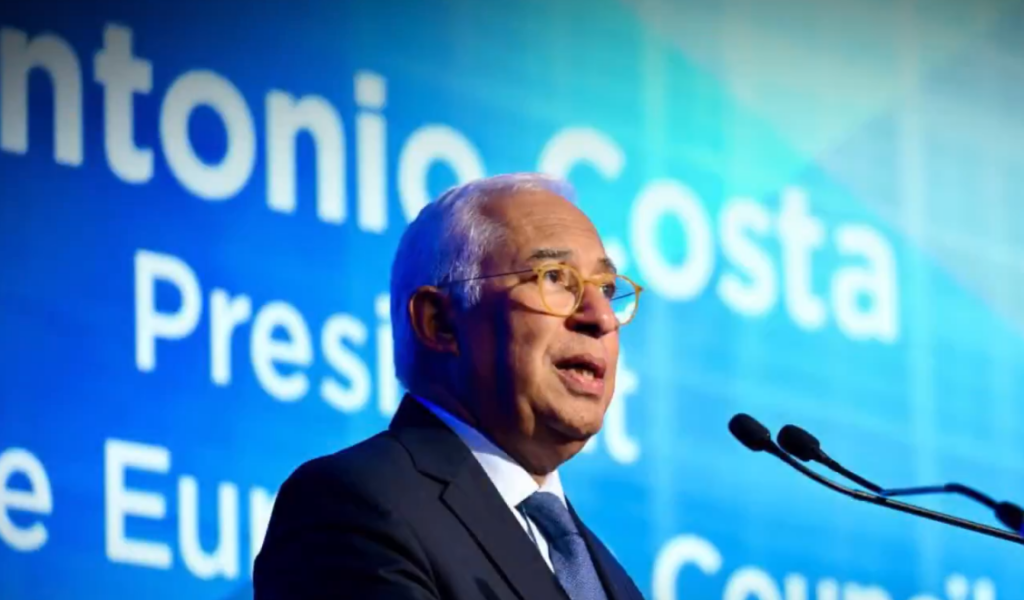
European Council President António Costa said EU enlargement should remain a “fair, consistent and merit-based” process, as he reiterated his support for bringing candidate countries into the bloc, and noted that Montenegro could become a member of the EU by 2028.
Speaking during the Euronews EU Enlargement Summit on Tuesday, Costa said he has made enlargement a “strategic priority” since taking office and has visited all candidate countries several times.
He described enlargement as central to the EU’s origins in “reconciliation and peace”, and said it continues to be framed as a tool for strengthening Europe’s security and stability, according to his speech published by the European Council.
He cited the EU’s 2004 expansion as an example of the economic impact of enlargement, saying more than 100 million people have joined the Union since then and the shared economy has grown by more than €2 trillion.
He said countries from Central and Eastern Europe that joined 22 years ago have more than doubled the size of their economies and that new member states have helped create 26 million jobs — more than 6 million of them in their own countries.
Costa said the accession process involves more than adopting EU rules and institutions, adding that it also requires building trust and resolving disputes through diplomacy and “good faith.”
He also said overcoming the legacy of past conflicts was a prerequisite for joining the EU.
Montenegro, Ukraine and Moldova cited as making progress
Costa said the EU has been working to bring candidate countries closer during the accession process through “gradual integration”, including measures intended to deliver visible benefits before membership, according to the European Council.
In the Western Balkans, he pointed to the EU’s Growth Plan and other initiatives supporting investment and closer links to the Single Market — the EU’s internal trading area — including participation in the Single Euro Payments Area, improved border crossings, stronger transport links, digital projects and lower roaming costs,.
He said the EU held accession conferences in October with Montenegro, Albania, Ukraine and Moldova, and that Montenegro and Albania “provisionally closed” additional negotiating chapters, while Ukraine and Moldova opened talks on new clusters — groups of policy areas in the accession negotiations.
Costa stressed that Montenegro was set to provisionally close another negotiating chapter this week, bringing it closer to completing talks across all chapters.
He also said he believed Montenegro could be the “28th by 28”, a reference to the country potentially becoming the EU’s 28th member by 2028.
On Ukraine and Moldova, Costa said both had benefited from closer cooperation with the EU, including visa liberalisation, lower roaming costs, energy support and infrastructure investment, the organisation said.
He also added that Ukraine had been facing Russia’s “war of aggression” for almost five years.
Costa also referred to Serbia’s “recent election”, saying the EU was ready to support a new Serbian government on its European path, with a focus on the rule of law, media freedom and tackling corruption.
He added that Western Balkan leaders would meet in three weeks at a fourth EU-Western Balkan Summit held during his mandate.
EU membership requires upholding the Union’s values, and “one cannot walk towards the European Union while moving away from democracy”, Costa concluded.
