
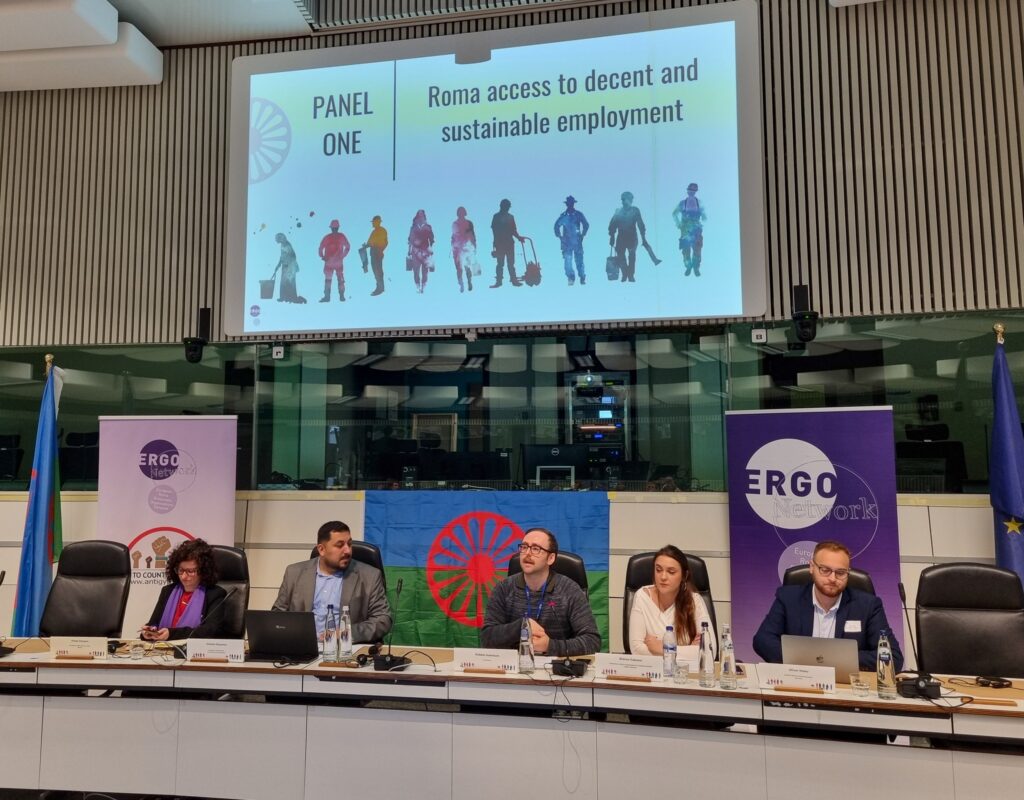
Progress can be seen across some policy areas but it remains uneven and barriers remain to true equality for Roma people in Europe, according to a report published on Tuesday by the European Commission on progress or lack of progress in the implementation of the national Roma strategic frameworks.
While the Commission calls on the EU Member States to ramp up the efforts needed to achieve the 2030 targets of the EU Roma Strategic Framework, the network of European Roma Grassroots Organisations (ERGO) is urging the Commission to get its own act together.
The report is the third since October 2020 when the EU adopted the EU Roma strategic framework for equality, inclusion and participation for 2020-2030. It introduced seven EU-level objectives and proposed for the first time quantitative targets for 2030. The report covers the period from June 2023 to March 2025.
The previous report in September 2023 found that the current level of ambition was insufficient to guarantee the achievement of the minimum progress set by the EU 2030 targets in the national Roma strategic frameworks.
The reporting cycle will be complemented by a mid-term evaluation of the strategic framework, which will begin in 2027. “This timeframe is reasonable, as structural changes take time to become measurable,” a policy group at ERGO told The Brussels Times.
“What matters is whether monitoring leads to concrete action and accountability,” ERGO commented. The mid-term evaluation should draw lessons from the shortcomings of the previous EU Roma Framework (2011–2020) and identify persistent implementation failures, the institutions responsible and the measures needed to address them.”
“The Commission should use its findings to introduce corrective measures, promote and scale up effective practices, and strengthen independent monitoring and follow-up to ensure tangible progress towards the 2030 targets. It needs to move beyond monitoring commitments and strengthen accountability for their implementation.”
Roma are Europe’s largest ethnic minority with an estimated population of 10 to 12 million people across the continent, of whom more than 6 million live in the EU. According to the report, this number is expected to increase significantly with the accession to the EU of Western Balkan countries.
The Commission says that its report identifies how the framework is helping advance Roma integration in society but admits that many Roma continue to face discrimination, antigypsyism and socio-economic exclusion despite ongoing national and EU efforts.
“I’m determined to continue our work for Roma inclusion and participation in all aspects of life,” said Roxana Mînzatu, Executive Vice-President for Social Rights and Skills, Quality Jobs and Preparedness. “This is a matter of equality, dignity and fairness for all. But it is also a political and economic necessity.”
Her colleague Hadja Lahbib, whose equality portfolio includes Roma integration and equality, underlined that, “Too many Roma children still face barriers at school. Too many parents struggle to find a job or a decent home because of discrimination. Equality is a European value that must be felt in classrooms, workplaces and everyday life. One fair chance can change a life.”
Segregation in education is among the most persistent problems. Nearly half of Roma children continue to attend segregated schools. Only around one third of Roma young people complete upper secondary education. While participation in early childhood education and care has risen from 42% to 53%, it remains significantly below that of the general population.
Several countries are lagging behind in education. The accompanying Commission Staff Working Document provides a detailed country-level picture, showing that school segregation is particularly severe in Bulgaria (70%), Slovakia (66%), Hungary (62%), Czechia (58%) and Greece (57%). Despite some positive initiatives, progress remains far too slow, with segregation even increasing in Bulgaria.
“Progress is particularly stagnant in areas such as school and housing segregation, discrimination and antigypsyism, because these require more than targeted projects or social inclusion measures,” ERGO explained. “They demand structural reforms, enforcement of anti-discrimination legislation, changes in institutional practices, and political willingness to confront entrenched prejudices.”
On the positive side, severe material deprivation among Roma people has decreased, from 62% in 2016 to 37% in 2024, while the proportion of young Roma in employment, education or training has risen from 38% to 53%. Housing deprivation has declined, from 61% to 47%. The proportion of Roma in paid employment has also increased from 43% to 54% during the period.
| ERGO’s list of good practices in Member States - Poverty: Belgium's Bridging Figures initiative helps disadvantaged Roma families access schools and public services. - Housing: Czechia's Housing Support Act combines Housing First approaches with anti-discrimination measures and safeguards against segregation. - Health: Romania's established network of Roma health mediators and community nurses helps improve access to healthcare. - Education: Bulgaria has made over 1,300 educational mediator positions permanent, moving beyond short-term project funding. - Employment: Slovakia has supported the employment of over 10,100 Roma in social enterprises. |
As regards positive institutional developments, ERGO mentioned Germany's appointment of a dedicated Federal Government Commissioner against Antigypsyism, Slovakia's parliamentary recognition of anti-Roma racism, and France's initiatives on training and monitoring.
ERGO’s key asks for the Commission
Asked why progress is uneven and stagnating in some areas, ERGO replied that a major obstacle is the lack of genuine political commitment to Roma equality. “Too often, governments treat national Roma strategies as an exercise in complying with the European Commission's requirements, rather than as a responsibility to deliver meaningful change.”
What should the European Commission do to accelerate progress? “It must enforce EU anti-discrimination legislation, including through infringement proceedings where necessary, and ensure that EU funding does not reinforce segregation or discriminatory practices. Adequate, sustainable and traceable funding is essential.”
“The Commission must also ensure that Roma equality is explicitly addressed in the next EU budget for 2028–2034, with dedicated objectives, measurable targets and transparent monitoring of allocations, expenditure and results. Funding should support long-term structural reforms and Roma-led civil society organisations, rather than relying primarily on short-term projects.”
ERGO argues that the Commission should strengthen its coordinating role under the EU Roma Strategic Framework, ensuring that Roma equality is integrated into mainstream EU policies and that national authorities are held accountable for implementation. Roma inclusion must be mainstreamed across Europe's broader social policy agenda.
It should also use the European Semester to drive Roma inclusion through explicit Roma-specific Country-Specific Recommendations, and embed EU Roma Framework targets in the Anti-Poverty Strategy, Social Pillar Action Plan, Child Guarantee, and housing and employment policies.
"Roma equality and fighting antigypsyism cannot remain a box-ticking exercise,” ERGO summarized. “Governments may adopt strategies and report on their commitments, but unless they are prepared to confront discrimination and antigypsyism, dismantle segregation and change the institutions that reproduce inequality, progress will continue to stagnate.”
