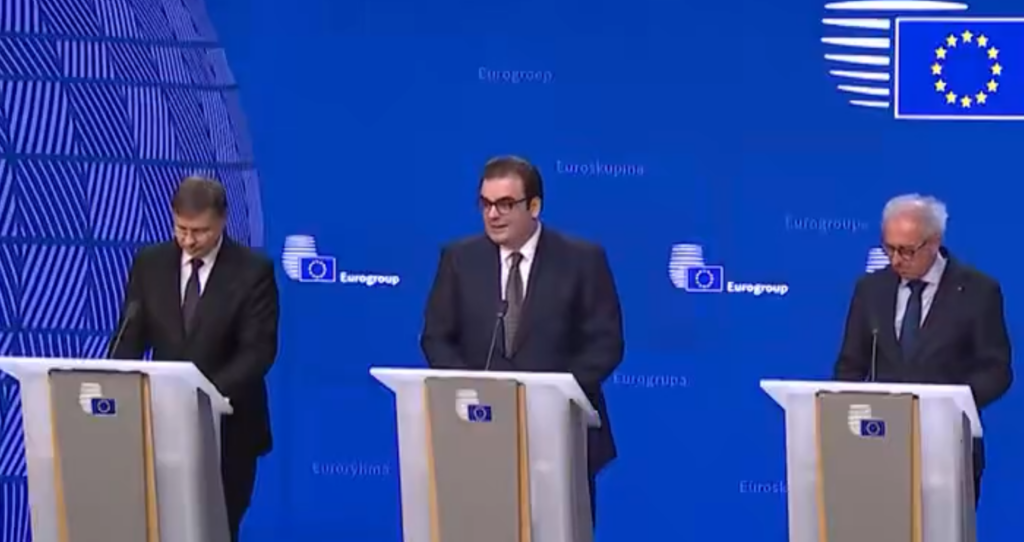
Eurozone finance ministers discussed economic volatility, defence funding, the digital euro and forthcoming changes to the European Central Bank’s top team at a Eurogroup meeting in Brussels on Monday.
Eurogroup President Kyriakos Pierrakakis said sharp swings in oil prices over the past 10 days had added to uncertainty, noting that Brent crude had approached $118 a barrel before falling to $94 as hopes rose for a diplomatic solution to the war in the Middle East, the Eurogroup informed in a release.
European natural gas prices were still roughly three times pre-war levels and inflation in the euro area reached 4% in October, he said.
Ministers also reviewed the fiscal outlook ahead of the European Commission’s assessment of member states’ draft budget plans for 2027, Pierrakakis added.
Defence spending and the digital euro on the agenda
Defence financing was a major focus, with Nato Secretary General Mark Rutte joining the discussion alongside non-euro area finance ministers, Pierrakakis stated.
He said the Eurogroup discussed the strain higher defence spending could put on public finances and pointed to the activation of the “national escape clause” — a mechanism that allows extra budget flexibility under EU fiscal rules — which he said would apply until 2028.
Pierrakakis said the ministers discussed four priorities: more joint European procurement of defence equipment; greater investment in research and new technologies; continued support for Ukraine and closer cooperation between European and Ukrainian defence industries; and mobilising more private capital, including for start-ups and small and medium-sized enterprises working on defence technologies.
On payments, Pierrakakis said negotiations between the Council and the European Parliament on the digital euro were entering their final stage, with the aim of reaching an agreement by the end of the year.
He also referred to the European Central Bank’s Pontes and Appia initiatives, describing Pontes as an effort to connect existing Eurosystem infrastructure with distributed ledger technology — a type of shared database often associated with blockchains — and Appia as work on longer-term financial transaction infrastructure.
Pierrakakis said the Eurogroup heard from the heads of the Single Supervisory Mechanism and the Single Resolution Board — the bodies responsible for supervising eurozone banks and managing bank failures — on the outlook for the banking sector.
He added that the process had begun to fill three seats on the ECB’s Executive Board after Christine Lagarde announced she would step down on 7 February, noting that Pablo Hernández de Cos of Spain and Klaas Knot of the Netherlands had been put forward as candidates.
Further departures are expected, with Isabel Schnabel stepping down on 4 January and Philip Lane’s term ending in late May, Pierrakakis said, adding that the final decision rests with the European Council.
