

The European Commission on Wednesday proposed the Digital Fairness Act (DFA), new legislation designed to better protect consumers from online scams, manipulative marketing and hidden costs.
The legislation replaces the current rules on unfair commercial practices dating from 2005 and will apply to social media platforms, video platforms, online shops, streaming services, booking sites and online gaming.
“Our ambition is clear: more choice and control for consumers, simpler rules and fairer competition for businesses, and stricter enforcement to tackle infringements,” said European Commissioner for Consumer Protection Michael McGrath on Wednesday.
Among other things, the Commission wants to give users the option to disable addictive features, such as endless scrolling and pop-ups that encourage additional purchases.
Additionally, gambling tactics aimed at minors – such as the sale of virtual loot boxes with unknown contents – will be banned, and in video games, the use of virtual coins by minors will be disabled by default.
Dark patterns and subscription traps
The Commission also aims to tackle so-called ‘dark patterns’. For example, pre-filled forms or pre-ticked boxes will be banned, and companies will no longer be allowed to provide misleading information about, for instance, the availability or popularity of a product.
Subscriptions and free trial periods must also be easier to cancel to avoid so-called ‘subscription traps’, and companies must be more transparent about dynamic pricing.
For influencers, the Commission wants stricter rules on advertising, and it intends to ban personalised adverts targeting minors or based on sensitive data.
Companies must also ensure that customers facing queries or problems can speak to real staff members, rather than being left to communicate endlessly with a chatbot. This does not mean that chatbots will be banned, but it does mean that the option must be available to existing customers who cannot find a solution to their problem.
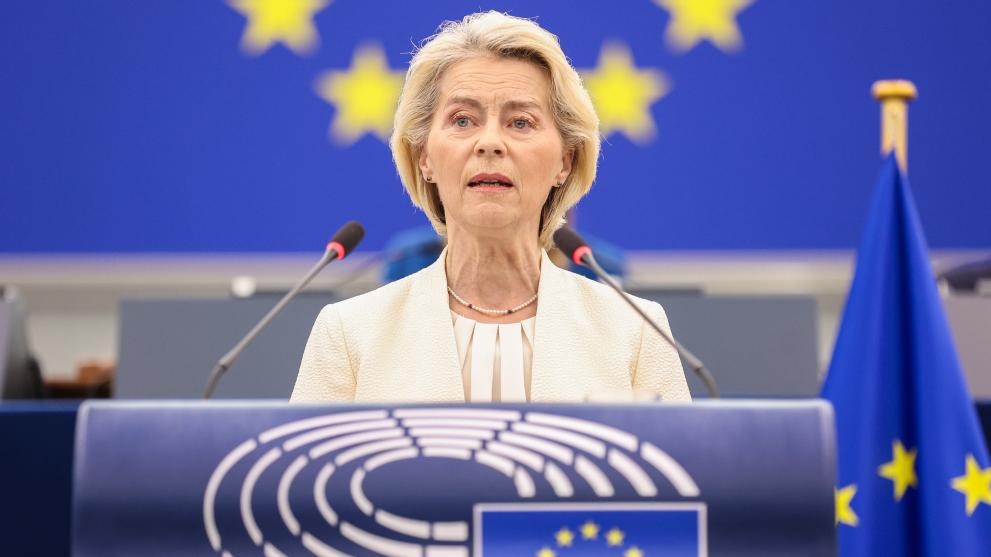
President of the European Commission Ursula von der Leyen. Credit: European Commission
The Commission said that the new rules will yield savings of more than €13 billion by preventing consumers from paying unnecessarily high prices or for subscriptions they do not want.
Finally, a review of consumer protection rules would give the Commission greater powers to investigate infringements and impose fines of up to 6% of companies’ global annual turnover.
Companies from outside the EU must appoint a representative within the EU to liaise with national authorities and the Commission.
The new DFA will complement other legislation designed to protect consumers in the digital age, such as the Digital Services Act (DSA), which specifically targets online platforms, AI legislation and the Kids Act proposed in September, which sets out the rules for minors.
The EU Member States and the European Parliament have yet to give their views on the new rules.
'Historic mistake'
For Belgian MEP Liesbet Sommen (CD&V), the EU is showing “courage in challenging systems that reward addiction.” However, she added that the EU should dare to consider whether safer social media should simply be the norm, referring to the ‘off’ switch for addictive features.
“Specifically for children, there is already such a proposal on the table (in the Kids Act), so why can’t that apply to adults too?”
“By hiding an ‘off’ switch in the settings, the Commission is once again placing all the responsibility on the user, while the very design of these apps is intended to completely undermine that personal choice,” said Belgian MEP Kathleen Van Brempt (Vooruit).
Her Social Democratic Group (S&D) wants to ensure that non-personalised recommendations become the default and that addictive features are only activated once the user has given their explicit consent.
The Dutch Green MEP Kim van Sparrentak, who will negotiate the dossier on behalf of her group, called it a “historic mistake for both our health and our democracy” that the Commission is proposing only an opt-out for addictive design.
“They could have stood up for the people, but chose to bow to the tech bros,” she said.
Like the Social Democrats, the Greens also want the system of dynamic pricing to be tackled more thoroughly.
Commission Vice-President Henna Virkkunen referred on Wednesday to the proportionality of the proposal. “It is part of companies’ business plans to capture customers’ attention, and we know that many consumers also want access to these features,” she said. “For adults, we want choice and transparency.”
