
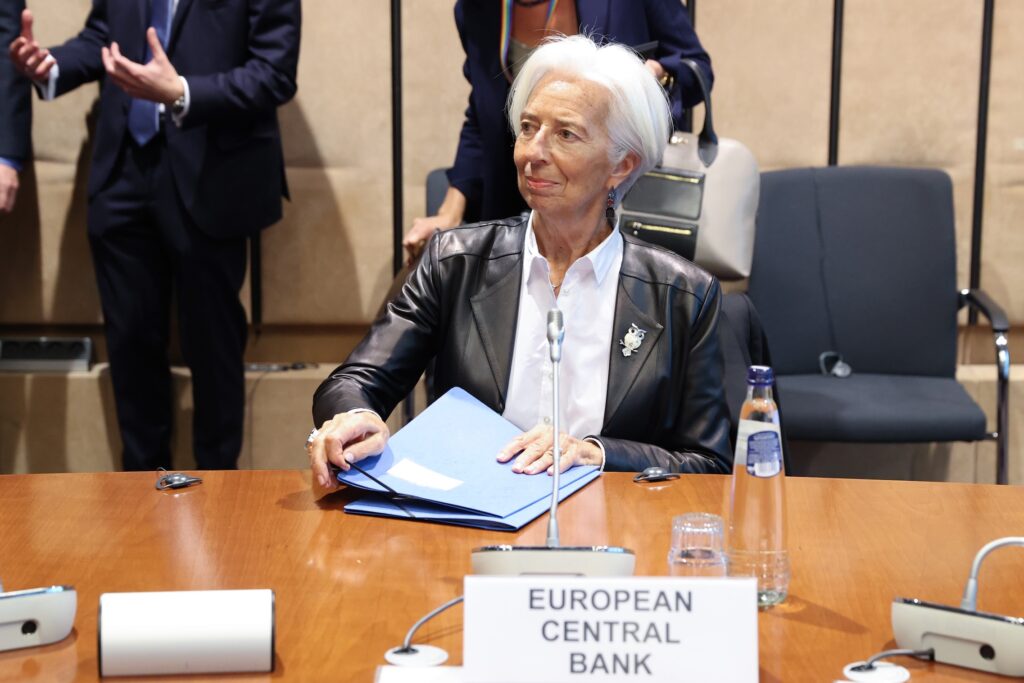
Christine Lagarde is leaving the European Central Bank top job a couple of months early, so a replacement is needed to take over in Frankfurt. But who decides who becomes president of the ECB?
There have been four presidents of the European Central Bank: Wim Duisenberg, Jean-Claude Trichet, Mario Draghi and Christine Lagarde. A fifth name will be added to that list after Lagarde announced she will leave the job early in February.
Lagarde is leaving because she says she can “no longer remain neutral” and wants to speak out on issues beyond monetary policy. Leaving in February also gives EU leaders a chance to pick a successor before France’s presidential election. Some have opined that Lagarde may even try to be involved in that campaign.
Ultimately it will be up to the European Council to decide who gets the job and at the moment, it is down to two names: Spain’s Pablo Hernandez de Cos and the Netherlands’ Klaas Knot.
A qualified majority is needed to appoint a successor and it will only be countries that have adopted the euro that will have a say. That means Czechia, Denmark, Hungary, Poland, Romania and Sweden will be asked to leave the room when the vote happens.
Whoever gets the nod will serve an eight-year-long term, unless they resign early like Lagarde, and they will not be eligible to hold the position again.
Before prime ministers and presidents are asked to endorse a candidate though, eurozone ministers will make a recommendation on who should get the nod. Then the European Parliament will be allowed to vote on it as well, although that result is non-binding.
Both candidates have served as the heads of their respective national central banks and both are considered willing to rethink certain aspects of monetary policy. Who gets the job may depend on a wider reshuffle at the ECB as well.
The term of the ECB’s chief economist expires in May and Germany’s member of the bank’s executive board is also leaving her role next year. If their replacements are financial doves or hawks this will affect the presidency negotiations as well.
A chief economist from a southern member state will have to be balanced out by a president from somewhere in the north, and vice versa. A dove will need a hawk as co-pilot and so on.
Lagarde was appointed head of the ECB in July 2019 during a landmark Council summit in which all of the EU’s top institutional roles were up for renewal.
French President Emmanuel Macron was able to secure the job for Lagarde, a former government minister and head of the International Monetary Fund, while Ursula von der Leyen was surprisingly picked as European Commission president as part of that package deal.
It marked the first time that either role would be held by a woman.
Who the member states pick for ECB chief this time around may even have an impact on future talks once von der Leyen's mandate is up and a new Commission chief is needed. Institutional memory in Brussels is, after all, long-lasting.
