
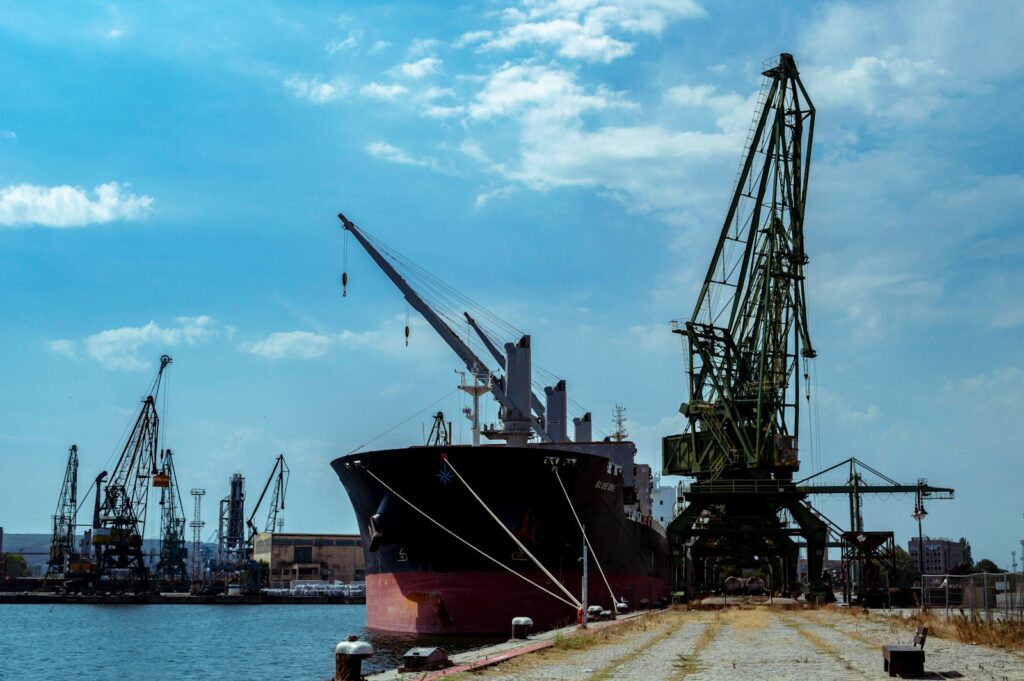
EU foreign policy chief Kaja Kallas and two European Commissioners met ministers and officials from the EU, the Black Sea region, the South Caucasus and Central Asia in Brussels to discuss security in the Black Sea and cross-regional transport, energy and digital links.
The meeting — the second Ministerial Meeting on Cross-Regional Security and Connectivity — brought together representatives from EU Member States and Armenia, Azerbaijan, Kazakhstan, Kyrgyzstan, Moldova, Tajikistan, Turkey, Turkmenistan, Ukraine and Uzbekistan, according to the meeting conclusions published by the Council of the EU.
Russia’s war against Ukraine and “hybrid threats” were cited as continuing pressures on Black Sea security, with participants discussing freedom of navigation, secure maritime routes, ports and offshore infrastructure.
Hybrid threats refers to a mix of non-traditional tactics such as cyber attacks and information manipulation.
Participants also discussed the impact of drone attacks on shipping and encouraged work at European level to improve counter-drone capabilities.
The talks included protecting critical underwater and offshore infrastructure, with participants exchanging lessons between the Baltic and Black Seas.
The European Commission said it would allocate €50 million to “fast track” work on a planned Black Sea Maritime Security Hub and set a timeline to make it operational.
The hub was discussed as the security environment in the region has deteriorated.
Transport, energy and digital links across the region
Alongside security, officials discussed a “Connectivity Agenda” spanning transport, energy and digital infrastructure between the EU, the Black Sea, the South Caucasus and Central Asia.
A Connectivity Agenda Platform launched in June 2026 was described as the main framework for political dialogue and coordinating investment and policy work with partner countries, international financial institutions and the private sector.
A first high-level meeting on digital connectivity took place in Chișinău on 9–10 November, covering topics including secure digital infrastructure, artificial intelligence ecosystems and digital public services.
On transport, co-chairs said they would continue work on the Trans-Caspian Transport Corridor, a multimodal route linking the EU with partners across the Black Sea, South Caucasus and Central Asia.
Discussions included making border procedures more efficient, strengthening customs cooperation and reducing transit times.
An energy-focused meeting under the Connectivity Agenda Platform is due in the first half of 2027, with plans to identify priorities linked to electrification, market integration and security of supply.
The co-chairs said they would reconvene in a year’s time.
