
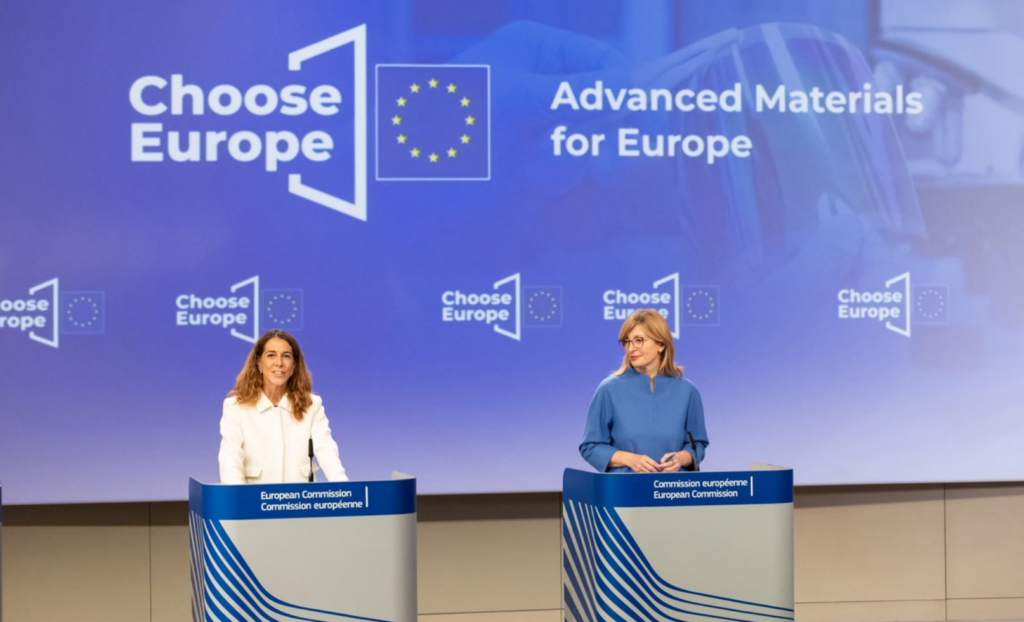
The European Commission has proposed an “Advanced Materials for Europe” agenda, setting out benchmark targets for 2035 intended to increase investment, company growth and the take-up of safer and more sustainable materials across the EU.
The plan calls for the EU to become a global leader in inventing, producing and using advanced materials by 2035, with cooperation between member states designed to speed up the shift from laboratory research to products on the market, the Commission informed in a statement on Wednesday.
Advanced materials are engineered at the level of atoms and can change how products perform, such as making them lighter, stronger or more energy efficient, the Commission said.
t listed potential uses in sectors including energy, mobility, electronics, construction, health, aerospace and defence.
Commission President Ursula von der Leyen said the initiative would help ensure “innovative materials created in Europe are also produced, scaled up and used in Europe.”
The Commission set three benchmark targets for 2035: 20% more investment in advanced materials research and innovation, 20% more EU-based start-ups and scale-ups in the sector, and 20% of projects reaching higher deployment levels for safer and more sustainable advanced materials.
New figures cited by the Commission put the current advanced materials sector at more than 15,000 companies, supporting around 1.5 million jobs across the EU.
Focus on scaling up and skills
The proposal also sets out a framework for closer coordination between member states, including aligning investments and cutting the time between research and commercial application, the Commission said.
It invited member states to work together on five priorities by 2030, including targeting research funding in strategic sectors, using digital tools and artificial intelligence to speed up discovery and testing, improving access to testing and pilot facilities, supporting scale-up through measures such as public procurement, and addressing skills through training and reskilling.
The proposal requires adoption by the Council of the EU.
Progress would be monitored using key performance indicators overseen by the Technology Council for Advanced Materials, with a first stocktake planned by the end of 2028 and a full implementation report by the end of 2030.
EU support for advanced materials under the Horizon Europe research programme totals €2.3 billion for 2021 – 2027.
