
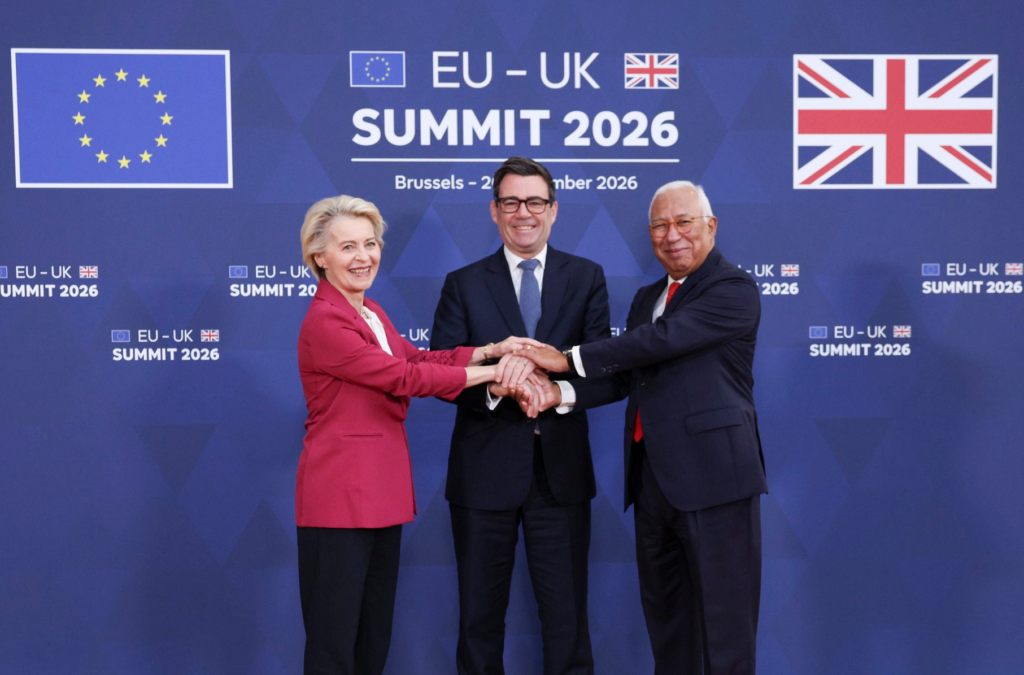
EU and UK leaders agreed a package of measures on security, youth mobility and trade at their second joint summit in Brussels on Friday, including plans for a new Youth Experience Scheme and the completion of negotiations to link their carbon markets.
The EU and the UK said they would “continue to provide” political, economic, financial, military, humanitarian and diplomatic support to Ukraine and would keep coordinating pressure on Russia, including through sanctions, according to their joint statement.
They also agreed to deepen cooperation on maritime security, including joint naval activities, and to increase information-sharing on tackling Russia’s “shadow fleet” and sanctions circumvention.
The summit statement said the two sides had concluded negotiations on a Framework Participation Agreement enabling the UK to take part in EU civilian crisis-management missions under the bloc’s Common Security and Defence Policy.
EU and UK leaders declared that they would develop a dialogue on “democratic resilience” covering issues such as safeguarding the information space and supporting electoral integrity, and would continue cooperation on countering foreign information manipulation and interference — known as FIMI in EU terminology.
Youth travel scheme and plans to cut border checks on food
A Youth Experience Scheme has been agreed in principle, allowing 100,000 young people from the EU and 100,000 from the UK to live in the other side’s territory for up to three years for activities including work, study, volunteering, au-pairing or travel, the joint statement said.
The agreement is intended to apply no later than 2028, with opportunities under the scheme meant to be available no later than January 2030.
The UK’s participation in the EU’s Erasmus+ exchange programme from 2027 was also highlighted, with the latest funding call opening on 18 November 2026.
On trade, the two sides said they had concluded negotiations on a “common sanitary and phytosanitary area” agreement — covering rules on animals, animal products, plants and plant products — that would remove most of the certificates and controls currently required for movement of those goods between Great Britain, the Crown Dependencies and the EU.
The deal is expected to apply from 1 March 2028, and the same benefits would be extended to movements between Great Britain and Northern Ireland through its interaction with the Windsor Framework.
Leaders also said negotiations had concluded on linking the EU and UK emissions trading systems, which set a price on carbon by requiring polluters to hold allowances for the emissions they produce.
The proposed ETS link would allow mutual recognition of EU and UK carbon allowances and would exempt goods traded between the two sides from their respective Carbon Border Adjustment Mechanisms — import charges linked to carbon emissions — subject to legal procedures, the statement said, adding that both sides aimed to apply the ETS agreement from 2028.
The statement also noted that full reciprocal access to fishing waters had been agreed until 30 June 2038.
Separately, EU and UK leaders noted that they would work towards an agreement on tuition fees for EU students in the UK and UK students in the EU, with negotiations to be concluded within six months of the summit date.
