
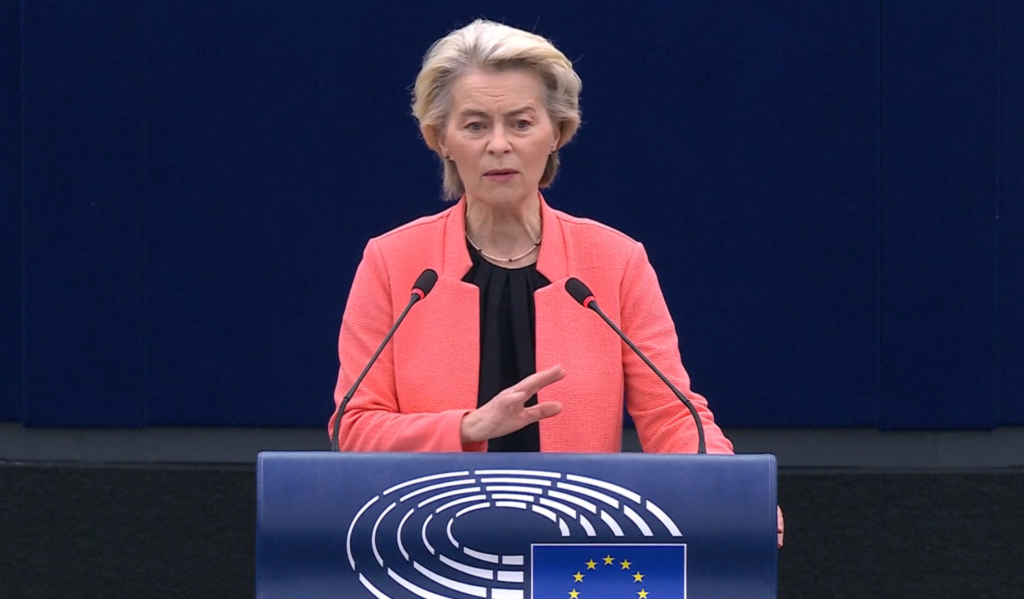
European Commission President Ursula von der Leyen said the EU had provided more than €235 billion in support for Ukraine since Russia launched its full-scale invasion almost five years ago, in a speech to the European Parliament in Strasbourg.
Russia’s offensive has stalled and it lost more territory than it gained in September and October, while suffering more than 50,000 casualties in October alone, she declared, according to her speech published on Wednesday.
At the same time, Russia has intensified attacks on Ukrainian cities, striking infrastructure more than 1,000 times since September — including power stations, heating systems and water supplies — she added.
Von der Leyen told MEPs that Ukraine’s financial needs for 2026 were covered, but said the country would face a funding gap of around €70 billion next year.
She said the Commission had proposed a new “Instrument for Coordinated Support to Ukraine” that would provide €45 billion in 2027, including €20 billion for budget support and €25 billion for military support.
The remaining third of Ukraine’s financing needs would need to be covered by international partners, the EC president stated, adding that repayment would only be required once “Russia has paid for the damage of its war”.
New EU sanctions package targets banks, energy and travel
Von der Leyen said the EU adopted its 22nd sanctions package against Russia on Monday, describing sanctions as the bloc’s “primary tool” to raise the cost of Russia’s war.
Measures include extending a transaction ban to about 60 Russian banks and further action against crypto and payment networks.
The package also expands restrictions on energy services so European companies can no longer help Russia develop or maintain its energy infrastructure, and adds more than 70 ships to the EU list targeting Russia’s “shadow fleet”, a term used for vessels involved in moving Russian oil and other cargoes outside standard oversight.
The Commission is also proposing an EU visa ban for people serving or who have served in Russia’s armed forces, and a prohibition on Europeans holding positions on the governing bodies of companies in Russia.
Von der Leyen added that the EU would ban Russian teams and athletes from competing under the Russian flag at sporting events in the bloc and restrict Russian sponsorship of European sporting and cultural organisations.
She declared that a “strong European team” would take part in the next round of talks on ending the war, and that progress would be judged on Russia’s actions rather than words.
She said discussions among partners had included Russia agreeing to a winter ceasefire on energy infrastructure and a truce to allow safe passage of food exports through the Black Sea.
Ukraine has continued reforms during the war and the EU is on track to open the final two clusters of accession negotiations this year, the EC president concluded.
