

The untapped potential for trade between Jamaica and Europe is great and far higher than current levels might suggest. This was the clear message of the EU–Jamaica Business Forum, organised by The Brussels Times and the Embassy of Jamaica in Brussels on 10 November.
The forum sought to forge stronger links between policymakers, investors, business leaders and development partners to help fulfil this potential, and Kamina Johnson Smith, Minister of Foreign Affairs and Foreign Trade invited the forum to “consider Jamaica beyond our great talent, phenomenal food, culture and climate”.
She observed that “Jamaica is uniquely positioned as a leading logistics and maritime hub”. The informal networking during the event and following the keynote speeches and discussions provided opportunities to cement those key relationships leading to new investments, business partnerships and stronger commercial links. And, of course, the evening’s rum tasting supplied the added glue.
The minister also affirmed that CARIFORUM-EU Economic Partnership Agreement (EPA) remains a cornerstone of bilateral economic relations, but she said that Jamaica is seeking deeper cooperation beyond traditional trade towards a broader, forward-looking partnership built on investment, innovation, infrastructure, digital transformation and sustainable economic growth.
She pointed to Jamaica’s low unemployment, significant reductions in public debt and crime, strategic location, modern logistics infrastructure, political stability, transparent regulatory environment and highly skilled English-speaking workforce.
Additionally, growing capabilities in knowledge-based services, manufacturing, mining and clean energy position Jamaica not merely as a consumer market but as a platform through which European companies can access opportunities across the wider Caribbean and the Americas, she said.

Senator the Honourable Kamina Johnson Smith, Jamaica’s Minister of Foreign Affairs and Foreign Trade, delivers a recorded keynote address. The conference brought together diplomats, business leaders, and representatives from EU institutions and national governments. Credit: Gilles Njaheut / The Brussels Times
Diedre Mills, Ambassador of Jamaica and Head of Mission to the EU, went further than her colleague and invited attendees to continue the conversation beyond the forum itself, encouraging them to participate in Expo Jamaica 2027. “There is no doubt there are tremendous opportunities for cooperation to drive business growth, foster innovation, and build the infrastructure and skills that will support the next generation of enterprise.
“Practical collaboration and personal engagement will enable us to truly unlock the value of our partnership,” she said.
Tapping into the trade potential
Geopolitical tensions, supply-chain disruptions, technological change and climate pressures are reshaping the way governments and businesses think about economic partnerships, acknowledged Maroš Šefčovič, European Commissioner for Trade and Economic Security, in his keynote address. However, he affirmed that “the EU is always keen to work with trusted partners like Jamaica,” noting that “reliable relationships like this are more important than ever before”.
He also highlighted the centrality of the EPA, saying that completing its ratification would send a strong signal of stability and commitment to investors. While the agreement, including provisions on trade and tariffs, has been applied since the end of 2008, it has yet to be formally ratified. However, he pointed to ongoing technical discussions to resolve practical trade and market-access concerns.
He further emphasised that sustainable economic partnerships are built on people-to-people connections, knowledge exchange and business collaboration, describing the forum as an opportunity to transform dialogue into practical outcomes. “Our partnership goes beyond goods and touches on the people, skills, creativity and expertise connecting our economies,” he said.
The first panel discussion on ‘Unlocking the EU–Jamaica partnership’ highlighted the importance of helping businesses move beyond market access towards genuine market participation. Ambassador Esmond Reid, Under-Secretary, Foreign Trade Division, Ministry of Foreign Affairs and Foreign Trade, said the EU can support businesses with their ambitions to upscale production capacity and help overcome regulatory and standards barriers. He noted that entry requirements and the need to repeatedly apply for visas pose significant practical challenges for small business owners trying to travel and trade in Europe.

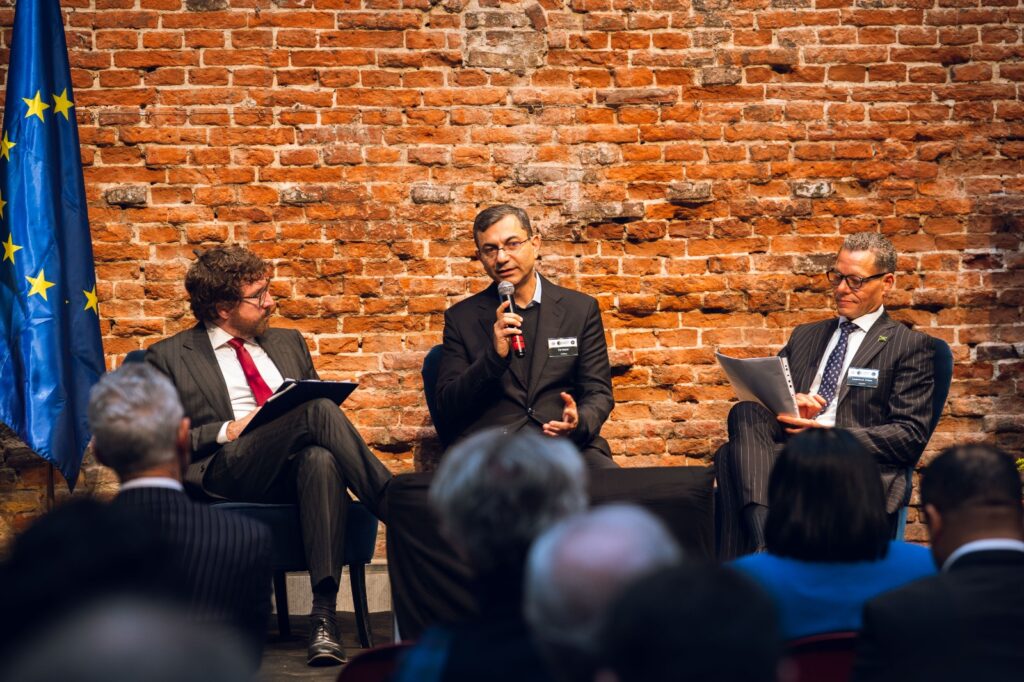
Rebecca Christie of Bruegel and Filippo Amato, Trade Affairs Officer – Trade relations with the Caribbean – DG Trade, European Commission, join moderator Dave Keating for the discussion “Trade, investment and strategic connectivity: Unlocking the EU–Jamaica partnership”. Credit: Gilles Njaheut / The Brussels Times
For Ambassador Reid, greater market participation could also be achieved by broadening the scope of trade, emphasising the potential to expand the export of services, agricultural processed goods and digital technology.
While trade between the EU and Jamaica has increased significantly over the last decade, according to Filippo Amato of the Directorate-General for Trade at the European Commission, “trade in services is probably where there is even more potential [for growth]”. He said the EPA provides “predictable and transparent framework”, but the challenge is to reach those businesses that might be unaware of the advantages provided by the agreement and are not yet exporting to Europe.
Rebecca Christie, a research fellow at the think tank Bruegel, also emphasised trade opportunities in services, as well as highlighting agriculture and shipping as potential growth sectors. “The EU is trying to diversify its supply chains, and partners like Jamaica have a role to play,” she said.
Indeed, the panellists highlighted Jamaica's potential role as a logistics and business hub at a time when countries are increasingly recognising the importance of improving their supply-chain resilience. Jamaica's strategic location, infrastructure and stable business environment make it an attractive destination for European investment in renewable energy, port development, digital services and regional distribution networks.
Such investment will help implement the country’s long-term national strategy, Vision 2030 Jamaica, to make the Caribbean island “the place of choice to live, work, raise families, and do business”. Ambassador Reid underscored the strategy’s goal to create “opportunities for people to do big things and achieve strong returns from partnering with Jamaica”.
Tomorrow’s global technological hub?
During the second panel discussion, Ed Watel, the founder of Intellibus – a privately held technology consulting and platform-engineering company headquartered in Reston, the US – emphasised that Jamaica has a unique opportunity to become a leading technology and digital innovation hub, at a time when Artificial Intelligence is reshaping the global economy.
Jamaica has taken steps to ensure its citizens own their personal data, which gives the country a major competitive advantage in the future digital economy, according to Watel. Additionally, its proximity to North American markets, time-zone alignment, English-speaking workforce and cultural compatibility with major clients offer further advantages.
Watel notes that “in the AI world, it's not about who can give us the answers, because AI is going to give you all the answers. It's going to boil down to people who are curious enough and ask the right questions… And I think that's where I see the real advantage, because people in Jamaica have a degree of curiosity; you have a degree of entrepreneurial spirit, and that's what makes them coachable.”
Ed Watal, Founder of Intellibus, speaks alongside Laurence Jones, European Regional Manager at JAMPRO, during the fireside chat “Jamaica in the digital global economy”. Credit: Gilles Njaheut / The Brussels Times
Intellibus has held several Hackathons in the country over the past few years, bringing together several hundred participants from local and international universities to build real-world technology solutions using AI tools. As well as cash prizes, the event offers top performers direct paths to tech jobs, internships and scholarships to the Intellibus AI Academy. Through the academy, he says the company has demonstrated that young Jamaicans can be trained rapidly for high-value technology jobs and able to compete internationally. “Our real vision is not [for Jamaica] to be an outsourcing destination. Jamaica should become the university of the future,” Watel told the forum.
However, Watel rejects the suggestion that AI will simply eliminate jobs, arguing instead that AI will create more employment opportunities than it destroys. He believes that societies and organisations that prepare early for this transition will benefit most. In his view, AI and digital technologies will reduce the importance of geography in determining salaries and opportunities, and workers will increasingly be compensated according to their skills and productivity. He also argues that ‘business engineers’ will emerge – i.e. skilled employees who combine commercial understanding with technological expertise and can help organisations use technology more effectively.
Laurence Jones, European Regional Manager, JAMPRO, pointed out that Jamaica can build on decades of success in business process outsourcing and its reputation as a reliable provider of digital services to North American and European markets. “We're not starting from scratch!” he said.
He argued that the country’s future, however, lies in broadening its “ambitions to software engineering, data analytics, cybersecurity, AI-enabled services and other higher-value work”. He pointed to the recent successes of Jamaican technology businesses in securing contracts in the UK as evidence of the sector’s international competitiveness.
Although he acknowledged that AI is disrupting traditional outsourcing models by automating routine tasks, he said that Jamaica should embrace AI by investing in the development of its workforce. He argued that trust, security and strong regulatory frameworks will become increasingly important competitive advantages. “I'm not afraid of AI. It's just that we need to keep the checks and balances,” he concluded.
His overarching message to European companies was that Jamaica is already open for business. “Don't wait five years to see what becomes of Jamaica. We need to be part of building it…The door's wide open!”
Resilience is key
A major theme running throughout the forum was infrastructure, with a dedicated panel focused on how infrastructure investment can support trade, improve resilience and strengthen Jamaica's position as a logistics hub.
Addressing vulnerabilities exposed by recent hurricanes, including the Category Five Hurricane Melissa that struck Jamaica in October 2025, Ambassador Antony Anderson of the National Reconstruction and Resilience Authority emphasised that Jamaica's recovery efforts must transcend simple rebuilding. With extreme weather intensifying, the goal is to shift from repeated reconstruction to long-term resilience. "Category Five [the highest level on the Saffir-Simpson scale] is increasingly becoming the new normal," he said.
Critical systems, such as the nation's electricity grid, must evolve to withstand severe climate shocks. The Ambassador cited key projects that are already being advanced, stressing that physical upgrades also increase local capacity and ensure workforce training and knowledge transfer are embedded across the supply chain.
For Mario Lievens, director of the Port of Antwerp-Bruges International, positioning Jamaica as a leading transshipment and manufacturing hub requires modernising port capacity while curbing operating costs. For example, there is an opportunity to expand the capacity of the Port of Kingston, develop logistics parks and strengthen links between maritime trade and local industry.
Indeed, Lievens highlighted that successful maritime investments go beyond stacking containers to include the integration of industrial production free zones and inland transfer points that help alleviate congestion and build supply chain resilience. “Sustainability must be a key consideration in every port development project,” he said.
He also underscored the importance of workplace training for efforts to boost efficiency, customer service and ecosystem productivity.
Bridging the persistent gap between infrastructure needs and project financing requires innovation and international cooperation, according to Olga Baus Gibert, Head of Unit at the European Commission’s Directorate-General for International Partnerships. She detailed how the EU's Global Gateway strategy moves beyond traditional development cooperation by implementing complex projects that combine public funding, private-sector investment, technical expertise and policy support. “Global Gateway is about partnerships... We are not looking simply at projects; we are looking at transformational projects,” she said.
Operating across pillars of policy reform, concessional funding alongside development banks and institutional partnerships, the initiative aims to establish high governance and environmental standards. Gibert noted that these efforts are reinforced by EU financial instruments, including the European Sustainable Fund for Development Plus and the Global Green Bonds Initiative.
Looking Ahead
By the end of the forum, it was clear that Jamaica and the EU are looking beyond traditional trade towards a broader partnership centred on innovation, investment and competitiveness. The focus now is on turning established frameworks and strong relationships into tangible projects and commercial outcomes. If the discussions in Brussels are any guide, both sides are committed to transforming ambition into long-term growth.
