
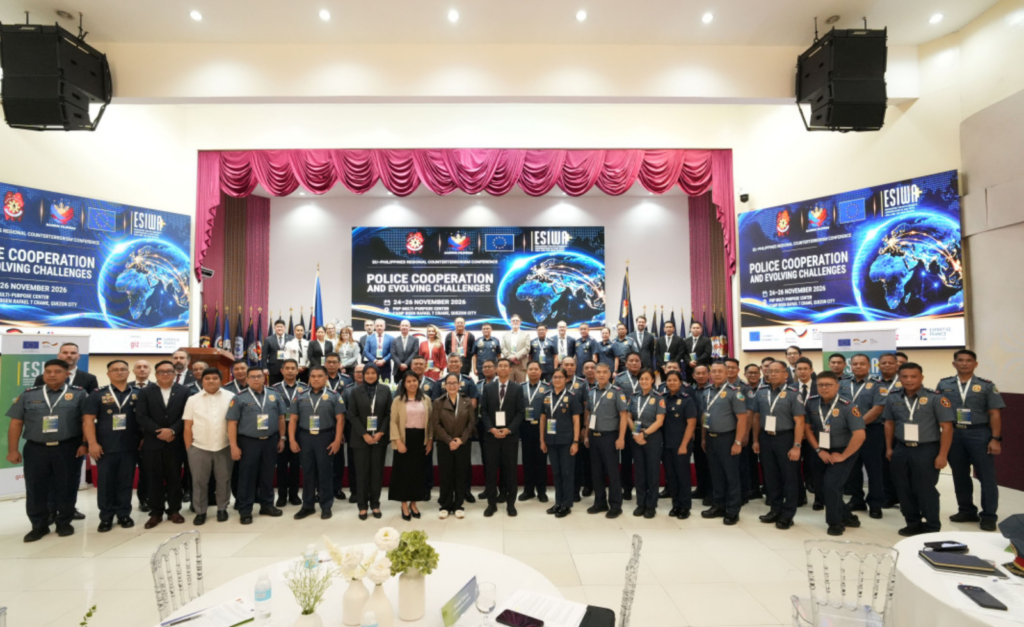
Police representatives from several Asian and European countries met in Manila this week for a three-day conference on counterterrorism cooperation.
The event was hosted by the Philippine National Police at its Camp Crame headquarters from 24 to 26 November and organised through the EU-funded Enhancing Security Cooperation in and with Asia and the Indo-Pacific (ESIWA+) project, in partnership with the police force and the Philippines’ Department of the Interior and Local Government, announced the European External Action Service (EEAS).
Delegates attended from the Philippines, France, Indonesia, Ireland, Japan, Malaysia, Spain and Thailand, alongside specialists from Europol’s European Counter Terrorism Centre — a unit that supports cross-border policing work across the EU.
Agata Nowicka, Deputy Head of Mission of the EU Delegation to the Philippines, said security and defence had become “one of the most dynamic areas” of EU cooperation with the country, adding that the EU wanted to be a “predictable” and “values-based” security partner in the Indo-Pacific.
Police Major General Arnold P Ardiente, the Philippine National Police’s Director for Intelligence, stated that the Philippines had “long lived with the realities of terrorism and violent extremism” and that the police continued to adapt to a threat that “does not stand still.”
Focus on information-sharing and new forms of extremism
Sessions covered police-led counterterrorism, civil-military coordination, intelligence-sharing and multi-agency cooperation.
The conference also discussed Composite Violent Extremism (CoVE), described as an emerging challenge.
Participants examined “fusion centres” and other coordination mechanisms used to combine information from different agencies to support threat assessments and operational responses.
Elmer G Cato, Assistant Secretary at the Philippines’ Department of Foreign Affairs, urged participants to build direct contacts during the event, saying: “In the middle of a crisis, there is no time for introductions.”
The EU-funded ESIWA+ project supports security engagement in counterterrorism, maritime security, cyber security and crisis management, and is co-funded by the European Union, Germany and France.
