
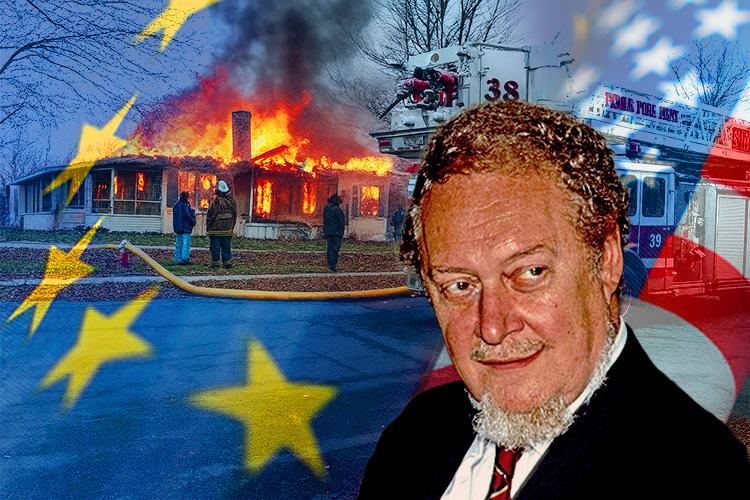
A revolt against modern-day monopolization is brewing in Europe. Among the responses is creation of a New Competition School to challenge the European Commission's deference to corporate power under the influence of the so-called Chicago School.
Led by economic libertarians like Milton Friedman and anti-government zealots like Robert Bork, the Chicago School prioritized notions of economic efficiency over enforcement of antitrust and competition law. The results have been catastrophic across a wide swathe of economies, says Nicholas Shaxson, one of the founders of the New Competition School and the author of a forthcoming book on monopoly, The Big Squeeze.
The trends toward concentration of economic power are plainly obvious and the perceived injustice is a factor pushing voters to support increasingly extreme political movements, especially on the radical right. That's where the New Competition School seeks to be a counterweight, returning the EU to the principles of robust enforcement that sprang in part from the defeat of Hitler's Germany.
The Nazi war machine, after all, had been underpinned by monopolization, and the lesson — about the incompatibility of democracy and unchained corporate power — was not lost on the authors of the Treaty of Rome.
The founders of the European project included laws inspired by German ordo-liberalism and by the American trustbusting tradition that aimed to keep relations between big business and government in check. But by the turn of this century, American politics swung back sharply towards laissez-faire neoliberalism and Chicago School economics in the sphere of antitrust.
The Bush administration dropped an antitrust case against Microsoft, which could have broken the company apart, and President George W. Bush personally complained when the EU blocked a $42-billion mega-merger between General Electric and Honeywell.
The transatlantic bust-up over GE/Honeywell was a pivot point. The EU buckled, adopting Chicago School standards and creating the role of Chief Economist, in turn enabling a parallel industry of unregulated economic consultants to flourish in Europe. Since then, the rate of merger prohibitions has collapsed even as the monopolization of the economy, including by technology giants, has gathered pace under the noses of the very people meant to intervene.
The general public "know that corporate power is a big, rising, and terrifying problem," says Nick. "But what is surprising is that there is one group of people who don't seem to know what corporate power is — and that is the regulators."
