
Kristina Chetcuti, a registered health coach (UKIHCA) specialising in behaviour change and lifestyle medicine (ELMO), answers your lifestyle dilemmas.
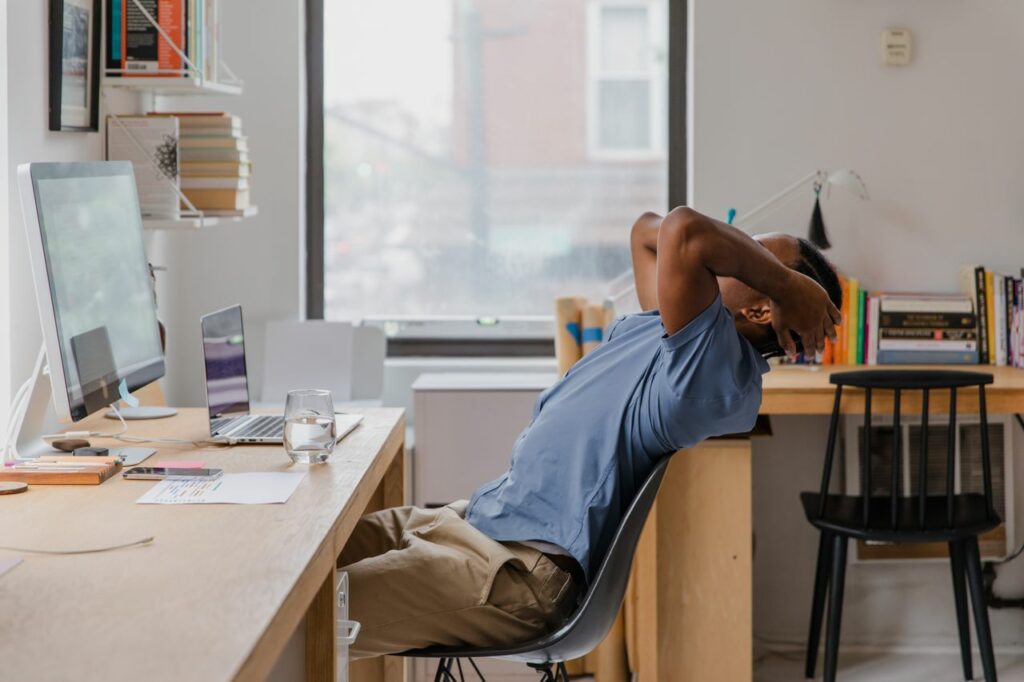
Q. Our offices are being refurbished. Since I keep hearing that sitting is so bad for us, should I ask for a standing desk?
A. The headlines in recent years have been quite dramatic: ‘Sitting is the new smoking’ or, even more ominously, ‘Sitting disease strikes the world’. Entire markets have sprung up on the premise that sitting is killing us, from treadmill desks to even desk bikes.
It all sounded so worrying that, at one point, I found myself frantically googling ‘standing desks’. The only reason I did not get one was because they all looked resolutely office-y: dull grey metal with the aura of dreary spreadsheets. I knew I would go to great lengths to avoid using it.
Just as well, as it turns out. When I looked into the research, standing desks are hardly the secret to eternal good health. Swapping a sitting desk for a standing one reduces sedentary time, yes – by around 40 minutes a day – but it still does not do much for our muscles.
Standing still at a desk keeps our muscles in one fixed position for hours on end and they are only slightly more active than when we are sitting in a chair. So, our body, I’m afraid, is not particularly impressed by a desk which can rise all the way up to our chin.
How to sit
The problem is not simply how much time we spend sitting; it’s also what our body is doing while we sit. To understand why, it helps to look at the Hadza, one of the last remaining hunter-gatherer communities in the world, living in Tanzania.
Researchers found that Hadza adults spend an average of around 10 hours a day sitting. Ding! That is surprisingly similar to the amount of sitting time our neighbours in the Netherlands clocked. It is also broadly the same in the United States and Australia. In short, the Hadza sit as much as we do.
The difference is in how they do it. When we stop moving, most of us sink into a very comfortable chair, a plush sofa or a deep armchair and we do not budge. The Hadza, when they rest, are more likely to squat, kneel or sit on the ground (in fairness to us, the Hazda do not have Netflix), positions that cannot be held for very long, and so they shift often.
As it happens, the researchers also measured what was actually happening in the muscles of the legs in these different resting positions. When the Hadza squatted or knelt, muscles were working at around 40% of their capacity. Sitting in a chair/sofa/armchair? Muscles enjoy a lovely snooze. The problem with muscles having long stretches of naps is that if we don’t use ’em, we lose ’em.
In many parts of the world, until relatively recently, everyday life involved far more squatting, kneeling, sitting on the ground and getting back up again. Nobody thought, “I really ought to exercise my glutes for ten minutes today.” It was simply how life was lived.
In Malta, where I grew up, people would sit and chat on low doorsteps on balmy evenings. In Belgium, France, Italy, and other countries of rolling farmland, people rested close to the ground, on low stone walls or fences. Sitting and standing from the ground were simply part of everyday life.
Sit on the floor
But as chairs became the default way we sit and rest, we only practise these varied movements as children. By the time we’re in our teens, we start losing some of the mobility, strength and balance needed to do them.
It’s a bit of a quandary: we’ve been designing increasingly sophisticated chairs to make eight hours of sitting more comfortable, and now we have to persuade ourselves to get out of them.
Perhaps the answer is not a better chair, but a slightly stiff one, which makes us want to get up and move around more often. And then we can experiment with the floor: sit cross-legged, shift to the side, kneel, stretch one leg out, tuck the other underneath. As no position stays comfortable for very long, we naturally keep moving.
One good test we can easily do is the sitting-rising test: a surprisingly good snapshot of strength, flexibility and balance. Being able to get down to the floor and back up again without support is strongly linked to independence and longevity. Which is handy when we want to get off the sofa in our 60s and 70s without a groan.
Dear reader, I’m not sure you can work on the floor in your new office. You might, perhaps, get a few frowns. But if you have a say in the refurbishment, perhaps you can suggest a work environment that encourages movement:
- put printers, bins or coffee facilities a little further away
- have some meeting areas where people can stand
- have a sit-stand desk available
- build short movement breaks into long meetings
- walk to speak to a colleague rather than emailing them
- have walking meetings when appropriate
- use stairs rather than lifts
- go out for lunch breaks
By all means, ask for a sitting/standing moveable desk. But while you’re at it, ask for a workplace that gives you reasons to move. And perhaps, if the refurbishment committee is feeling adventurous, give the floor a chance.
