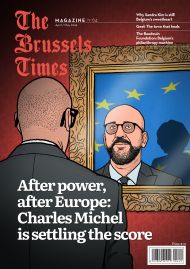
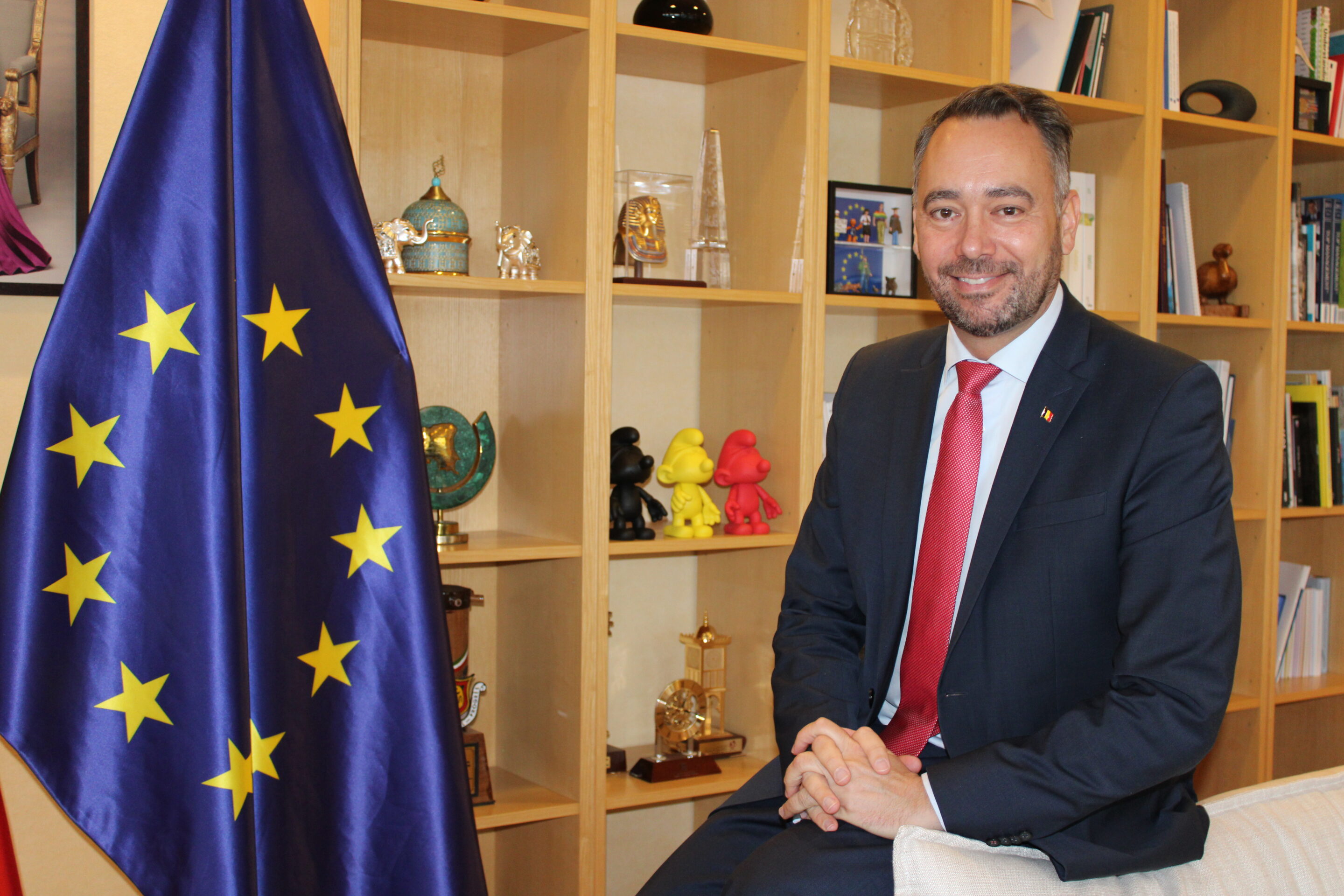
In his corner office at the Foreign Ministry, Maxime Prévot gestures proudly towards a trio of Smurf figurines painted in Belgium’s national colours, red, yellow and black. They are playful mascots, yet they say much about his vision of diplomacy: creative and unafraid of a touch of whimsy.
Since taking office as Belgium’s Foreign Minister in February, Prévot has redrawn Belgium’s global map, spoken bluntly on Gaza, Donald Trump and Ukraine, and quietly turned his centrist Francophone party, Les Engagés, into one of Europe’s most interesting political revivals.
The toys are amusing, but they’re not trivial. To Prévot, who insists on posing next to them for his photo, they symbolise Belgium’s foreign policy: imaginative, inclusive and just a bit self-mocking. The Smurfs, after all, are one of Belgium’s most recognisable exports – a form of cultural diplomacy in miniature – and Prévot’s readiness to embrace them captures his belief that soft power can coexist with seriousness. And a practical test of how a small, multilingual country can exercise influence in an era of geopolitical disorder.
Even Belgium’s politics and institutions, which often seem chaotic and confusing, can be assets, he says. “The creativity of our political class has sometimes made the system complicated – an institutional lasagna that isn’t always easy to digest. But our ability to forge compromises, to stay solution-oriented, gives us agility that many other countries lack.”
Now he is part of that process, as the Foreign Minister in Bart De Wever’s five-party ‘Arizona’ coalition. The 47-year-old former mayor of Namur is using his time in high office to try to combine moral conviction with managerial overhaul.
Vision, action, solutions
Prévot’s blend of prudence and passion can appear paradoxical: he preaches balance but speaks with conviction; he embraces compromise but demands clarity. To his critics, that can sound technocratic. To his supporters, it is exactly what Europe needs.
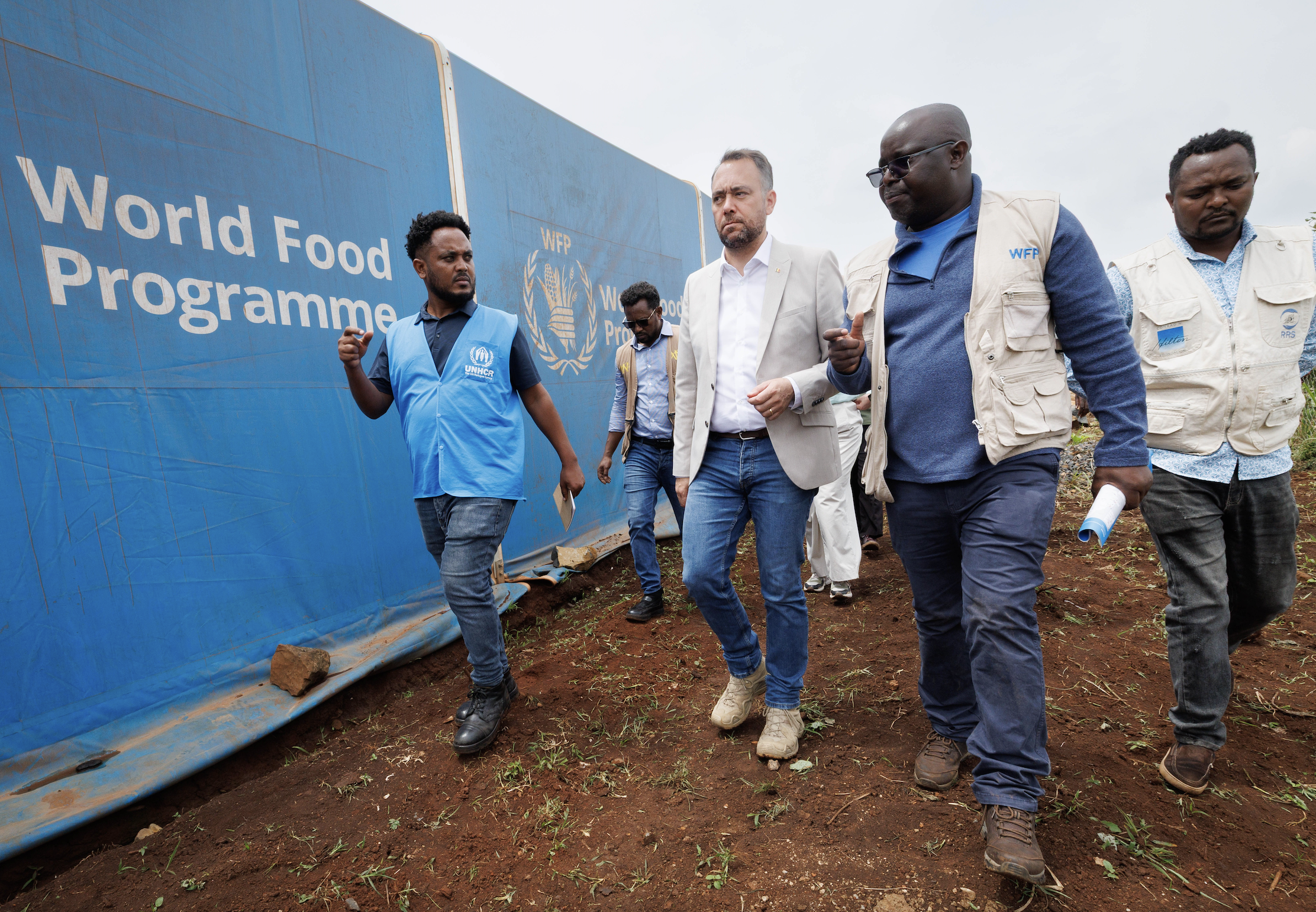
Deputy-Prime Pinister and Minister of Foreign Affairs Maxime Prevot pictured during a visit to the Ura Refugee Site in Assosa, Ethiopia on Friday 22 August 2025. Credit: Belga / Benoit Doppagne
“We can talk about anything with anyone,” he says. “It depends on how we do it. But we must keep to an approach that creates genuine cooperation, not asymmetry.”
That emphasis on process – on the how rather than the headline – may be Belgium’s most enduring contribution to the world, and Prévot’s own.
Earlier this year, he said Europe is “no longer the continent of the Enlightenment,” due to the rise of populist parties that are winning elections. In a period of shrill politics, whether dealing with Trump or Tehran, Palestine or populism, he argues that diplomacy begins not with shouting but with seeing clearly.
Asked to define Belgium’s foreign policy identity, Prévot begins with what he calls “a diplomacy of vision, action, and solutions.” His manner is precise but animated. Belgian diplomacy, he says, must look lucidly at “the world as it is” while refusing to become purely mercantile.
“Economic diplomacy is very important – it’s an integral part of political diplomacy – but it must not reduce our relations to the commercial dimension,” he explains. “We must continue to defend universal principles that are currently under attack: multilateralism, human rights, women’s rights, LGBTQ rights, climate commitments. We can’t sweep them under the rug like dust we refuse to see.”
Lucid diplomacy
His watchword, again and again, is lucidity: the need to see global power shifts without moral blindness.
“Today’s challenges are multifaceted,” he says. “First, there is the challenge of realism in economic diplomacy, which requires us to work on consolidating new trade partnerships and diversifying our strategic hubs.”
Russia’s ongoing war in Ukraine is an obvious threat, as is China’s increasing assertiveness. But the return of Donald Trump to the White House earlier this year has raised questions about whether the United States can still be relied upon as a strategic partner and ally.
With the Trump Administration threatening to abandon Europe militarily and strongarming the bloc with tariffs, this has been a sober reckoning. But Prévot says Europe failed to react effectively. “Europe today is divided and struggles to have a credible foreign policy,” he says. “We are divided on the stances to adopt in the Middle East conflict, on the issue of the trade war, or even on sanctions against Russia,” he says.
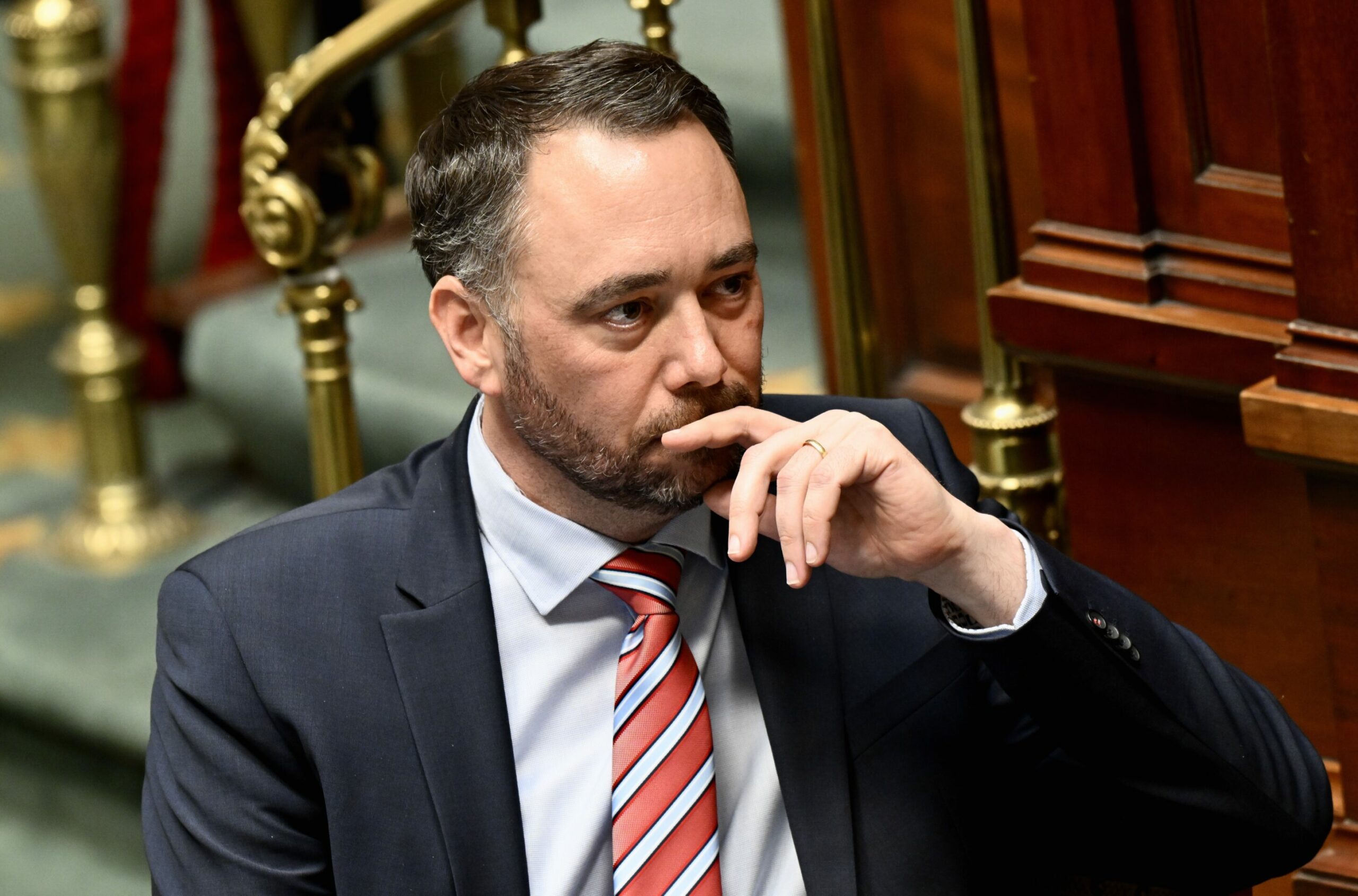
Minister of Foreign Affairs Maxime Prévot. Credit: Belga / Eric Lalmand
The EU’s foreign affairs supremo, Kaja Kallas, he says, has been undermined by “member states that prefer to roll out the red carpet” for the likes of Trump and Israeli Prime Minister Benjamin Netanyahu.
The result, he fears, is internal corrosion. “My main fear is that forces hostile to the European Union, from east or west, will achieve their aims by dislocating our cohesion from within. Too many national governments make short-term calculations to appease opinion, forgetting the long-term need for unity.”
He points to the recent trans-Atlantic trade disputes as symptoms of this vulnerability. “Being forced to make over €700 billion in military purchases looks like humiliation for the EU,” he concedes, referring to the terms of the August EU-US trade deal. “But growth needs investment, and investment needs predictability. The deal at least offers us predictability.”
Prévot recalls being in New York for the UN General Assembly in September. “I heard President Trump’s speech. The lack of consideration he showed toward European partners was genuinely shocking.”
Still, he sees a silver lining. “The merit of his remarks is that they force Europe to question itself. If that strengthens European unity, so much the better. If it deepens division, then it’s a ticking time bomb,” he says. “The United States is and will remain a key ally, but the Trump Administration has also awakened something in us: the duty to diversify our partnerships and therefore to turn our attention with more care and involvement than in the past.”
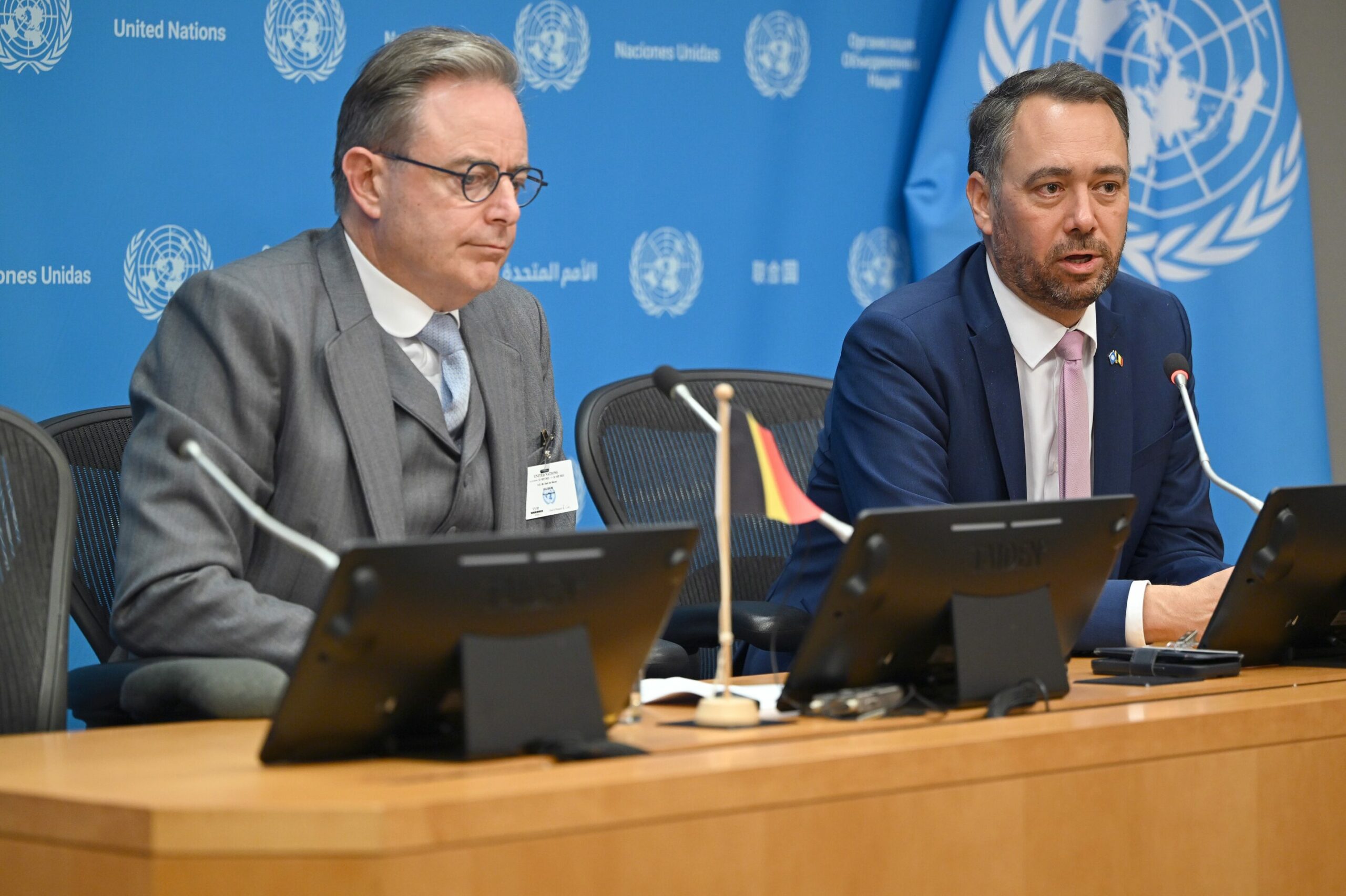
Belgian Prime Minister Bart De Wever and Minister of Foreign Affairs Maxime Prevot speaking to press moment after a Conference on the Peaceful Settlement of the Question of Palestine during UNGA80, in New York City, 22 September 2025. Credit: Belga
Asked what he would say to Trump if they met face-to-face, Prévot is characteristically blunt. “He misunderstands the European Union,” he says. “It was not created to harm the United States but to prevent new wars and build prosperity through cooperation, not fighting. Therefore, to consider the European Union as the source of all evils, including the socio-economic realities of America, is a dangerous oversimplification.”
Palestinian recognition
The moment that defined Prévot’s first months in office came with Belgium’s recognition of the state of Palestine in August – a decision that placed Brussels among Europe’s most assertive voices on the Middle East.
“It was important to give a voice on the world diplomatic stage,” he says. “We recognised the legitimacy of the Palestinian people’s right to their state at a time when Israel announced its intention to annex the West Bank and to occupy Gaza militarily.”
He describes the recognition as a two-stage process – political first, legal later – carefully timed so that it could not be construed as sympathy for Hamas. “Our action could in no way be exploited in the narratives of either side as an endorsement of the October 7 attacks,” he insists.
The recognition came just a few weeks after Prévot described Israel’s attacks in Gaza as a ‘genocide', and it stirred issues within the coalition, with Les Engagés, the Flemish Christian Democratic CD&V and Flemish socialist Vooruit calling for a tougher stance while De Wever’s N-VA and the francophone centre-right MR opposed.
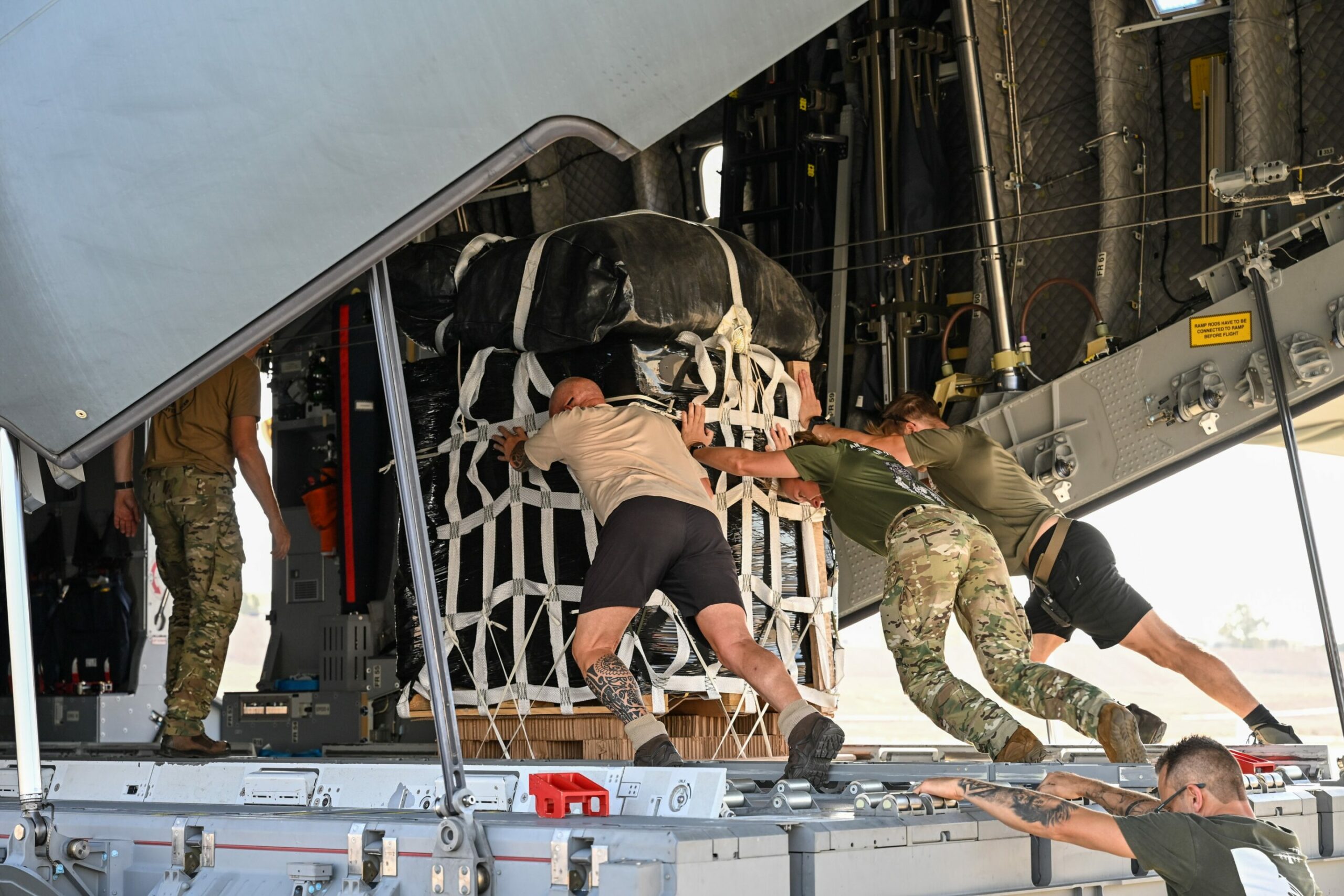
Belgian military members loading a Belgian Defense A400M transport aircraft which is about to take off from Jordan to successfully drop sixteen pallets of supplies over the Gaza Strip, Sunday 03 August 2025. Credit: Belga
While he welcomes the US-brokered October ceasefire aimed at ending the Gaza war, he was instrumental in pushing Belgium’s earlier sanctions on Israel’s government, joining a small European group willing to move from words to measures. For Prévot, it was an act of realism as much as of empathy: “Peace requires credibility, and credibility sometimes means discomfort.”
Symbolism, Prévot adds, is never enough. “Recognition, however important, doesn’t feed the hungry mouths of children and women trapped in Gaza. The priority must be to break the humanitarian blockade – and for that, only diplomatic and economic pressure will work.”
Frozen assets
From Gaza, he turns, almost seamlessly, to another test of principle: whether Europe should confiscate Russia’s €190 billion frozen sovereign assets, most of which are held at the Brussels-based Euroclear central securities depository, to help Ukraine?
“Not in the current state of affairs,” he says flatly. He warns that confiscation could cross a legal and economic Rubicon. “The temptation is strong,” he admits, “but it could cause collateral damage – a risk of a devaluation of the euro, a systemic shock to European financial centres, a loss of confidence among countries that hold sovereign assets here. Countries could fear that their assets could be confiscated for political reasons, not for a judicial decision. International law cannot be bent for convenience. Disregarding it would be self-defeating.”
The issue was discussed by EU leaders at their summit in Brussels on October 23, but De Wever blocked it, saying the proposal failed to provide the legal guarantees Belgium needs to ensure it would not be solely liable for any potential claims.
Prévot, however, opens the door to it, so long as the EU amends its asset management system to spread the risks across all EU member states. He says officials need to offer the maximum legal protection, taking into account scenarios like if the Kremlin confiscates a whole series of Western sovereign assets in Russia.
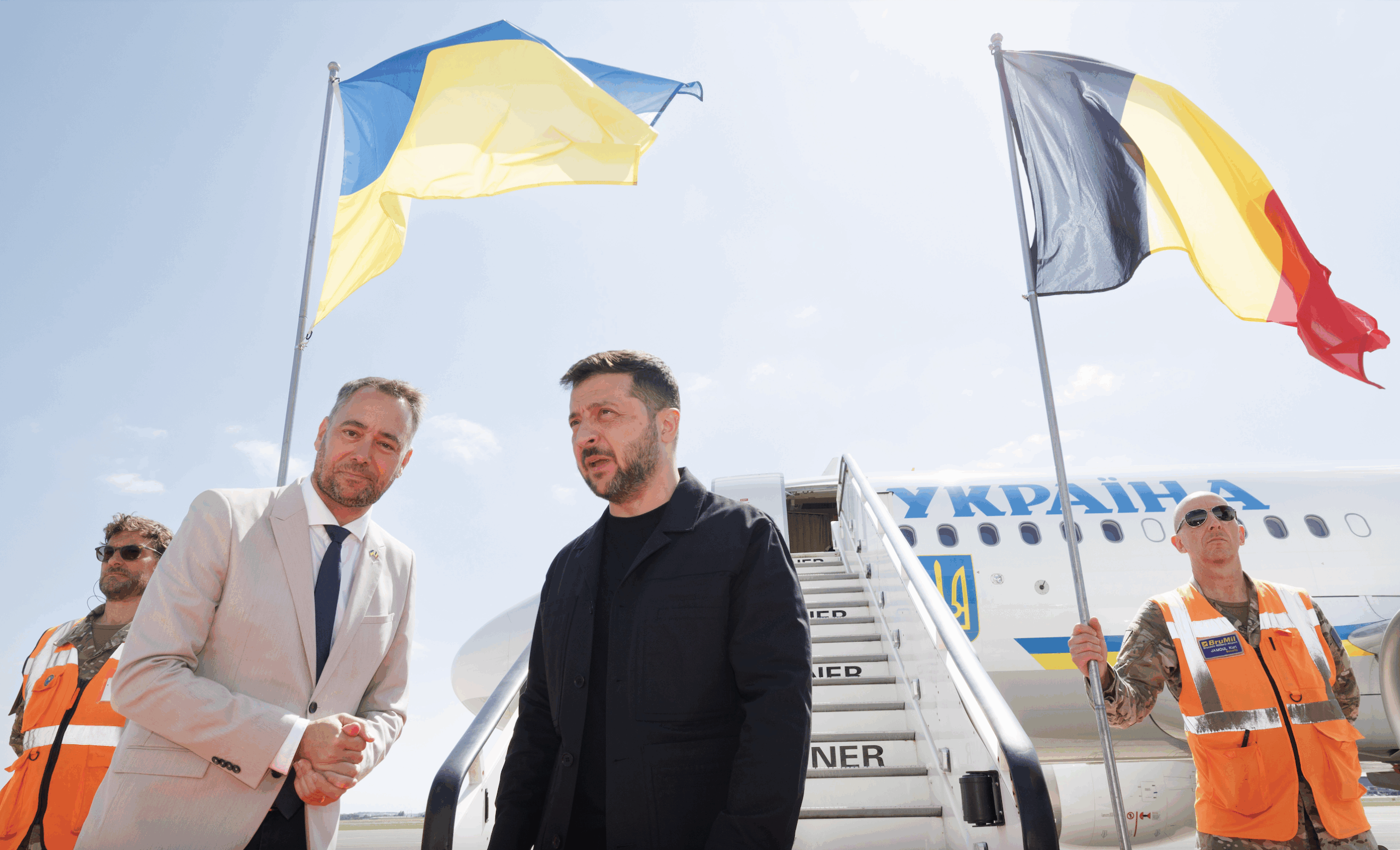
Belgian Foreign Minister Maxime Prévot meets Ukrainian President Volodymyr Zelenskyy at Brussels Airport. Credit: Belga
“What happens if there are retaliatory measures against European companies that are still active in Russia?” he says. “This issue is far too sensitive to be resolved simply by some political principles that are easy to explain at a press conference, but much more complex in their implementation and risk management. We need a risk-sharing approach because Belgium alone cannot bear the brunt of the repercussions and the risk associated with potential retaliatory measures or legal proceedings from Russia. We don’t just need a coalition of the willing, but also a coalition of the billing,” he adds, with a slight smirk at the pun.
Strength through complexity
Eventually, the conversation returns home. Belgium, Prévot admits, is not easy to explain – “so complex that even Belgians sometimes struggle.” Yet he sees strength in that complexity.
Compromise, for him, is a virtue, not a weakness. “In France, people often think that making a compromise is compromising oneself. In Belgium, we know it can be noble. It doesn’t guarantee success, but it allows progress.”
That skill, he believes, gives Belgium credibility abroad. He cites the example of the international mining code negotiations on deep-sea minerals, where Belgium was asked to draft a balanced proposal between countries wanting exploitation and those demanding a moratorium. “It shows that others trust our capacity to find fair solutions,” he says.
In Prévot’s telling, Belgium’s unwieldy federal structure becomes a kind of training ground for global mediation – diplomacy by necessity.
That conviction underpins a signature initiative at the ministry, a strategic review of Belgium’s embassies and consulates, warning that there may be some pruning ahead. “Some embassies still exist for historical reasons that are no longer justified. Others, in emerging regions, urgently need strengthening.” The plan, he says, is to rethink the network over a 10-to-15-year horizon – “long enough to match diplomacy’s tempo, short enough to adapt to change.”
Prévot frames this exercise not as bureaucratic tidying but as moral positioning. Europe, he argues, must resist the drift toward purely transactional foreign policy, especially as China and Russia court African and Asian partners with few conditions on rights or governance.
“Many countries that once sought close ties with the EU for development aid are now receiving offers from elsewhere, with far less regard for human or workers’ rights,” he says. “Europe must not abandon its values. We can talk about anything with anyone, but our approach must create genuine win-win cooperation – far removed from the asymmetrical partnerships of the past.”
This linking of ethics and efficiency, of clarity and compromise, has become Prévot’s hallmark – and, increasingly, his message to a world that often confuses neutrality with indifference.
Early lessons
Prévot’s convictions were shaped by a difficult childhood. Born in Mons, his father became a European Commission official in Luxembourg, where he spent some of his early years. His parents divorced when he was seven, and his mother raised Maxime and his younger brother in Dave, a Namur suburb – his vocal support for single mothers can be traced to this period. His uncle on his mother’s side is disabled, which again has influenced Prévot’s politics to support people with disabilities.
His father quickly moved on to another woman who clashed with the boys - he didn’t invite his sons to the second wedding – and died in a plane crash when Maxime was 18.
Prévot would later study political science in Namur before joining audit and consulting giant PricewaterhouseCoopers. At the same time, he was involved with the Humanist Democratic Centre party (fashioned as cdH in French), whose head, Joëlle Milquet, appointed him as political secretary when he was only 26. From there, he rose to become a minister in the Walloon government, and then mayor of Namur in 2012, a position he held until this year.
He became head of the CDH just five months before the 2019 federal elections, but could not save the party from crashing to just 3.7% of the total vote, losing four of its nine MPs in the 150-seat parliament.
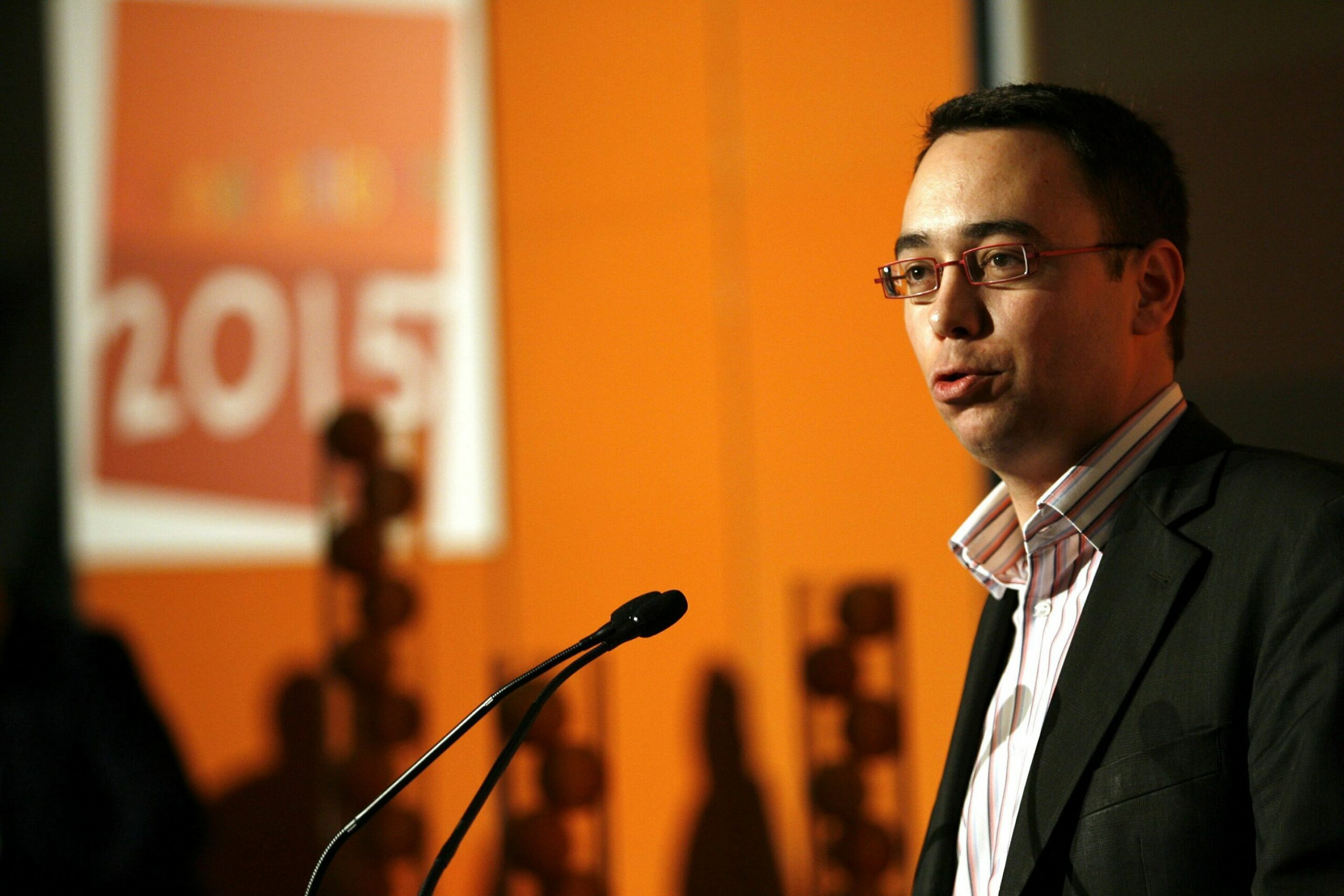
Maxime Prevot gives a speech during a congress of French-speaking CdH party, which became Les Engagés, Saturday 26 April 2008 in Louvain-La-Neuve. Credit: Belga / Bruno Fahy
His response was to reinvent the party, widely seen as fusty and irrelevant. “We had to respect the voters and the message they sent,” he says. “If we lost their trust, our message no longer matched their expectations.”
It started with two years of self-questioning. “Political parties often defend doctrines forged 50 years ago,” he says, listing the changes since then: the digital revolution, ecological transition, single-parent families, new work patterns. “We had to start from scratch.”
The party embarked on nationwide consultations, listening to citizens “with humility – even their anger.” Out of that came a platform that was more centre-right economically, more liberal socially. And a rebrand in 2022 as Les Engagés - including a logo colour shift from CDH’s tired orange to zippy turquoise – which Prévot says reflects commitment as well as engagement. He also shifted its political base even further from its Christian democrat origins, taking it from the conservative European People’s Party (EPP) group within the European Parliament to the liberal Renew family.
The 2024 elections rewarded the experiment with the party’s best result in three decades, winning 14 seats. Prévot attributes the comeback to tone as much as policy. “We live in an age of clashes and trash talk,” he says. “Algorithms feed fake news and polarisation. In that context, the only true courageous act is to offer a nuanced message – harder to explain, but healthier from a democratic standpoint.”
He believes the result proves that “a large share of public opinion still wants serious politics that doesn’t rely on populism,” he says. “Left and right both focus on segments of the electorate. We can’t cling to past achievements, as the left does, nor to try to protect privileges at all costs, as the right does. The true nobility of politics is to improve the lives of everyone, beyond partisan boundaries.”
In the election’s aftermath, he quickly built a bond with MR’s Georges-Louis Bouchez – from the same generation, with a similar regional background and personal style – to forge a united alliance between the victorious francophone parties ahead of the negotiations that eventually led to the De Wever coalition.
Running, mountains and karaoke
Pressed on how he relaxes outside politics, Prévot laughs. “I like jogging. Before becoming a minister, I tried to run ten kilometres twice a week. Now I have less time, but I try not to get too out of shape.”
His real escape, he says, is trekking in the mountains. “That’s when I disconnect completely.” Otherwise, he spends his rare free evenings with family or friends “around a good meal.”
Then, coyly, he confesses to another hobby: karaoke. His press spokesperson bursts into laughter as he admits that his go-to song is Mexico, a 1951 French ditty by Spanish tenor Luis Mariano – an exuberant choice for a man known for caution.
The cheesy karaoke choice goes some way to explaining Prévot’s approach: embrace your true self, however quirky. And perhaps it is why the idea of standing beside those Smurfs appeals to him. They are less a gimmick than a reminder: small figures, distinct but united, capable of saying something serious – even softly – about who Belgium is and how it speaks to the world.
