
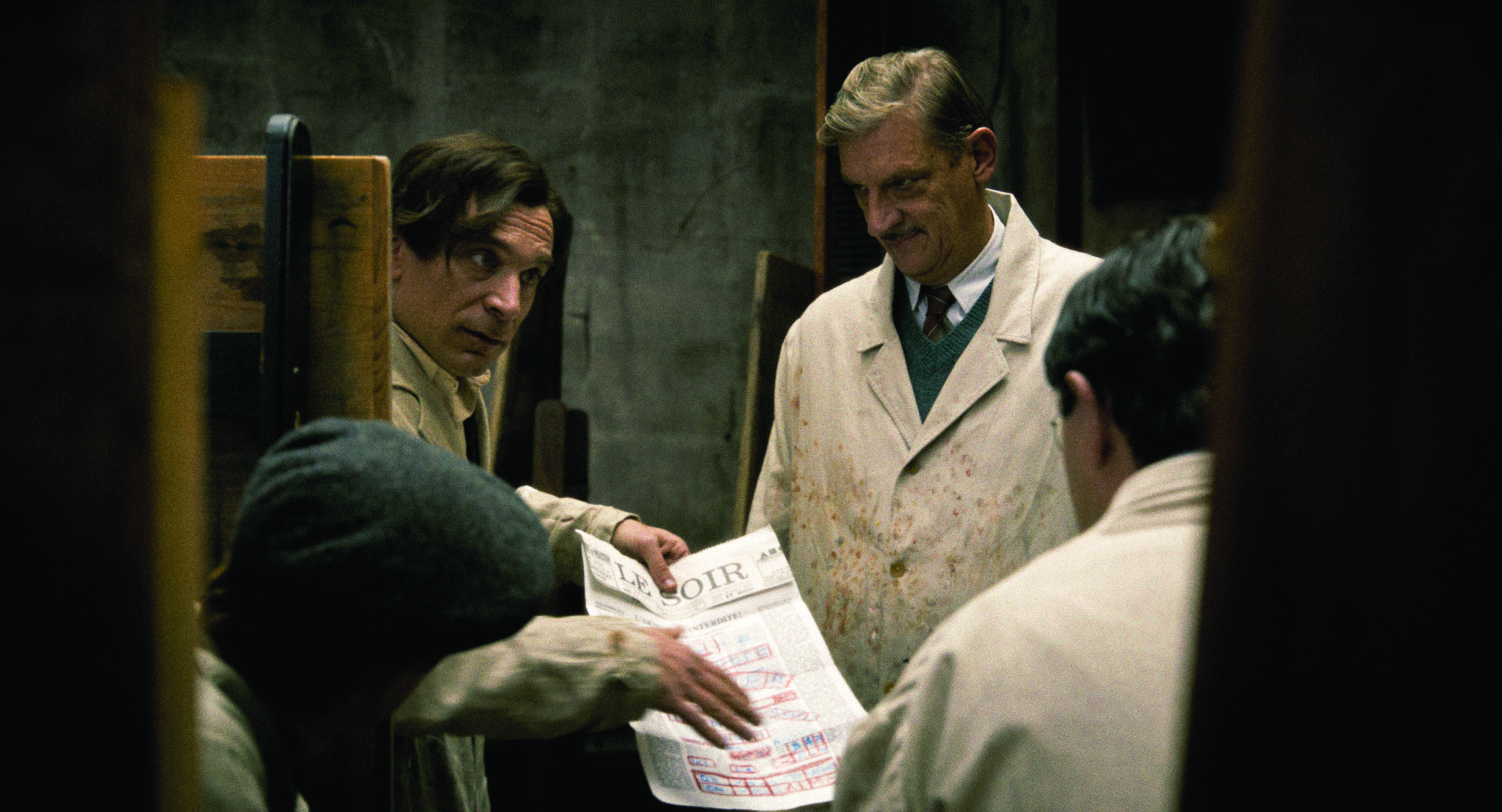
In 1943, Belgian Resistance fighters pulled off an extraordinary stunt, publishing a spoof edition of a Nazi-controlled newspaper. Now, director Michaël R. Roskam has brought their story to the screen. He tells Dennis Abbott about wartime courage, the power of humour and why he doubts he would have joined the Resistance himself.
Michaël R. Roskam admits he might have collaborated with the Nazis during the Second World War.
Asked whether he would have made a propaganda film under the occupation of Belgium, the acclaimed director does not hesitate.
“To save the life of my children, I’ll make that movie. Without a doubt.”
His new French-language film, Le Faux Soir, celebrates an audacious act of Belgian Resistance defiance. Yet Roskam, 54, struggles to imagine joining the underground himself.
“What would I do? Sacrifice my family? For what?” he shrugs.
It is an uncomfortable question. Resistance members risked execution or deportation, sometimes alongside their families.
On the face of it, Roskam’s response to the what-would-you-have-done-in-the-war question is hardly surprising. He has two young children, a daughter aged two, Colette, and a baby son, Jacomo, with his 38-year-old partner Eline De Munck, a former singer and actress turned entrepreneur and founder of the trendy Flemish designer eyewear chain, Odette Lunettes.
The whole family features regularly in clips on her Instagram feed. Roskam also has a 17-year-old, Elliot, from a previous relationship with script editor Anneleen Masschelein.
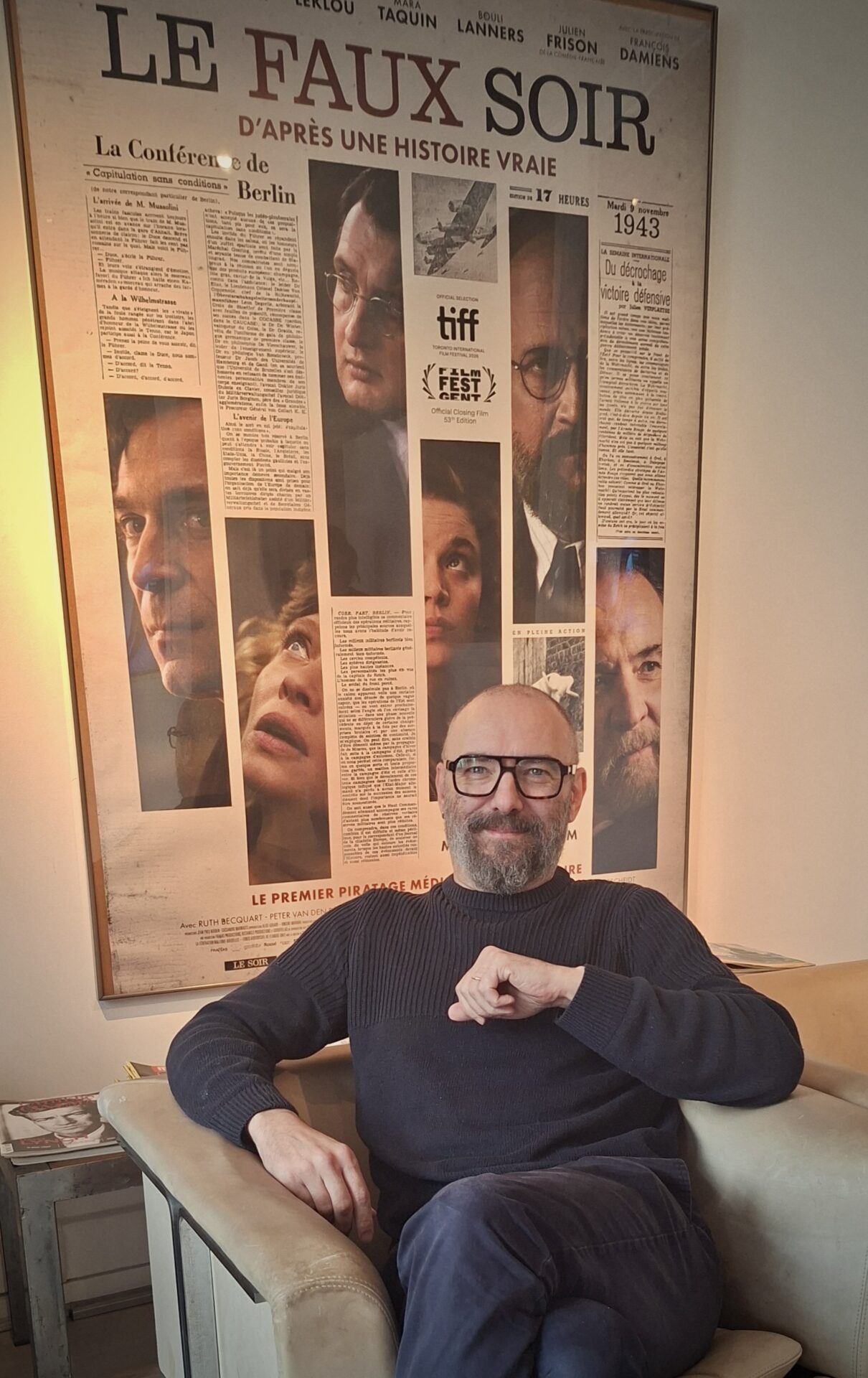
Michaël R. Roskam. Credit: Dennis Abbott
But Roskam is already reconsidering the consequences of his hypothetical decision – or perhaps imagining the next scene.
“I make a nice propaganda movie, right? But, at that point I realise I’m gonna be fucked by the Resistance. Ok, so maybe I can then spy for them. Let them use me. I can become an anonymous member of the Resistance, in the shadows.”
So, the traitor becomes a silent hero?
He doesn’t seem 100% sure now. It’s as if he’s having an internal dialogue, weighing the pros and cons.
“I like to talk,” he warns, and he does: provocative, funny, thoughtful, sometimes contradictory and never boring.
He and Eline have just put their townhouse in Molenbeek up for sale. The couple, who are planning to move to Antwerp to be closer to his other half’s flagship store, have even made a video, in which they both feature, in a bid to attract buyers. It’s a snazzy looking place with a pool in the garden. Roskam is likely also hoping for a call from their estate agent, then.
Roskam is buzzing about his new film, which arrives in Brussels after positive reactions at screenings in Toronto, San Sebastián and Ghent.
The newspaper that fought back
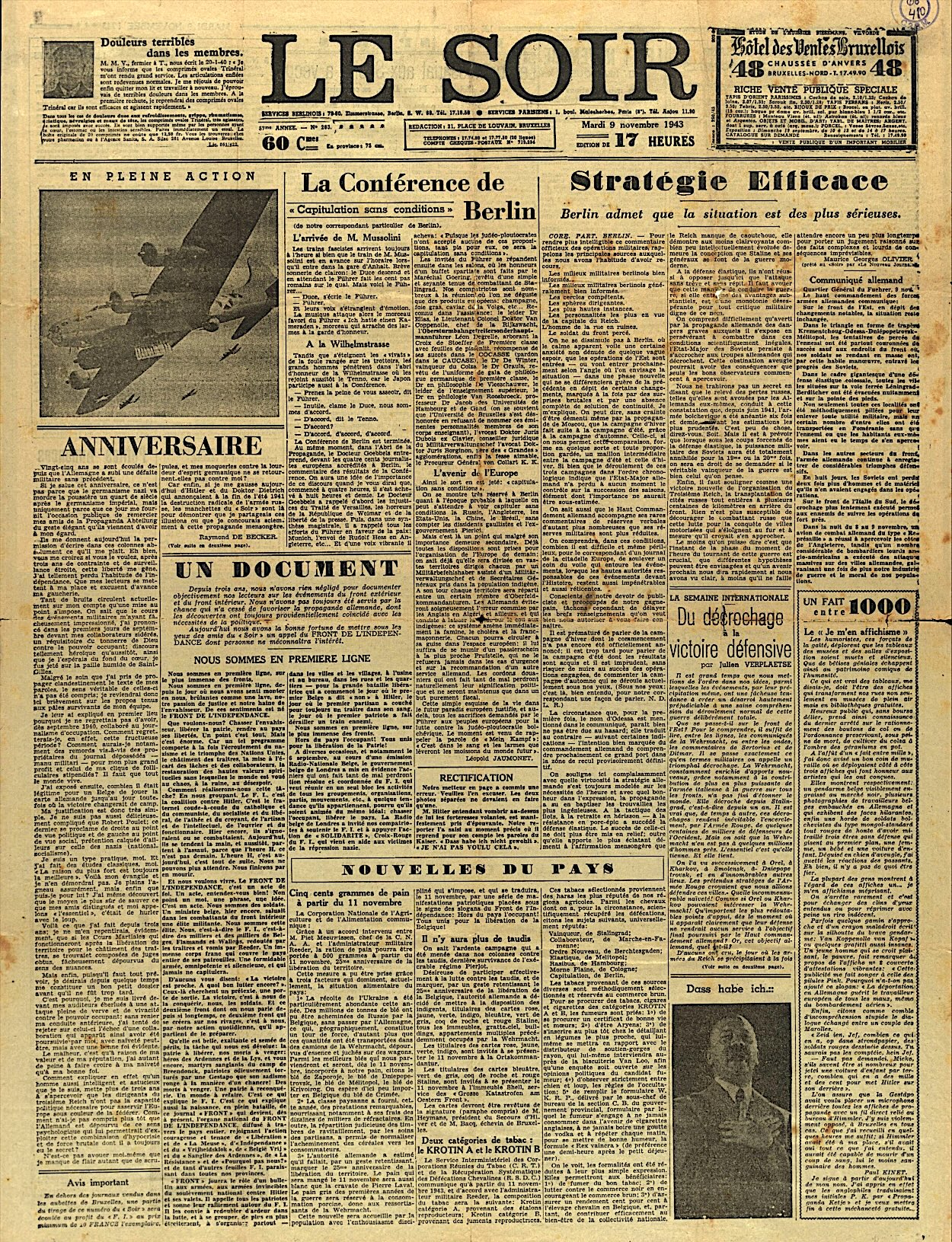
The film is based on a remarkable episode during the German occupation of Belgium from 1940 to 1944. Le Soir, the country’s leading French-language daily, was taken over after its 30-year-old owner, Marie-Thérèse Rossel, refused to cooperate with the occupiers.
The title then was relaunched with ‘New Order’ collaborationist journalists such as Horace Van Offel and Raymond De Becker.
Dubbed Le Soir volé (the stolen Soir), it employed Georges Remi, better known as Hergé, creator of Tintin. He denied collaboration, but many in the Resistance never forgave him.
Journalist and poet Marc ‘Yvon’ Aubrion devised a fake edition to ridicule the occupiers and their propaganda. In the €13m film, he is played by Arieh Worthalter, alongside an ensemble cast including Mélanie Thierry (as Andrée “Françoise” Grandjean), Karim Leklou (René “Jean” Noël), Bouli Lanners (Théo Mullier), François Damiens (Ferdinand Wellens), Mara Taquin (Géraldine “Louise” Gevaert), Peter Van de Begin (Léon Navez), Ruth Bequart (Lucienne JNavez), Viviane De Muynck (Madame Fourcroy), Alexis Manenti (Léon Degrelle), Laurent Capelluto (Adrien van den Branden de Reeth) and Yolande Moreau (Marguerite).
A Faux Soir. ©Frakas Productions/Rectangle Productions/Goodfellas
A long road back to the cinema
But before delving into how Roskam made his version of the story, I ask him why it’s been nearly a decade since his last feature film, 2017’s Racer and The Jailbird (also known as Le Fidèle), a gritty drama set against the backdrop of gangland violence in Brussels, starring his pal Matthias Schoenaerts and Adèle Exarchopoulos.
Indeed, since his 2011 breakthrough with Bullhead (known as Rundskop in Flemish), notable for an unforgettable performance by Schoenaerts as a cattle farmer caught up in an illegal trade in growth hormones, Roskam has made only one other feature film, 2014 hit The Drop.
Based on a short story by US crime writer Dennis Lehane, the cast included Tom Hardy, Noomi Rapace, James Gandolfini (in his final role), and, inevitably, Matthias Schoenaerts.
“Life happened,” Roskam says.
He was working. He had prepped a movie about the rise and fall of Blackwater, the controversial US military contractor founded by former Navy SEAL officer Erik Prince. Le Faux Soir came onto his radar in 2019 but was derailed by the Covid-19 pandemic.
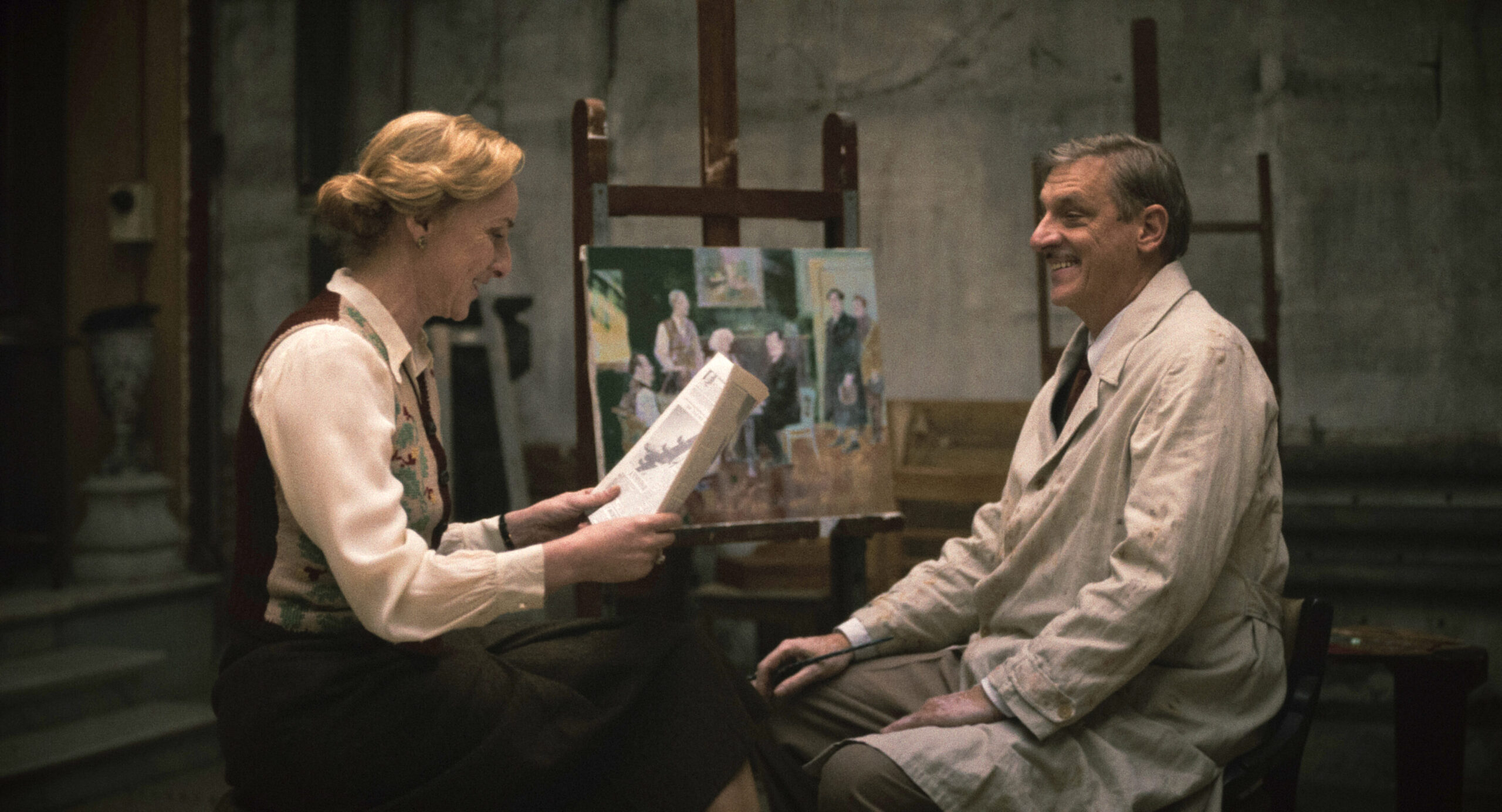
© Frakas Productions/Rectangle Productions/Goodfellas
Then Dennis Lehane called him again, asking if he wanted to do a mini-series called Blackbird for Apple TV. Roskam directed the first three of six episodes, based on the true story of a former high school football star and drug dealer James ‘Jimmy’ Keene (Taron Egerton) who goes undercover in a maximum-security psychiatric prison to extract a confession from suspected serial killer Larry Hall (Paul Walter Hauser).
Roskam then returned to Le Faux Soir – a tale the Sint-Truiden native admits he was completely unfamiliar with until his co-writer Bernard Falaise came up with an initial script. “The story is better known in Brussels and Wallonia than on the Flemish side,” he concedes.
Much of the series was based on Marie Istas’s 1987 book, Le ‘Faux’ Soir: 9 novembre 1943, but he also benefitted from direct access to Le Soir archives.
“They still have everything about Le Faux Soir,” he says. “We deconstructed the story and then reconstructed it so that we could dramatise it properly. We added a few little things here and there but overall, I think, it is historically correct.”
Brussels under occupation
The film features the Grand Place, Bourse, Palais de Justice and Laeken cemetery, with additional scenes shot in Mons. The cobbled Rue de Lilas, alongside the Saint-Jean-Baptiste-au-Béguinage church, is the scene of a “pop-up” black market and the Grand Hospice Pachéco was used for some interiors.
In the film, huge swastika banners adorn the front of the Bourse and Palais de Justice. Roskam lets us into a secret: they’re down to post-production digital enhancement.
“At the Bourse we made use of the existing banners for the beer museum and overlaid Nazi shit on them,” he explains, smiling.
The director recalls that someone who had seen the filming taking place posted on Facebook that the crew were a “bunch of amateurs for shooting a Second World War movie with a sign for McDonald’s in the background,” without realising that this and any other hint of the 21st century would be removed at the editing stage.
However, our eagled-eyed editor did spot a petit snafu in the film trailer, in which part of the building erected in the late 1960s on the site of Victor Horta’s Maison du People (Volkhuis), is clearly visible. Oops.
In any case, surely the freedom to speak nonsense without fear is part of what the Resistance fought for?
Roskam nods. It’s good that people can mouth off without serious repercussions, he acknowledges. “You might feel the consequences professionally or personally, but the damage will be petty. Your life and your family will not be in danger. You can walk away, go home and sleep.”
Words as weapons
Why do Second World War films still resonate, and what does *Le Faux Soir* say to today’s audiences?
“The war was probably one of the most impactful events in the history of mankind, especially in recent history. The world was at war, that speaks for itself,” he says. “I think the reason why we still tell stories about it is because, while there is interest in the event itself, it’s more because it says something about the times we live in.
“I feel the film is perfect timing. We have a president of one of the biggest countries in the world constantly talking about ‘fake news’,” he states, in an undisguised dig at Donald Trump. “With social media, with all the manipulations, words today create wars. In the movie, we literally say that ‘words are weapons.’”
And for the message of the film? “After 80 years of movies about sabotage and battlefields, freedom of speech feels more relevant than ever. I hope this freedom continues to be about opinions, because that means we’re in a very shitty situation. That's why our guys from Le Faux Soir had to do something.”
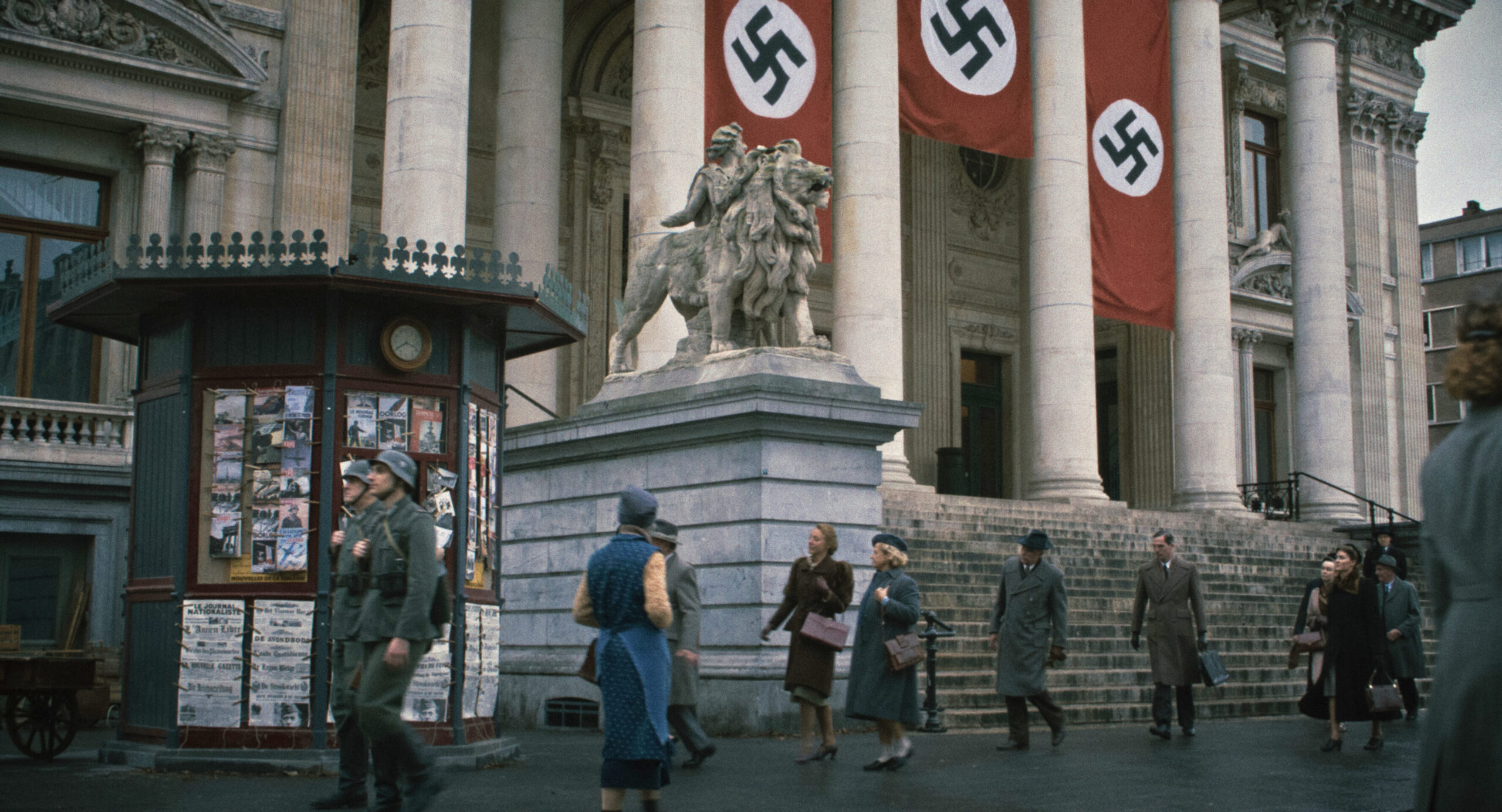
© Frakas Productions/Rectangle Productions/Goodfellas
His visual approach was influenced by François Truffaut’s Le Dernier Métro, set in a theatre where a Jewish director hides from the Nazis.
“Everything plays within the four walls of the theatre. There’s a scene in which Gérard Depardieu’s character leaves to make an attack. We see him go and come back later. We know he did it, but we don’t follow him. In every other movie, we would and we’d see the attack. But we’re stuck in the cellar like the director."
“With Le Faux Soir the camera is always in the middle of the Resistance bubble. We never went into a scene with the bad guy, the collaborator or the Nazi. If the enemy comes towards us, I hide. I use a long lens. If we're outside, we’re discreet. We hide as much as we can to avoid compromising our characters.”
The film does have its lighter moments: Roskam describes it as “a very serious film about very funny people.”
“Humour is by its nature an act of resistance,” he continues. “It helps you to battle the negative feelings you have. Existentially, it is resistance. Maybe some philosopher already knew this, but I’ve just found out!”
There were certain challenges in making a film set in 1943. The German uniforms were relatively easy to find, but the only realistic-looking newspaper vans were badly damaged: they needed repairs and a temporary engine.
“They couldn’t do more than a hundred metres without it exploding!” he says.
Le Faux Soir is something of a love letter to the golden age of newspaper production. Despite being a journalist himself before breaking into film, at Flemish daily De Morgen, Roskam admits he knew practically nothing about how newspapers were printed.
“I fell in love with the magic of it,” he recalls. He visited the printing department at the Museum of Industry in Ghent and discovered the joys of a “hot metal” press using linotype, a typesetting machine that uses a 90-character alphanumeric keyboard. “Like, wow, that is a machine.”
For the film, he found a Goss printer at a museum in Le Malesherbois, south of Paris. “It’s 45 tonnes of steel and it still runs. It’s beautiful. We built a whole print shop around it at the museum to recreate the workshop of Le Faux Soir printer Ferdinand Wellens.”
The team located another original, working press at Le Démocrate de l'Aisne in Vervins, Hauts-de-France. The last weekly newspaper set with a linotype, it uses a rotary printer dating from 1924. “We used that for the other print-shop in the film, belonging to Jean Plas. We barely needed to change anything.”
Before everything gets too inky and geeky, it seems apposite to ask him if he thinks the Belgian Resistance has been over-shadowed by the better-known French Resistance.
“It’s true,” he says. “I think it's because the French had a collaborating government in Vichy. Their Resistance was not only fighting against the Germans; they had to fight French people, too. Some chose to work with the Nazis.”
The complexities of collaboration
The Belgian situation was more complex still.
“You had these two groups. The Walloon collaborator, who had a purely fascistic, ideological love affair with Nazism," he says. "Then you have the Flemish and their favourite subject of how the war was an opportunity to emancipate themselves as a people, their language and social identity that they felt was suppressed by the French-speaking elite."
"You have to remember the Germans are our cousins," Roskam says. "We can almost understand each other when we speak. There’s also our Catholicism. Even if the big enemy was communism and Hitler was an atheist, all his powerhouses were southern Catholic generals.”
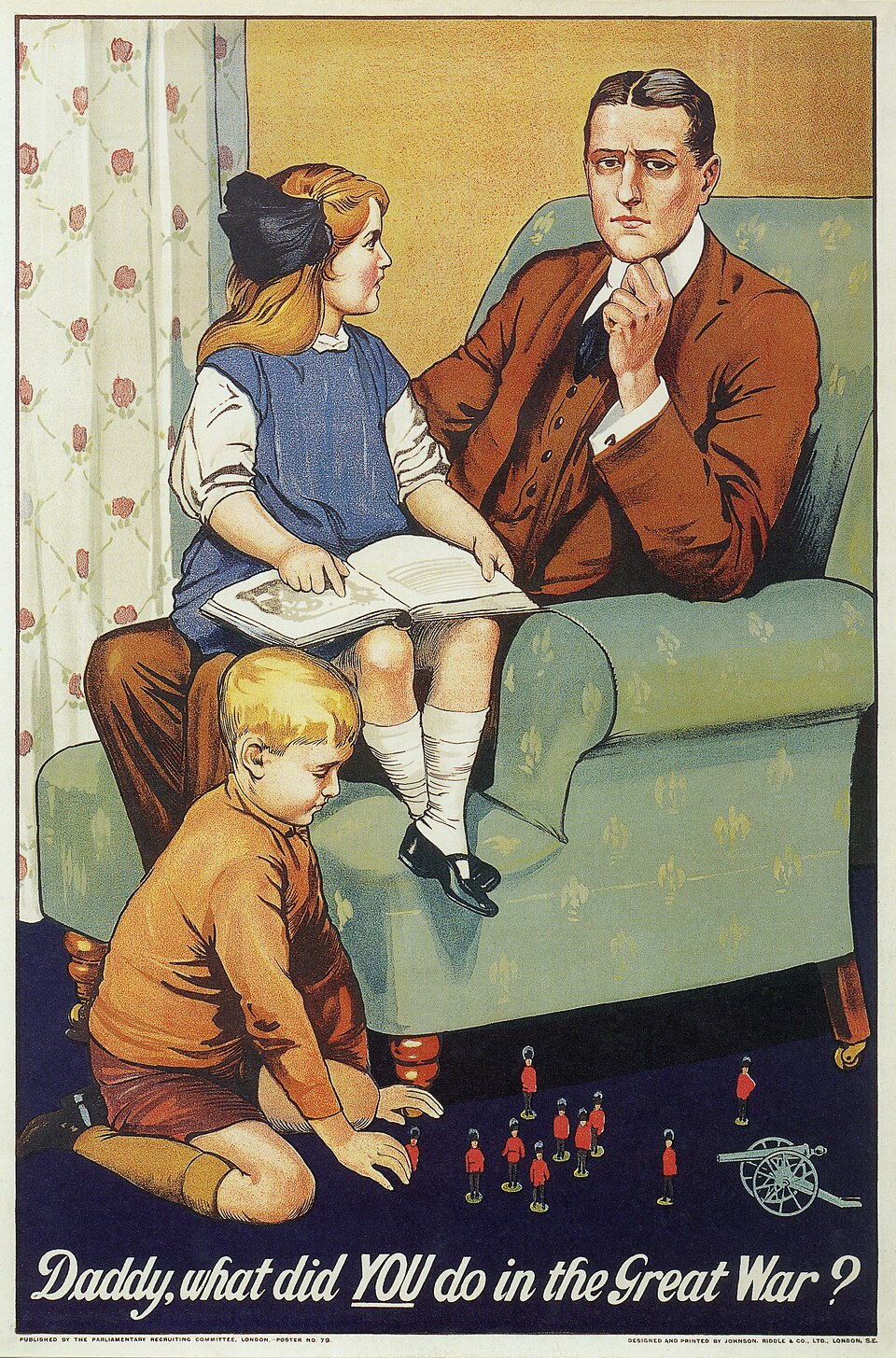
An estimated 150,000 Belgians engaged in the Resistance during the war, around two percent of the country’s then eight million population.
The comparable figure in France was around 400,000 – equivalent to one percent of its 40 million population. So, comparatively speaking, the resistance in Belgium had stronger support.
“Yes, but I think the Belgian attitude is also a factor. We’re one of those smaller countries with a history of repression and oppression and being occupied. We battle with humour and don’t necessarily choose to step up. Because you might be a hero today, but tomorrow they’ll kill you for it. We've seen it too many times."
The price of defiance
More than a dozen of the figures behind the audacious stunt were arrested and sent to concentration camps. Ferdinand Wellens, who printed 50,000 copies of the two-page fake newspaper at his workshop in Rue de Ruysbroeck, together with accomplice Théo Mullier, did not return.
Guy Mottard, an 18-year-old cartoonist, was shot. The key instigator, Marc Aubrion, was due to receive the death penalty but his sentence was later commuted to a 15-year jail sentence. His health was permanently damaged from his incarceration and he passed away in Brussels, aged only 57, in 1968.
An attack from the air
The film also recalls the January 20, 1943 attack on Gestapo headquarters in Brussels by Jean de Sélys Longchamps, a Belgian RAF pilot who strafed the building on Avenue Louise.
Sélys Longchamps died months later, aged 31, in a landing accident in Kent. A bronze bust commemorates him near the former Gestapo headquarters.
Another more imagined episode in Roskam’s film depicts Leon Degrelle, real-life leader of the far-right Belgian francophone Rex party and head of the SS Légion Wallonie, played by Alexis Manenti, visiting Le Faux Soir’s printer, Ferdinand Wellens (an excellent portrayal by François Damiens).
The story’s first screen outing
The story reached cinemas once before, in Gaston Schoukens’s 1955 black-and-white film Un Soir de Joie, a comedy with a Belgian-French cast.
Schoukens celebrated the spoof newspaper as an expression of Brussels’ working-class zwanze humour. Audiences loved it, though some critics thought it too frivolous. A clip on YouTube shows a scene shot in the Forêt de Soignes.
Roskam has not seen the original. “I’ve heard it was a kind screwball comedy, but I didn’t want to see it.”
A paper that moved with the times
Le Soir was launched on December 17, 1887, in Brussels by Marie-Thérèse Rossel’s grandfather Émile and two friends. Its first headquarters were at Rue d’Isabelle 42, with the newsroom two doors away at number 46. The paper was initially free for readers living in ground-floor accommodation.
In January 1898, the administration moved to Place de Louvain 23-35, the address used on the title masthead until August 1914, when Émile’s son Victor was forced to suspend publication following the German invasion and occupation in the First World War. Le Soir ceased operations for more than four years, re-launching on November 18, 1918.
From October 1919 an editorial ‘salle des dépêches’ address at Rue Royale 124 appeared on the title and, by 1923, the paper was producing four editions a day. It also listed offices at Rue de la Bourse in Paris and in London’s Fleet Street.
In 1935 Victor died and the family empire passed to his 24-year-old daughter Marie-Thérèse. She halted printing on May 17, 1940, a week after the Germans invaded Belgium again. The paper was re-launched with collaborationist staff on 14 June 1940, with a newsroom and print shop set up at Rue du Marais (Wildstraat) 20.
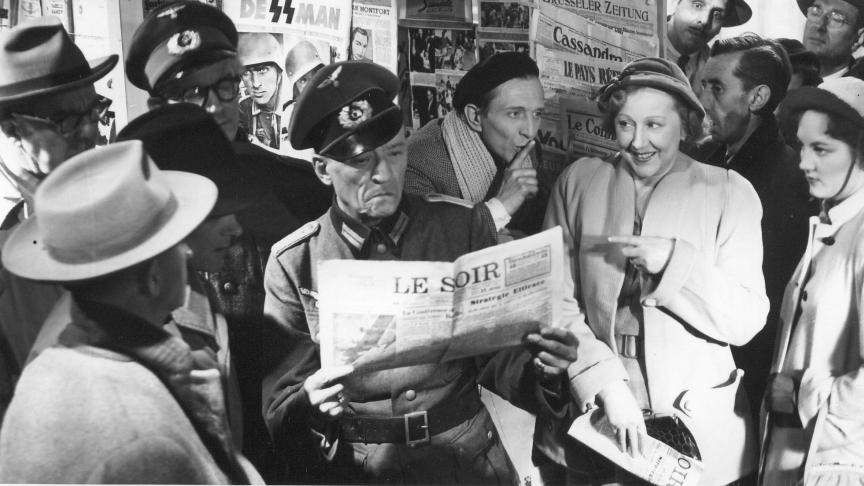
© Frakas Productions/Rectangle Productions/Goodfellas
The address on the title changed to Place de Louvain 21 in February 1942. By early 1943, with newsprint in short supply, Le Soir had shrunk to two pages (which made things a bit easier for the Resistance to produce its spoof version).
The paper was relaunched on September 6, 1944 after the liberation, labelled as “Le Vrai Soir, probe et libre” (steadfast and independent), and switched back to its pre-war address of Rue Royale 124.
As Le Soir expanded, it updated its address to Rue Royale 122 in December 1956, only to revert to Place de Louvain 21 the following year.
Marie-Thérèse Rossel passed away on June 18, 1987 – close to a century after her grandfather founded the paper. The ownership passed to her cousin Patrick Hurbain.
The company started printing Le Soir in Nivelles in 2005, while its editorial base since 2007 has been Rue Royale 100.
