
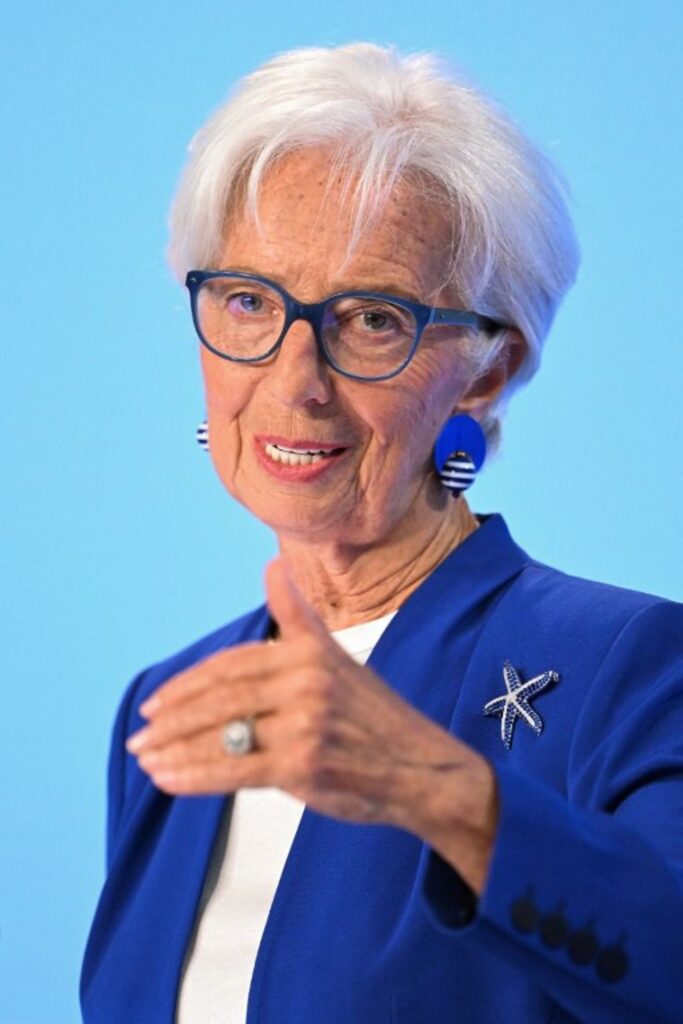
The European Central Bank left interest rates unchanged on Thursday, saying uncertainty linked to renewed hostilities in the Middle East justified a pause after June’s increase, although a fresh energy shock could still force another rise in September.
The deposit rate, the ECB’s key benchmark, remained at 2.25% after a quarter-point increase in June, the first rise since 2023, prompted by higher energy prices.
The Frankfurt-based institution has opted for a summer pause despite the collapse of the truce between Iran and the United States in early July, which reignited attacks on both sides and led to another closure of the Strait of Hormuz, a vital route for global oil and gas trade.
Prolonged war in the Middle East could fuel higher inflation, Lagarde warns
For now, the ECB says, energy price prospects, although highly volatile, remain close to the baseline scenario in its June forecasts.
However, ECB President Christine Lagarde warned at a press conference that a prolonged war in the Middle East could lead to higher inflation than previously expected.
“The energy shock could intensify, and its effects on prices and wages could be stronger than expected,” she said.
Uncertainty remains high
The ECB also warned that uncertainty remains high and that the full inflationary impact of the energy shock has not yet fully emerged.
The bank is treading carefully as the eurozone economy remains fragile. Its decision to raise rates in June was criticised by many commentators, who argued it risked weakening an already subdued recovery across the 27-member bloc.
At the same time, if the ECB waits too long and tensions between Washington and Tehran continue to escalate, rising energy costs could hit households and businesses more severely.
Houthi attacks expand conflict and push oil prices up
Concerns were heightened further on Thursday when Yemen’s Iran-backed Houthi rebels claimed attacks in the Red Sea on Saudi oil tankers.
The attacks, which expanded the conflict’s reach, pushed Brent crude above 100 dollars a barrel on Thursday.
Lagarde said some ECB governors had considered raising rates in July, but the final decision to hold was unanimous.
Even so, Thursday’s decision appeared to strengthen expectations of a rate rise in September.
September rate hike viewed as 'almost certain'
Carsten Brzeski of ING said such a move now looked “almost certain”, unless oil prices begin to fall sharply in the coming weeks.
He argued that the ECB had “lacked courage” by delaying the decision and had not wanted to break with its well-established practice of avoiding surprises for markets.
As usual, Lagarde said the ECB would decide the direction of monetary policy “meeting by meeting.”
In its statement, the Governing Council said it was closely monitoring the intensity and duration of the shock, as well as its indirect and second-round effects.
Inflation projections could well be revised
Under its June baseline scenario, the ECB expects overall inflation to reach 3% in 2026, though it may revise those projections again in September given the rapidly changing situation.
Under the more optimistic “moderate” scenario, inflation would come in at 2.9%.
“The situation can reverse so quickly that it is difficult either to confirm or to dismiss the possible materialisation of this moderate scenario,” Lagarde said.
The world's major central banks to meet next week
Positive inflation data for June, which showed a fall to 2.8% from 3.2% in May, are already “completely useless” for judging what comes next, according to Eric Dor, director of economic studies at IESEG School of Management.
The ECB was the first major central bank to raise interest rates after the outbreak of the war in late February.
The Bank of Japan followed a few days later, lifting rates to their highest level in 31 years, while the US Federal Reserve and the Bank of England have so far held back.
All three institutions are due to meet in the final week of July.
