
Amichai Chikli, a member of Israel’s governing Likud party and Minister for Diaspora affairs and Combatting Antisemitism, was invited to give a key-note speech in the European Parliament on Tuesday but cancelled it on Sunday evening quoting security concerns.
The meeting was supposed to take place at the occasion of the International Holocaust Remembrance Day and was titled ‘Never again? Indoctrinating hatred of Jews: What has changed in 80 years?’. Two MEPs, both from the European People’s Party, Andrey Kovatchev (EPP, BG) and Lukas Mandl (EPP, AT) co-hosted the event.
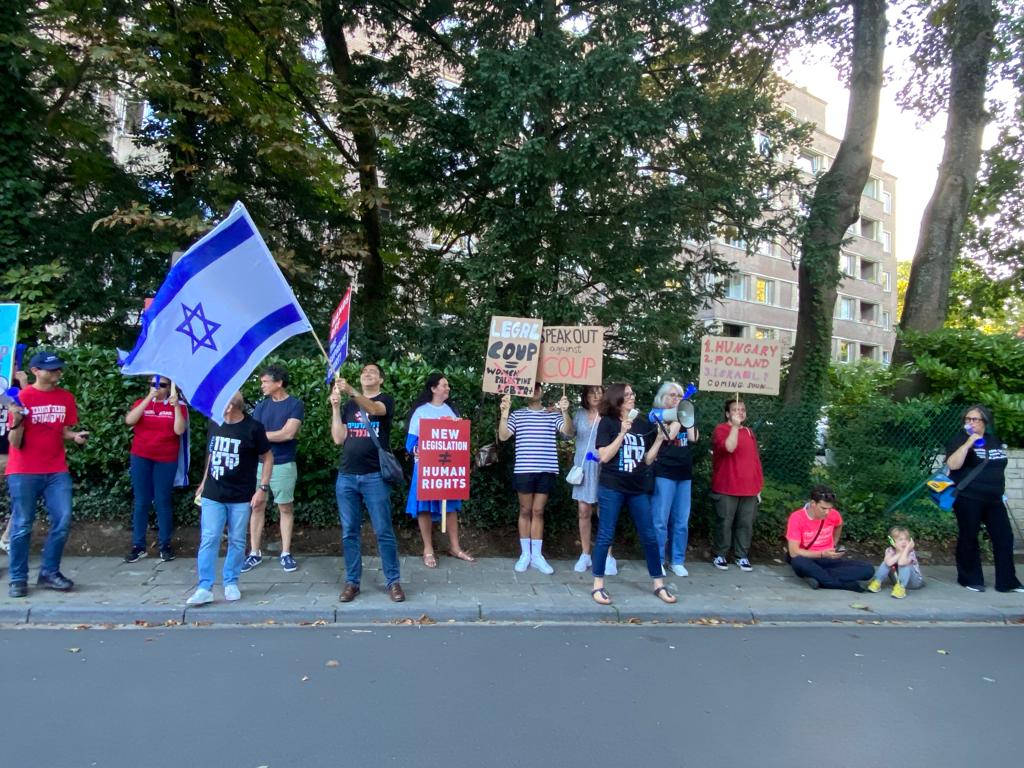
The Israeli minister has visited Brussels before. He was met by pro-democracy demonstrators in September 2023 protesting against the government’s plan for a controversial judicial overhaul of checks and balances in the country. The plans were partly suspended during the war following Hamas’ terrorist attack on Israel on 7 October 2023 but have been revived again by the government.
This time his planned visit triggered protests by MEPs, families of the Israeli hostages and representatives of Jewish liberal communities across Europe.
In a letter addressed to the two co-hosts and copied to Manfred Weber, President of the EPP Group, and Roberta Metsola, President of the European Parliament, the families and representatives expressed their concerns regarding his invitation.
Chikli was one of two Likud members in the coalition government who voted against the recent ceasefire-hostage deal between Israel and Hamas. He has even supported the expulsion of populations from both Gaza and South Lebanon, according to the letter.
He twitted on X that he decided not support the ceasefire-hostage deal after he was exposed to the list of convicted terrorists who would be released in the first phase of the deal in exchange for hostages and his fear that they would revert to terrorism. But he hoped his decision will prove to be wrong. In fact, prisoners with life-long sentences for terrorist attacks are deported to other countries.
He has also expressed support for far-right politicians in the EU, “whose rhetoric and policies often undermine the fight against antisemitism and hatred.” His “extremist and divisive positions do not reflect the values or voices of the broader Israeli public or global Jewish communities,” the signatories claim.
Swedish MEP Evin Incir (S&D) called on her colleagues to co-sign a letter to Parliament President Roberta Metsola to rescind the invitation to Chikli. “Antisemitism is a real and rising threat that requires unity and solidarity to combat. By inviting figures whose actions risk alienating key communities, we may inadvertently undermine our collective efforts.”
In their reply to the protest letter, written before the cancellation of Chikli’s visit, the two MEPs stood by their invitation. “Likeminded colleagues like us consider Israel as strong partner state. We advocate, among others, strengthening the EU-Israel Association Council agreement. We do not involve ourselves in domestic politics in Israel. We have welcomed each and every representative of Israel.”
As regards the EU-Israel Association Council, a high-ranking EU official said last Friday that there are still discussions going on among EU Member States on a common position but he expects them to agree and that the meeting will take place in a month from now.
Brussels-based Rabbi Menachem Margolin, chairman of the European Jewish Association, was also invited to speak. Asked by The Brussels Times why Chikli was invited, considering his vote against the ceasefire, he replied that his organisation cooperates with every Israeli minister and official representative.
“This is specially true,” he added, “when the minister’s visit to the European Parliament was intended to clarify the extent to which EU’s humanitarian mobilization does not reach the Palestinian population but rather the terrorist organisations.” According to the ceasefire deal, Israel is required to significantly increase the access to much needed humanitarian aid into the Gaza Strip.
A weakness in the phased ceasefire-hostage deal is that minor disagreements about the implementation can easily derail the first phase and provide pretexts for not continuing to next phase to permanently end the hostilities. Despite different incidences, as those that happened on Saturday in the second release of hostages, the ceasefire is all in all holding, the EU official said.
The latest word is that the meeting in the European Parliament has been cancelled. The European Jewish Association commented that the cancellation of minister Amichai Chikli’s visit to a Western European country for security reasons is evidence that the declarations of ‘never again’ are hollow.
M. Apelblat
The Brussels Times
