
American bomb planes struck three nuclear sites in Iran on Sunday morning after days of uncertainty if a diplomatic solution would be found following a meeting in Geneve on Friday between European foreign ministers and their Iranian counterpart.
The B-2 stealth bombers flew to the region on Saturday with a load of GBU-57 Massive Ordnance Penetrator bombs capable of destroying the most critical Iranian underground nuclear site in Fordo. The strike came as a surprise as it was believed that Iran would relent and agree to a diplomatic solution to dismantling its nuclear capabilities.
US President Donald announced early Sunday that the attack had been successful and “Iran’s key nuclear enrichment facilities have been completely and totally obliterated”.
“Our objective was the destruction of Iran’s nuclear enrichment capacity and a stop to the nuclear threat posed by the world’s number one state sponsor of terror,” he said. “Now is the time for peace,” he added, but warned Iran of a “tragedy” if it would not choose peace.
Iran responded to the US strike with a barrage of ballistic missiles against Israel which sent the population into shelters. Most missiles were intercepted but a few places were hit and reportedly 20 persons were injured.
Even if the nuclear sites were completely destroyed, which Iran denies, the issue of the uranium remains and can only be resolved by diplomacy. The International Atomic Energy Agency (IAEA) has reported that ca 400 kg of uranium has been enriched to 60 %. It does not require many centrifuges and time to enrich it further to 90 % which is enough for 10 nuclear bombs.
This weapon-grade uranium has probably been moved from the nuclear sites that were bombed and is hidden somewhere in Iran.
Iran’s foreign minister Abbas Araghchi wrote on social media that Iran had a legitimate right to respond to US attacks on its nuclear facilities and warned, “Iran reserves all options to defend its sovereignty, interest, and people.” He accused the US of violating the UN charter, international law and the non-proliferation treaty (NPT) by attacking Iran’s nuclear sites.
“The events this morning are outrageous and will have everlasting consequences. Each and every member of the UN must be alarmed over this extremely dangerous, lawless and criminal behavior."
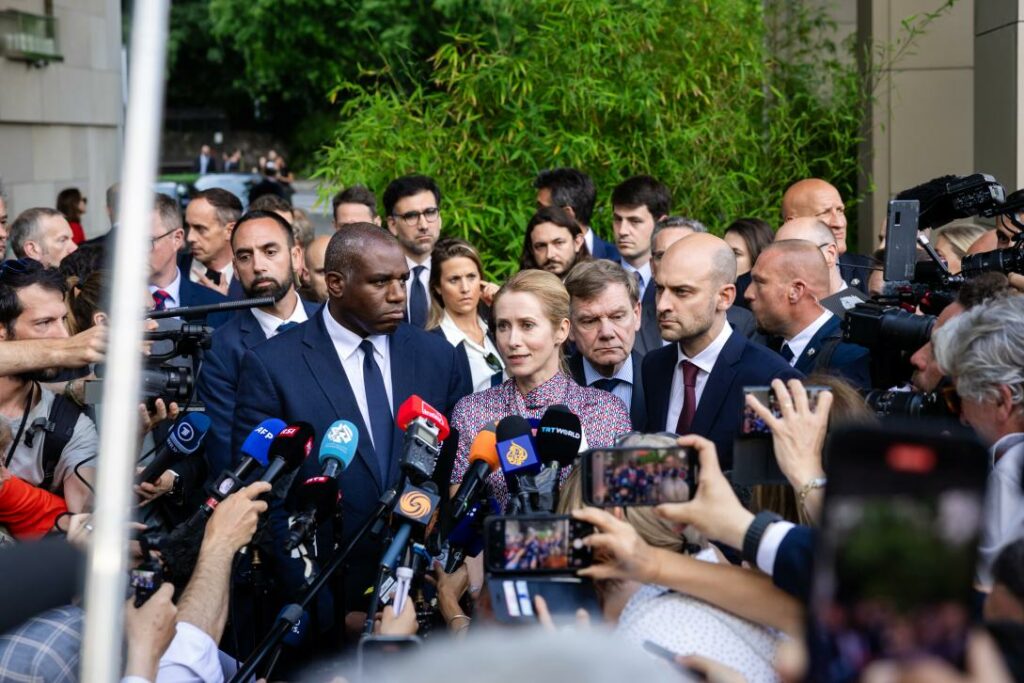
The Iranian foreign minister met EU’s High Representative Kaja Kallas and the foreign ministers of France, German and UK (E3) in Geneve on Friday for talks on a diplomatic solution. After the talks, the European foreign ministers and the High Representative issued a joint statement where they called on both sides to “urgently find a negotiated solution to ensure that Iran never obtains or acquires a nuclear weapon”.
The reiterated their longstanding concerns about Iran’s expansion of its nuclear programme, “which has no credible civilian purpose, in violation of almost all the Joint Comprehensive Plan of Action (JCPOA) provisions”.
Aragchi, the Iranian foreign minister, reacted after the talks on Friday that he was open for a dialogue with the EU but that negotiations with the US on a diplomatic solution could only be resumed if Israel stopped it attacks against Iran.
UN Secretary-General Antonio Guterres wrote on X that he was “gravely alarmed by the use of force by the United States against Iran today . . . This is a dangerous escalation in a region already on the edge – and a direct threat to international peace and security . . . At this perilous hour, it is critical to avoid a spiral of chaos. There is no military solution. The only path forward is diplomacy. The only hope is peace.”
