
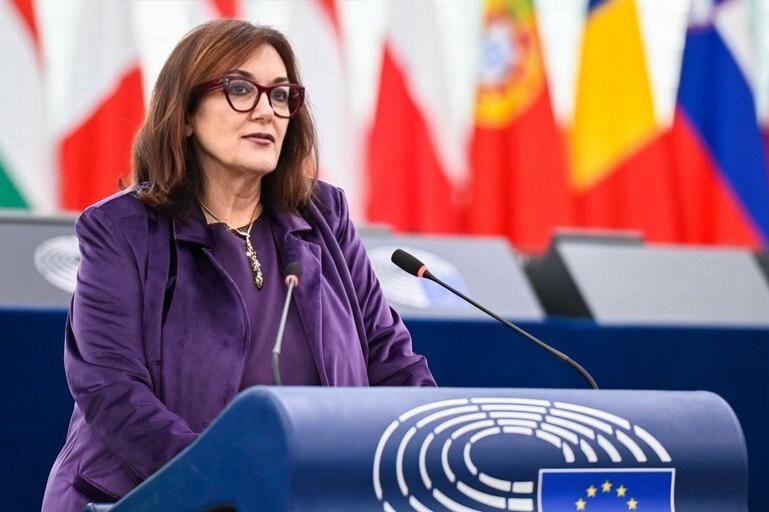
The EU-Southern Neighbourhood Ministerial Meeting took place on Monday in Brussels ahead of the Foreign Affairs Council and was described as historical by Dubravka Šuica, Commissioner for the Mediterranean.
Her tasks are new and were established in the second von der Leyen Commission. According to the mission letter, her overall task is to “create a common and people-centred agenda and develop partnerships with the Mediterranean region and countries across its Southern Neighbourhood based on common values and dialogue”.
In that role, she leads the work on a New Pact for the Mediterranean, working together with Kaja Kallas, the High Representative for EU foreign affairs and security policy. Linked to that is also EU’s migration policy and the fight against smuggling and irregular migration across the Mediterranean Sea.
She is also supporting the High Representative on an EU Middle East Strategy “with a view to the day after the war in Gaza, focusing on promoting all the steps needed for a two-state solution”. The tasks include “contributing to developing, with international partners, a dedicated reconstruction plan for Gaza”.
In addition, she supports the High Representative on the implementation of the Gulf Strategy and advancing work on strategic partnership agreements with each of the six Gulf countries.
The new Pact on the Mediterranean is one of the key priorities of the European Commission. The ministerial meeting aimed at providing a new impetus to the EU engagement in the Mediterranean region.
The Pact is currently in preparation by the Commission and the European External Action Service (EEAS) in consultation with partner countries, EU member states, and local authorities, civil society, academia, research institutions, the business sector, and other interested parties from both the EU and the Southern Mediterranean region.
“The Pact is being developed through a broad and inclusive consultation process involving also regional stakeholders and NGOs,” she told The Brussels Times. “The involvement of these actors, which includes also the Anna Lindh Foundation, will be key to its successful implementation. It’s vital to ensure a sense of ownership and responsibility for the successful delivery of the Pact.”
The Pact was also on the agenda of the foreign affairs council (15 July), alongside discussions on the Middle East, Iran, Syria and Libya. “Ministers agreed to intensify cooperation around three strategic priorities, which form the foundation of the Pact.”
“First priority is people-to-people ties – including mobility, education, culture, and youth engagement; second is economic development and connectivity – including investment, energy cooperation, and the green transition, and finally security, stability, and migration management – through deeper cooperation to foster security and combat terrorism and organised crime.
How are the consultations on the new pact going and what is the timeline for them? “The aim of these consultations is to shape a concrete, respectful, and lasting partnership that reflects the shared aspirations and priorities of both the EU and our Southern partners,” she replied. “This means going beyond broad principles to define together initiatives and flagship projects that can deliver tangible results.”
“We have engaged closely with our Member States and Southern partners as well as with our partners in the Gulf in designing the Pact,” she added. “This was also the first Ministerial meeting with our Southern partners under this Commission, a strong signal of renewed political momentum and mutual commitment.”
“All partners around the table provided support for the Pact, to foster stability and prosperity on both sides of the Mediterranean. The timeline moving forward is clear: we are consolidating input from the consultations and preparing to present the Pact for the Mediterranean in mid-October, ahead of the 30th anniversary year of the Barcelona Declaration in November.”
The Barcelona Declaration in 1995 launched EU’s partnership with the region and established a multilateral cooperation between the EU countries and the countries of the Mediterranean. “It’s both a symbolic milestone and a clear reminder that the world has changed since 1995, and our tools and approaches must evolve accordingly.”
“We need a Pact that addresses the scale and complexity of today’s challenges,” Commissioner Šuica said. “The region faces ongoing conflicts, economic fragility, demographic pressures, the climate crisis, and growing inequalities. These are no longer isolated issues; they are interconnected and affect both shores of the Mediterranean and beyond.”
“The Pact aims precisely to address this shift. It is about reforming and modernising our priorities, working methods, and models of cooperation. The goal is to build a more focused, effective, and strategic partnership.”
Will irregular migration across the Mediterranean be dealt with in the new Pact? “Migration management and protection is one of the key priorities under the Pact. Our goal is a comprehensive, partnership-based and whole-of-route approach that promotes stability, offers real opportunities, and ensures humane and effective migration governance between the EU and partners.”
“The contributions from the Member States stressed that the flagship initiatives of the Pact should contribute to addressing the drivers of irregular migration and forced displacement. They will aim at creating jobs through investments and matching them with skills through tailor-made trainings for enhancing mobility of workforce, supported through legal pathways.”
You are also in charge of EU's role in the reconstruction of Gaza "the day after". Has your directorate-general drafted any assessment on the reconstruction needs?
“Gaza and its people suffer immensely. Both Palestinians and Israelis deserve to live in peace, security, and dignity,” she replied. “Before addressing recovery and reconstruction, there must be a permanent ceasefire. All parties have a political responsibility to make this a reality.”
“The EU stands ready to continue discussions on this basis with the wider international community, while seeking further assurances on governance, security, and cost-sharing before moving to concrete pledging. We are working towards the establishment of a donor coordination platform, where these open questions can be addressed in a structured way.”
The Commissioner referred to the upcoming high-level political conference in New York on the implementation of the two-state solution. The conference, which was postponed due to the Israel-Iran war in June, is now planned for 28-29 July. “It will be an important forum to further engage on Gaza’s future reconstruction, the two-state solution, and the broader future of Palestine.”
