
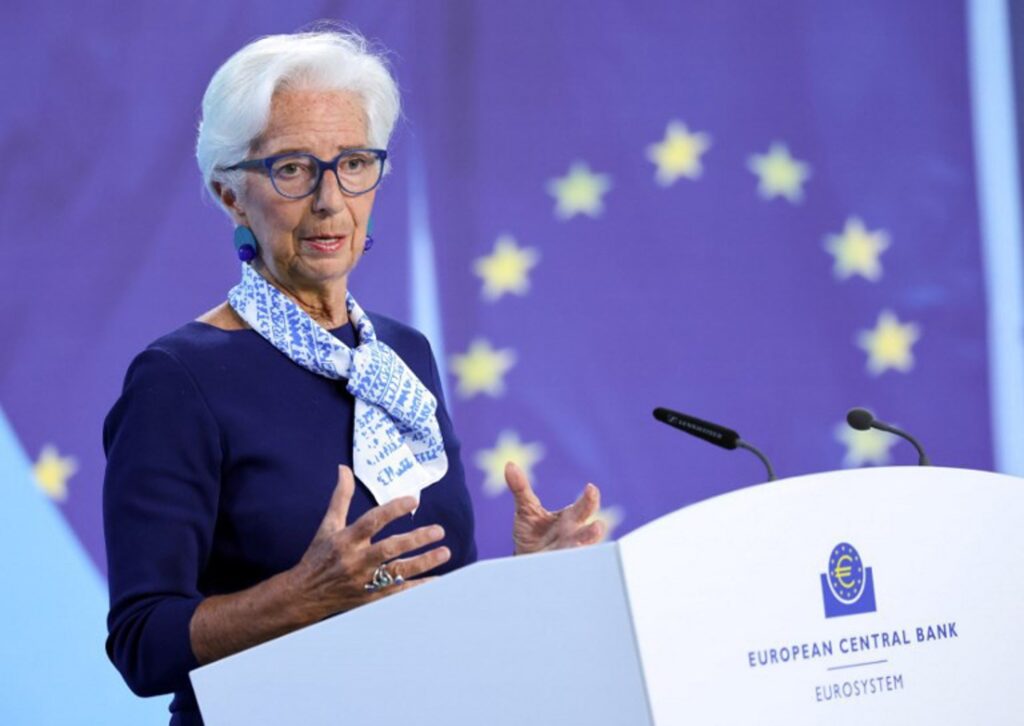
The newly agreed trade deal between the European Commission and Washington has eased global uncertainty but has not eliminated it, European Central Bank (ECB) President Christine Lagarde said on Wednesday in Geneva.
Speaking at a meeting of the World Economic Forum, Ms. Lagarde noted that uncertainty remains, particularly regarding tariffs on pharmaceuticals and semiconductors, which are still not clearly defined.
In late July, the European Commission and the US agreed on a 15% tariff for European exports to the United States, with hopes for exemptions in specific sectors.
This agreement was reached just days after the ECB’s monetary policy meeting, at which it decided to keep interest rates steady after a prolonged period of cutting rates, reflecting a cautious approach amid heightened trade tensions.
According to Lagarde, the average rates currently stand between 12% and 16%, which is slightly higher but still close to the projections made by the ECB in June.
At that time, the Frankfurt-based institution had lowered its Eurozone inflation forecasts to 2.0% for 2025 and 1.6% for 2026, citing declining energy prices and a stronger euro.
The ECB also anticipated Eurozone GDP growth would fall slightly below earlier expectations, predicting a 1.1% growth rate in 2026.
The central bank had prepared for a more pessimistic scenario involving tariffs exceeding 20%.
Lagarde assured that the ECB’s updated inflation and growth forecasts, due mid-September, will incorporate the impact of this trade agreement.
In its latest outlook, the ECB has forecasted a slowdown in Eurozone economic activity for the third quarter, following a strong start to the year.
Meanwhile, US President Donald Trump has recently issued repeated threats to impose additional tariffs on key sectors such as pharmaceuticals, which account for 20% of European exports to the US.
