Amid concerns about the fragile ceasefire in Gaza and the implementation of Trump’s peace plan the unstable situation in Lebanon has come to the forefront again and raised concerns about a military escalation.
Following Israeli strikes against Hezbollah military targets in Lebanon, EU’s foreign affairs spokesperson Anouar El Anouni said on Friday that all parties must focus on preserving the ceasefire in the country and the progress achieved so far. This did not have any effect and the strikes continued on Monday.
“The EU calls on Israel to cease all actions that violate (UN Security Council) resolution 1701 and the ceasefire agreement reached a year ago in November 2024,” the spokesperson told The Brussels Times. “At the same time, we urge all Lebanese actors and especially Hezbollah to refrain from any measures or responses that could further inflame the situation.”
The ceasefire between Lebanon and Israel entered into force on 27 November last year but has not been fully implemented despite the deadline was extended to February this year. The Lebanese army was supposed to be deployed in southern Lebanon and replace Hezbollah there. Israeli troops should have completed its withdrawal but still keeps five positions on the Lebanese side of the border.
The Lebanese president, Joseph Aoun, a former commander in chief of the Lebanese armed forces, was elected last January on promises to reform Lebanon’s dysfunctional government institutions and affirming the state’s monopoly on arms. Hezbollah should have been disarmed by now. Israel says that Hezbollah is trying to rebuild its military capacity which was heavily decimated in the war following 7 October.
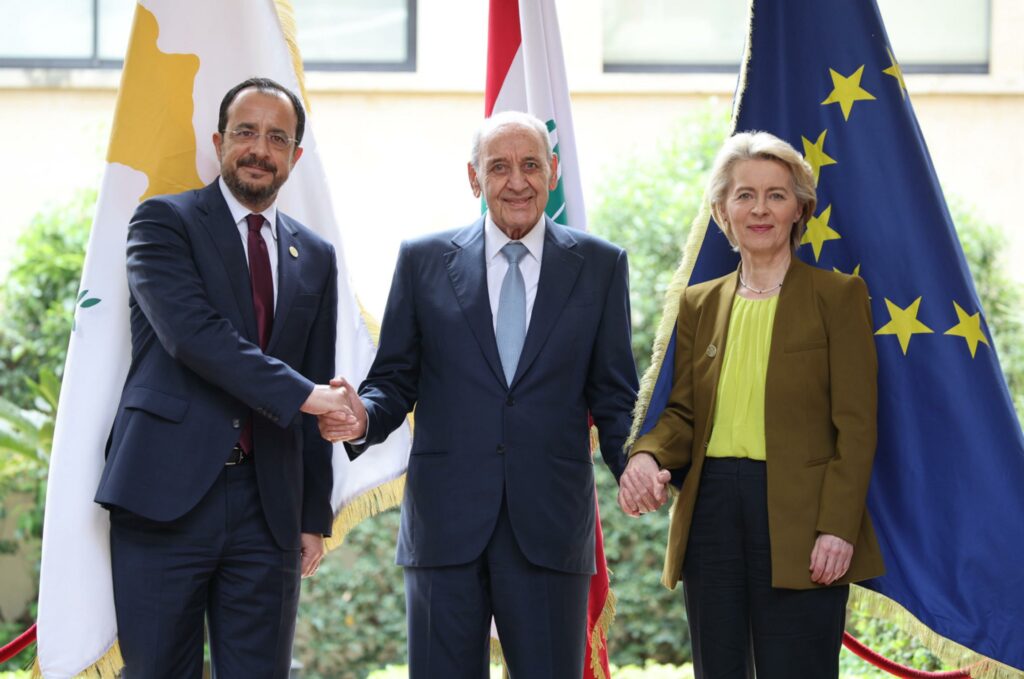
Already before the ceasefire entered into force, the EU committed to support the Lebanese army with equipment and training for border management and to fight against smuggling. As previously reported, Commission President von der Leyen announced at her visit in Beirut in April 2024 that the EU will provide a financial assistance package for Lebanon worth €1 billion in grants for 2024 to 2027.
Just before the ceasefire was agreed, former High Representative Josep Borrell also met Joseph Aoun and twitted on X that, “Nobody should take the Lebanese people’s sovereignty hostage, be it from the inside or the outside,” referring to both Hezbollah and Israel. He said that the EU is ready to devote €200 million to strengthen and train the Lebanese army so that it would be able to fulfill its role.
In reality, the sum is less. Most of EU’s financial assistance to Lebanon is designed to improve the overall economic situation of the country and to support good governance and reforms, economic resilience, and sustainable recovery in Lebanon.
The Commission said earlier this year that the first half of the financial assistance package was adopted in July 2024 and that the second half would be adopted at a later stage, taking into account progress on necessary reforms and the overall situation.
The Lebanese army would benefit of a total amount of €70 million under the package during 2024 - 2025. In addition, the EU provided €15 million for the Lebanese army in 2024 and another €40 million have been earmarked for this year under the European Peace Facility (EPF). The Commission did not reply to questions how much has been disbursed until now to strengthen the army.
Can the Lebanese army disarm Hezbollah? Dr Moran Levanoni, an expert on Lebanon and researcher at the Israeli Institute for National Security Studies (INSS) doubts it.
“The Lebanese army is one of the weakest and most underfinanced armies in the world. Its soldiers earn less that Hezbollah fighters. Up to 40% of the soldiers, including senior officers, belong to Shiite community who do not see Hezbollah as their enemy and leak information to them,” he told The Brussels Times. “The disarmament of Hezbollah has not even been approved by the government.”
The aggressive Israeli policy, reacting against the slightest violation of the ceasefire agreement by Hezbollah, seems counter-productive. “Despite the Israeli attacks, Hezbollah manages to recover and build up its strength again,” Levanoni says. “Israel has not managed to stop the smuggling of weapons, which continues, both by land and by sea."
The disarmament has mostly taken place south of the Litani river but it should have taken place throughout Lebanon. He estimates that only 10% of the smuggling of weapons is currently stopped and draws also the attention to the smuggling of drugs, among them captagon, which finances Hezbollah and is produced in Syria and in the Beqaa valley in Lebanon.
The US is mediating in the conflict. Can the EU play a more active role? “EU’s financial assistance to the Lebanese army is far from enough to equip and strengthen the army,“ he replied. Instead, he recalled EU’s Naval Force Operation Irini. It continues to operate in the Mediterranean See to enforce the UN arms embargo on Libya after its mandate was extended until 31 March 2027.
If its mandate would be amended, Irini could possibly also prevent smuggling of weapons to Hezbollah. Its mandate would also have to be amended to enforce the embargo on weapons to both sides in the civil war in Sudan. Asked about Irini’s mandate, the Commission declined to comment.
As long as Israel has not completed its withdrawal and continues the air strikes, Hezbollah can present itself as a resistance movement defending Lebanon. Only a political solution would break this vicious circle.
