
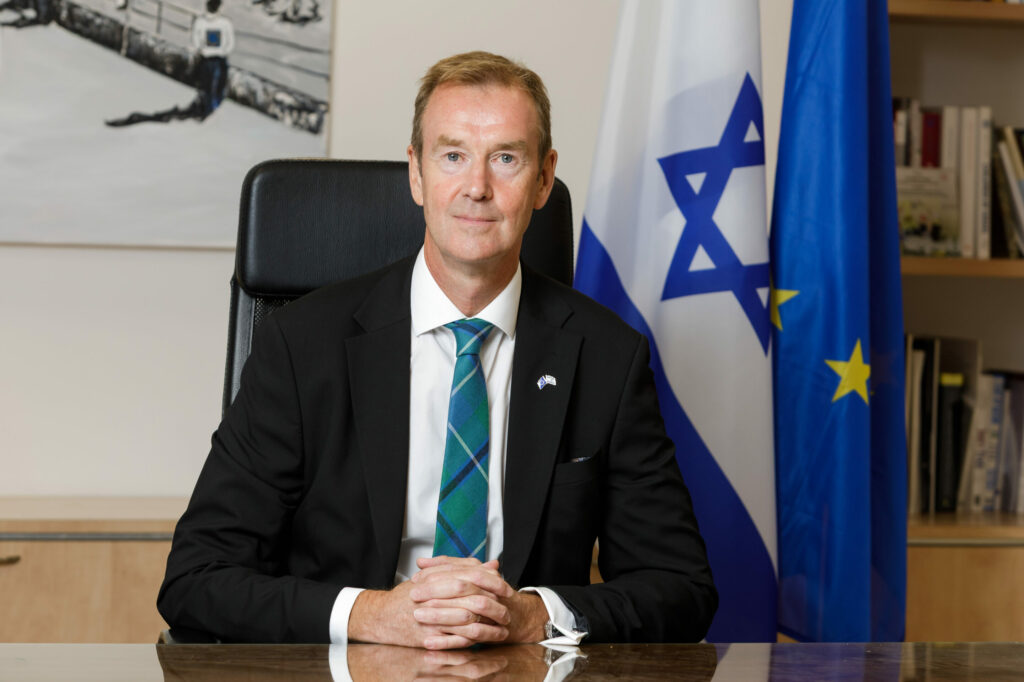
Michael Mann, the EU’s new Ambassador to Israel, faces two main challenges in his post in Tel Aviv: how to improve the EU’s tense relations with Israel and how to use its leverage and toolbox to contribute to the implementation of US President Trump’s peace plan, including the pathway to the two-state solution.
A former journalist turned diplomat, with double British-German citizenship, he started his career in the EU in 2002. During 2011 – 2014, he was chief spokesperson for former High Representative Catherine Ashton. He has been EU Ambassador to Iceland and special envoy for the EU’s Arctic policy at the European External Action Service (EEAS).
The latter continues to be a hot topic for both geopolitical and climate change reasons. He participated in The Brussels Times' webinar in May 2021 on how to align EU’s Arctic policy with the European Green deal. Since then, global warming has continued and is threatening the ice shelves in the Arctic and Antarctica.
In the last three years, Michael Mann was head of the department at EEAS responsible for Israel, the occupied Palestinian territory and the Middle East Peace Process. He presented his credentials to Israel’s President Isaac Herzog on 16 September.
As EU's new ambassador to Israel, did you feel relieved to start your mission after the war had ended in Gaza? How challenging is the current timing for your tasks ahead as ambassador?
“I have always been fascinated by Israel and the Middle East so I felt delighted and privileged to have been chosen to be the EU’s ambassador here,” he replied.
“When I arrived in Israel on 1 September, the ceasefire in Gaza hadn’t yet entered into force and the situation looked bad,” he added, referring to Commission President von der Leyen’s “State of the European Union” speech (10 September). In her speech, she announced a package of targeted measures against Israel after its army had launched a military offensive in Gaza City against Hamas.
“Then the ceasefire came into effect, which was of course fantastic news – the fighting ceased, humanitarian aid started flowing and by now all living hostages and the bodies of almost all the deceased hostages have been returned to Israel, which of course improved the mood in the country tremendously. Now our job is to do everything we can to help with the implementation of President Trump’s peace plan.”
Among others, a Civil Military Coordination Center (CMCC) has been established in southern Israel to facilitate humanitarian aid, monitor the Gaza ceasefire, and oversee stabilization efforts. Six EU countries (Cyprus, Denmark, France, Germany, Spain and Italy) are already participating in the center.
“The EU has also started to contribute to its work,” he said. “I just visited the center to which the EU has seconded a police officer and a military officer.”
However, the EU Border Assistance Mission to the Rafah Crossing Point (EUBAM Rafah) and EU Police Mission for the Palestinian Territories (EUPOL COPPS) are still on stand-by in Gaza. The latter mission is currently operating in the West Bank. The Rafah crossing has not been opened by Israel.
“In the meantime, the Member States are discussing the possibility to extend the activities of both missions so that they can play a significant role in implementing the peace,” he said. EEAS has also reportedly proposed to take the leadership in training the Palestinian police force in Gaza with a view to training thousands of police officers on behalf of the Palestinian Authority.
EU-Israeli relations continue to be tense, among others because of statements made by Israeli politicians and European Commissioners that do not necessarily accurately represent the common position of the EU.
Even the Israeli President, Isaac Herzog, who welcomed the EU Ambassador when he presented his diplomatic credentials, complained about statements made by EU leaders, including the Commission president. While stressing the importance of deepening Israel - EU relations, he argued about the humanitarian situation in Gaza.
In your meetings with the Israeli foreign ministry and other Israeli counterparts, do you feel that they listen to EU's viewpoints or are they in a denial mode? How do they understand EU's common position?
“All the people I meet, including from the ministry of foreign affairs, listen to what the EU has to say,” Michael Mann assured. “Contrary to the impression created by some media reports, our conversations are diplomatic, polite and frank. We have a common interest in discussing all issues, including ways to strengthen our bilateral relations and how to help implement President Trump’s peace plan.”
The EU is in a unique position to work with both sides in the conflict. “Israel and the EU are connected by long-standing historical, cultural and economic relations. We are also the largest donor to the Palestinian Authority and are supporting its reform programme.”
Trump’s 20 points plan foresees a reformed Palestinian Authority (PA). It says, “While Gaza re-development advances and when the PA reform program is faithfully carried out, the conditions may finally be in place for a credible pathway to Palestinian self-determination and statehood, which we recognize as the aspiration of the Palestinian people.”
The most immediate steps, that were vaguely mentioned in Trump’s peace plan, are the disarmament of Hamas and an UN agreement on the composition, mandate and deployment of the International Stabilisation Force (ISF) in Gaza. Without them, the reconstruction of Gaza can hardly get started.
“There has been progress in the reforms but there is still a lot to do,” Michael Mann admitted. Palestinian Authority President Mahmoud Abbas fired recently his finance minister who had continued to pay out allowances to families of convicted terrorists in Israeli prisons despite a commitment to cancel them.
The sanctions proposed by the Commission have not been adopted by the EU but are still on the table. Is it because of the new context after the ceasefire in Gaza or because of lack of unanimity/qualified majority among EU Member States?
“The measures are still on the table and we are yet to find the required majority,“ he replied. “But the circumstances have also changed since they were proposed by the Commission last summer.” The issue will probably be discussed when the Foreign Affairs Council later this week will discuss the latest development in the Middle East.
High Representative Kaja Kallas has focused on diplomatic outreach and keeping the channels open with Israel to improve the situation on the ground in Gaza. After the ceasefire, the Commission is not keen to push for any of the proposed sanctions, even those that are targeting extremist settlers and ministers that opposed the ceasefire and continue to incite to violence.
“Humanitarian aid has increased since the ceasefire agreement,” Ambassador Mann confirmed, “but we want to see a greater proportion delivered by international NGOs through the UN system”.
The American-led Gaza Humanitarian Foundation (GHF), which replaced the UN and NGOs after Israel resumed the war earlier this year, failed to deliver aid to those in need and Palestinians seeking aid at its few distribution centers risked their lives.
Aid figures are provided by an Israeli agency (COGAT) and cannot be independently verified. A senior EU official at the Directorate-General for European Civil Protection and Humanitarian Aid Operations was prevented last July from entering Gaza with UN staff to monitor if the aid deliveries complied with an understanding reached between the EU and Israel.
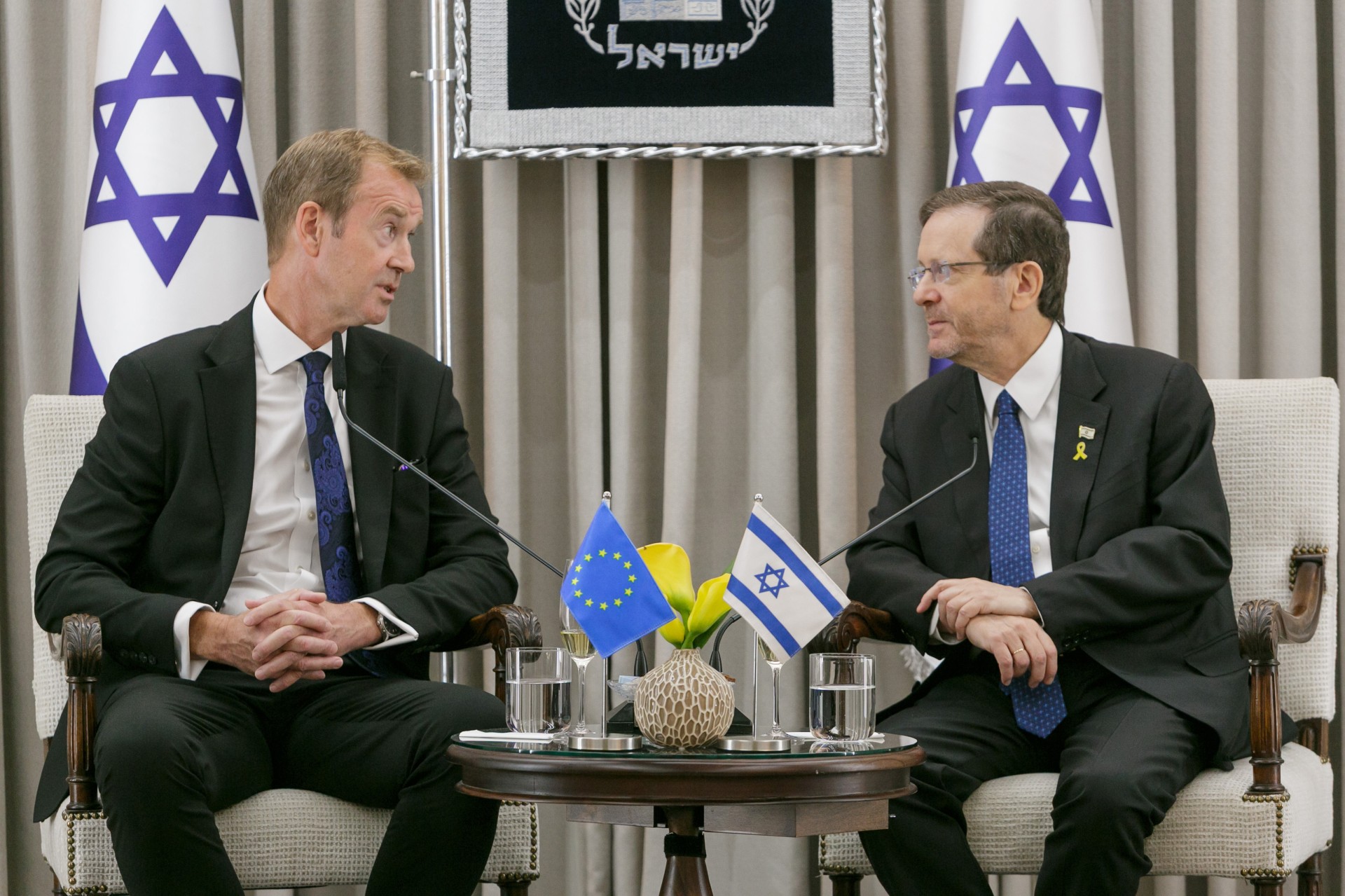
Israeli President Isaac Herzog with EU Ambassador Michael Mann, 16 September 2025, © GPO/Kobi Gideon
At their meeting, President Herzog told Ambassador Mann that Israel is open to any fact-finding mission and invited the EU to “come and sit down with COGAT, examine the figures—on calories, food shipments, UN distribution routes, and more”.
In the interview, Michael Mann repeated the EU’s demands that Commission staff and journalists should be allowed to enter Gaza. The registration of international aid organizations should be facilitated. Israel should also transfer the taxes which it is collecting on behalf of the Palestinian Authority and swiftly extend an agreement to transfer money via the Israeli bank system.
Israel is reportedly considering among others the EU demands on allowing foreign journalists into Gaza in the new context after the ceasefire entered into force. Until now only Israeli journalists were allowed, embedded with the Israeli forces and mainly reporting their viewpoints to raise morale in the country.
While the war in Gaza has effectively ended, except single incidents, the situation in the West Bank has deteriorated drastically. The violence perpetrated by settlers from illegal outposts against Palestinian villages and Israeli peace activists defending them reached unprecedented levels during the recent olive harvest and is not reined in by the authorities.
Will the EU delegation, together with the embassies of the EU countries in Israel, continue to carry out visits in the occupied territories to monitor what happens there and, if possible, prevent violations of international law and human rights?
The situation in the West Bank raises serious concerns in the EU and might derail the peace process towards the two-state solution. Ambassador Mann follows the situation in the West Bank but the monitoring is actually the task of the EU Representative’s Office in East Jerusalem. The office organizes fact-finding missions to which the ambassadors are invited.
The EU Ambassador was invited to an interview at a conference, ‘Building Hope – Choosing the Diplomatic Path’, organized on 13 November by the Mitvim Institute, an Israeli think tank, in collaboration with the Friedrich Ebert Foundation. The institute published last year reports on the two-state solution and the reconstruction of Gaza.
“It was great to discuss to the current state and future trajectory of EU-Israel relations, with a special focus on the role we can play to help the implementation of the Trump plan,” he twitted on X after the conference.
Did you think twice to attend a conference together with Israeli opposition politicians?
“Not at all,” he replied. “I like to speak publicly. It gives me the opportunity to explain the EU’s position and promote EU–Israel relations. I would of course also accept invitations to government-sponsored conferences.”
Last but not the least, what do you think about Israel joining the EU one day? Is that an option in a future political scenario?
The question has been raised in the past, in less turbulent times when relations between the EU were much better, but the EU Ambassador looked surprised. It is not on the agenda now and other urgent issues must first be solved.
