
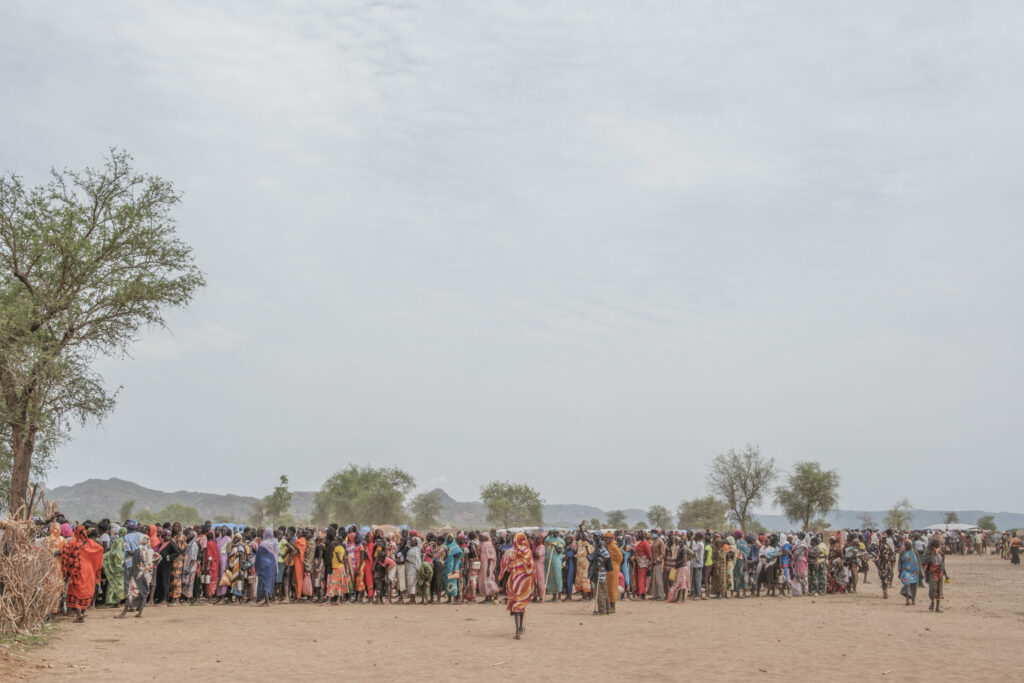
The EU continues to be engaged in Sudan where the civil war has caused the world's largest humanitarian crisis. It is struggling to deliver humanitarian aid but is not actively involved in enforcing the UN arms embargo on Sudan.
The civil war started in April 2023 and is fueled by weapons deliveries from regional and international sponsors. “The responsibilities for this man-made calamity rest with the Sudanese Armed Forces (SAF) and the Rapid Support Forces (RSF) as well their respective affiliated militias,” said former High Representative Josep Borrell.
In October 2024, he stated that the conflict in Sudan had generated displacement at levels unseen since the war in Syria and that close to 25 million people were in urgent need of humanitarian aid. The figures have not changed since then.
Najlaa Eltom, a Sudanese writer, wrote yesterday in an op-ed in Swedish daily Dagens Nyheter that the scale of the suffering is a constant: “Sudan is the scene of the world's largest humanitarian crisis, with millions of refugees, widespread famine, sexual violence and a collapsed health system.”
While the United Arab Emirates (UAE) imports weapons from EU Member States, it has become the main provider of weapons to the RSF. “After Abu Dhabi has surrounded Sudan with a network of ports, airfields and trade agreements, its logistical corridors also serve as arms routes in a deadly exchange: blood gold leaves Darfur; drones, mercenaries and banned military equipment flow in.”
In a statement last October, the EU condemned the on-going conflict in Sudan and emphasized that “the primary responsibility for ending the conflict lies with the leadership of both the Sudanese Armed Forces (SAF) and the Rapid Support Forces (RSF), and those supporting these entities”, without mentioning any of the countries providing them weapons by name.
The EU stated that is had defined certain asks to all parties to the conflict. These included among others constructive engagement in negotiations towards an immediate ceasefire, a credible inclusive peace mediation process, leading to a sustained cessation of hostilities; and ensuring rapid, unimpeded and sustainable humanitarian access and the protection of civilians across all of Sudan.
It also said that it will “continue to employ, and where possible intensify the use of the full range of foreign policy instruments at its disposal - including, where appropriate, targeted restrictive measures - to achieve a peaceful resolution to the crisis”.
Sudan was on the agenda, as always, of the latest foreign affairs council (20 November). In a statement, High Representative Kaja Kallas, condemned the atrocities perpetrated by the RSF in Sudan. The only response was that the EU adopted restrictive measures against one person, Abdelrahim Hamdan Dagalo, the second in command of the RSF. Before that, six individuals and six entities in Sudan were subject to travel restrictions and the freezing of assets.
“In Sudan, the situation is deteriorating sharply,” Kaja Kallas said at the press conference following the meeting. “The capture of El Fasher by the RSF opened another devastating chapter in this war. The conflict has brought thousands of deaths and immense suffering.”
She explained that the adding of a person to the sanctions list would send a signal that the international community will come after those who are responsible. All 27 EU Member States called on the parties to resume negotiations for a ceasefire. They also urged all external actors to take necessary measures to end the sale or supply of arms to all parties in line with the UN the arms embargo.
The civil war in Sudan is fueled by the weapons other countries are providing the two sides. “Clearly, to stop this we need to discuss what more can we do in this regard. The reach out to the countries is what we agreed. The diplomatic outreach to those countries and raise those issues to really stop this and then we can see what more can we do.”
While the EU issued a stronger statement, in practice it plays no active role in contributing to a ceasefire and implementing the arms embargo. This task falls on the so-called Quad which consists of the US, Egypt, Saudi Arabia, and the United Arab Emirates, some of which are themselves breaching the arms embargo.
In a joint statement on 12 September, the Quad recalled that the conflict in Sudan has provoked the world’s worst humanitarian crisis and committed to a shared set of principles with regard to ending the conflict in Sudan. They proposed a three-month humanitarian truce, to enable the swift entry of humanitarian aid to all parts of Sudan, followed by a permanent ceasefire and a nine-month transition to civilian rule.
This has not happened yet. In the joint declaration at the African Union (AU) – European Union (EU) Summit this week in Luanda, Angola, the leaders mentioned briefly the situation in Sudan. They condemned the atrocities committed in El-Fasher by RSF and called for an immediate cessation of hostilities and unhindered humanitarian access throughout the country.
The Summit did not mention the Quad and pinned its hope on an “AU-IGAD-led, Sudanese-owned political process towards a unified and civilian transition”. IGAD is the Intergovernmental Authority on Development (IGAD), an eight-country trade bloc in Africa which includes governments from the Horn of Africa, Nile Valley and the African Great Lakes.
As regards humanitarian aid, the EU announced at the summit that it is providing €143 million in aid for Sub-Saharan Africa, including €35 million in South Sudan. After El Fasher fell to the RSF, the Commissioner for Preparedness, Crisis Management and Equality, Hadja Lahbib, announced another €1 million in humanitarian aid.
This funding comes in addition to the €272 million the EU has allocated in 2025 to provide humanitarian assistance both to the people affected by the conflict in Sudan, and to the Sudanese refugees fleeing to neighbouring countries. The funding in aid for Sudan in 2024 amounted to €72 million.
Asked how much more funding the EU planned to allocate next year, a Commission spokesperson told The Brussels Times that the Commission does not disclose the funding in advance. “El Fasher is inaccessible for humanitarian workers,” the spokesperson said. “They face not only bureaucratic obstacles but also risk their lives in an extremely challenging situation.”
“We know that the needs of the people in Sudan are immense. They need all basic aid, water, food, shelter and medicines. Most children in Sudan are malnourished. There is a famine in El Fasher. Some managed to flee to Tawila (another town in North Darfur) and to neighboring countries. Our aid projects are directed not only to Sudan but also to other countries such as Chad.”
