

Militias belonging to the national Syrian army bombarded Kurdish neighborhoods in Aleppo and clashed with the Kurdish-led Syrian Democratic Forces during the visit of European Commission President Ursula von der Leyen and European Council President Antonio Costa last week.
"Attacks must stop for dialogue to take place," stated Ilham Ahmed, Co-Chair of the Foreign Relations Department of the Autonomous Administration of North and East Syria (AANES), at a virtual press conference on Tuesday. The situation in Syria continues to be volatile. After a temporary ceasefire in Aleppo, the two sides have continued to exchange fire and there is a risk of further escalation.
Warning that the attacks on the Sheikh Maqsoud and Ashrafiyeh neighborhoods of Aleppo pose a great danger to the country and the region, she said that the AANES and its forces are in favor of dialogue and negotiation. The latest events in Syria might increase external interventions and once again bring foreign terrorist fighters to the country.
In fact, that is what already happened in Aleppo despite the new transitionnal government’s promises of a peaceful transition to a democratic and inclusive Syria. During the clashes, around 50 civilians were killed, among them her own relatives, more than 130 were injured and around 275 are missing. Tens of thousand of people were forced to flee to Afrin, a city which Turkey invaded during the civil war.
In an op-ed in October last year, she wrote that Syria's fate is hanging in the balance between a peaceful and stable democratic future and backsliding to possible civil war. “The country finds itself at a crossroads, where the willingness of the EU and the international community to help is crucial. The situation is fragile, and interference in Syria’s internal affairs by neighboring countries does not serve its interests.”
During the press conference, she showed photos of foreign fighters published on social media and identified the units of the Syrian national army that had participated in the clashes. She also claimed that they were backed-up by Turkey which had provided drones and tanks.
The latest eruption of violence in Aleppo came after similar attacks against the Alawite and Druze minority groups in Syria. Ilham Ahmed added that the Syrian government is responsible for the failure to implement an agreement signed on 10 March 2025 between the central government in Damascus and the Syrian Democratic Forces (SDF) in north-east Syria.
As previously reported, the agreement, which was signed by interim president Ahmad al-Sharaa and SDF commander Mazloum Abdi, consist of eight points aiming at granting citizenship and minority rights to the Kurdish minority and integrating its forces in the national army. The EU welcomed the agreement. Turkey which also welcomed the agreement insists that the SDF should be disarmed.
Recent talks aimed at finding a solution which would result in integrating intact Kurdish units in the national army rather than dissolving them. Talks took place in Damascus on 4 January between Kurdish military commanders and Syrian ministers and officials. The two sides were close signing an agreement but according to the SDF the talks were interrupted by the interference of a Turkish diplomat.
Only two days later, the clashes started in Aleppo and continued during the EU visit in Damascus. Asked if the transitional government had an interest in fomenting unrest and violence, Ilham Ahmed blamed the militia groups. The reality on the ground differs from the perception of ‘one’ national army. In fact, it still consists of radical militia groups.
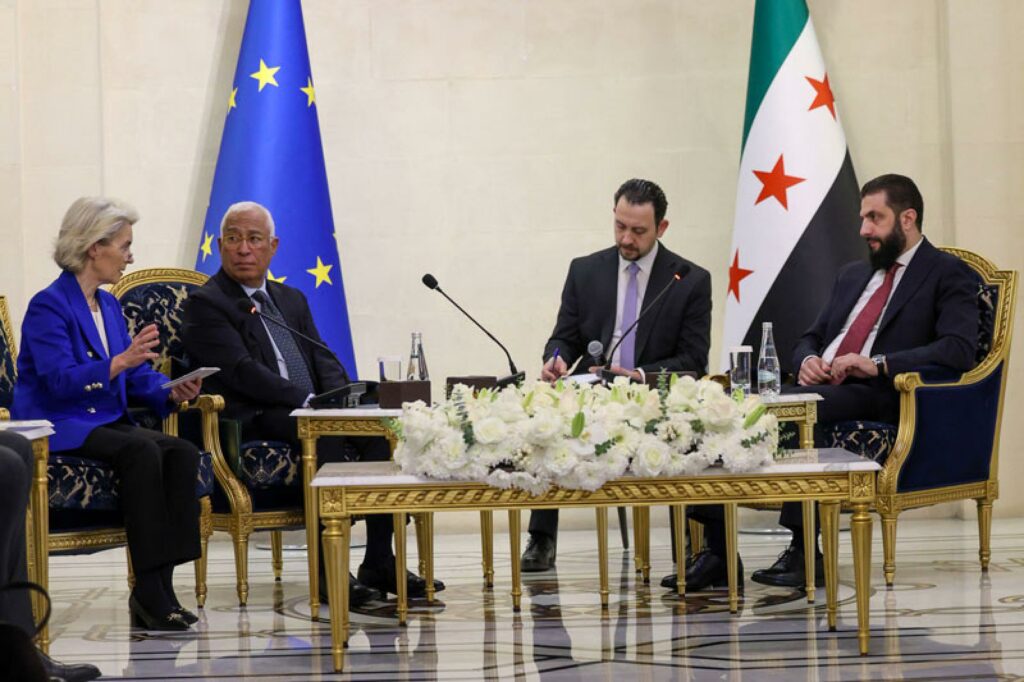
EU leaders meeting Syrian president in Damascus, 9 January, credit: EU
During their visit in Damascus, EU leaders announced that all EU economic sanctions on Syria have been lifted. This was also confirmed by a Commission spokesperson on Tuesday, without mentioning any conditions. Ilham Ahmed agreed that sanctions should be eliminated but added that the EU should think carefully how to ensure the protection of civilians and the disarmament of foreign fighters.
Dr Moran Levanoni, a researcher at the Israeli Institute for National Security Studies (INSS), told The Brussels Times that President Ahmed al-Shaara has an interest in preserving Syria’s territory but that there still are concerns about his real intentions considering his jihadist background. In the meantime, US President Trump supports both al-Shaara and Turkish President Erdogan who has a say in Syria.
Who then could have prevented the violence in Aleppo? The EU was content with issuing a statement calling “for an end to the hostilities in and around Aleppo, stressing the importance of protecting civilians at all times and easing access for humanitarian aid”. The US President might have stopped the violence but the Kurdish leadership is critical against the role of his Ambassador Tom Barrack.
Elisabeth Tsurkov, a Russian-Israeli researcher who has been held hostage by a jihadist group in Iraq, wrote on X that unless an agreement is reached between SDF and Damascus, a government offensive on the Deir Hafer pocket west of the Euphrates held by the SDF is a matter of time and weather.
Sources involved in the SDF-Damascus talks told her that the Syrian government is willing to incorporate the SDF into the Syrian army. This would leave Kurds in charge of their own security.
“Damascus is also prepared to make amendments to the authoritarian constitutional declaration, to guarantee the cultural rights of Kurds. A deal will avoid bloodshed and destruction and is the best path out of this. The distrust toward Damascus is understandable, but the absence of a deal will mean more Syrian lives are lost and destroyed.”
In her speech when meeting the Syrian President, von der Leyen said that the violent escalations were “worrisome” and called for continued dialogue.
“The roadmap on Suwayda (Druze area south of Damascus where clashes took place last July) that you developed with Jordan and the US is a very good example for the way forward,” she said. “We support your commitment to deliver on the goal of a new, peaceful, inclusive and safe Syria.”
The meeting in Damascus was described by the Commission as the opening of a new chapter in EU’s relations with Syria. The EU announced a financial support package of around €620 million for 2026 and 2027, which includes humanitarian aid, early recovery support and bilateral support. Launching a new political partnership, a High-Level Dialogue will take place in the first half of 2026.
The high-level EU visit in Damascus, without the participation of the Cyprus EU Presidency, was the first since the end of the Assad regime and part of a mission to the region which also included Jordan and Lebanon. It followed the opening of the Cyprus EU Presidency where the hosts and EU leaders stressed the key role Cyprus plays as a bridge between Europe and the Mediterranean and the Middle East.
“It’s clear that there cannot be any peace or stability in Syria without a process of national dialogue on reconciliation and transitional justice,” commented EU’s foreign affairs spokesperson Anouar El Anouni when asked about the situation in Syria and EU’s role. “We have condemned any foreign military attempt to undermine Syria’s territorial integrity and the prospects of a peaceful transition.”
