
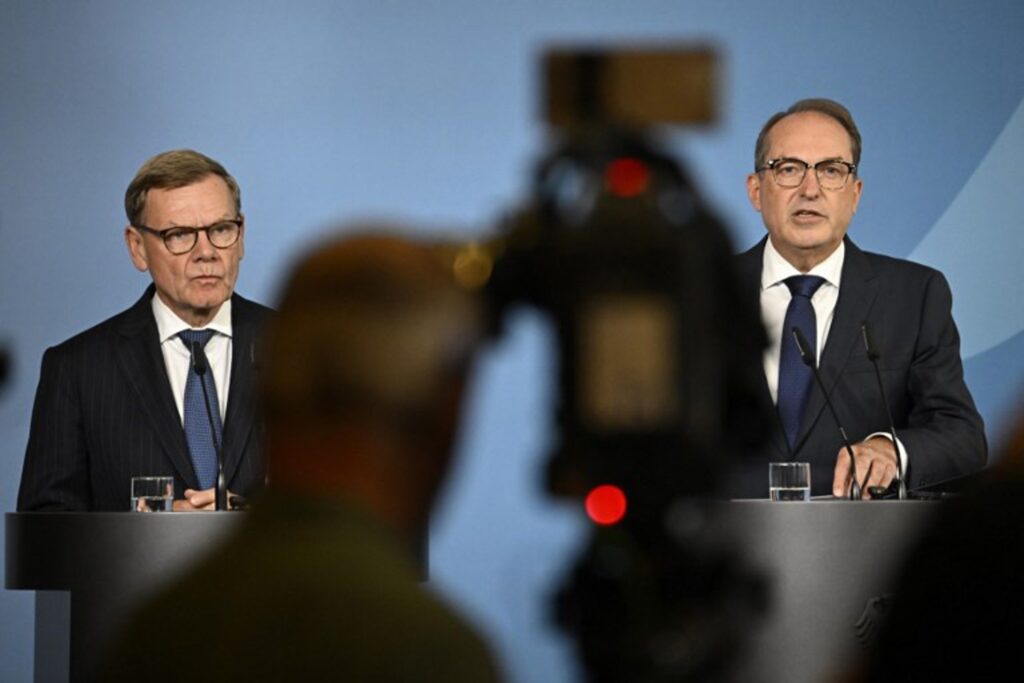
Germany announced retaliatory measures against Russia on Tuesday after accusing Moscow of sending an explosives-laden drone in early August to Leipzig Airport, a key military hub for the German army and NATO.
Interior Minister Alexander Dobrindt and Foreign Minister Johann Wadephul said the incident bore the hallmarks of a Kremlin-linked operation at a strategic airport used to support Ukraine.
“Taken together, the police investigations, the methods used and intelligence findings demonstrate Russian responsibility for the attempted attack at Leipzig airport,” Dobrindt said.
Last Russian consulate, cultural centre to be shuttered
In response, Germany will close Russia’s last remaining consulate in the country, in Bonn, on 18 September. It will also shut the Russian cultural centre in Berlin, also known as the Russian House, Wadephul said.
Berlin will also propose adding more Russian nationals to the European Union’s sanctions lists.
Wadephul said Germany would also “increase pressure on the Russian shadow fleet,” referring to ageing vessels with opaque legal status that Moscow is accused of using to circumvent Western sanctions.
Widespread support for Germany's move
European Commission President Ursula von der Leyen said the EU stood “fully” with Germany. NATO Secretary General Mark Rutte said the alliance would continue to strengthen its ability to deter and defend all allies against any threat.
Britain, France, Poland and Estonia also welcomed Berlin’s response.
Russian President Vladimir Putin said Germany’s measures were mistake.
“I think this is another grave mistake. In my view, it clearly runs counter to the interests of the German people,” Putin said at a press conference carried by the Russian news agency Tass.
Russia rejects accusations as 'baseless'
He suggested the German response was linked to “upcoming election campaigns."
In a statement posted on Telegram, Russia’s ambassador to Germany, Sergei Nechayev, called Berlin’s accusations “baseless, absurd and contrary to common sense.” He said the sanctions marked “an unprecedented escalation in Russian-German relations and would not be without consequences.”
He also claimed the “hastily staged provocation” at Leipzig airport served only the interests of “the Kyiv regime, the militarist wing of the European political class and the magnates of the military-industrial complex interested in fuelling the conflict in Ukraine.”
Since the start of the war in Ukraine in February 2022, Germany and several other European states have repeatedly accused the Kremlin of destabilisation, espionage and sabotage operations on their territory.
Attack on thermal power plant
On Tuesday, police said an improvised explosive device had damaged several power lines near a thermal power plant in eastern Germany, but gave no further details about suspects.
Without naming Moscow, Chancellor Friedrich Merz warned last week that those behind hybrid attacks against Germany would “pay the price.”
Attention quickly turned to the future of the Russian House of Science and Culture, a building constructed in 1984 in former East Berlin, near the Russian Embassy.
A platform for spies?
In an interview with the private broadcaster Welt TV, conservative MP Roderich Kiesewetter said the site was being used as a platform for Russian spies.
He claimed that more than 100 people lived there “without anyone knowing who they are,” and said the building’s electricity consumption was unusually high.
Until now, Berlin had favoured maintaining the status quo because of an existing bilateral arrangement involving the Goethe Institute in Moscow.
