
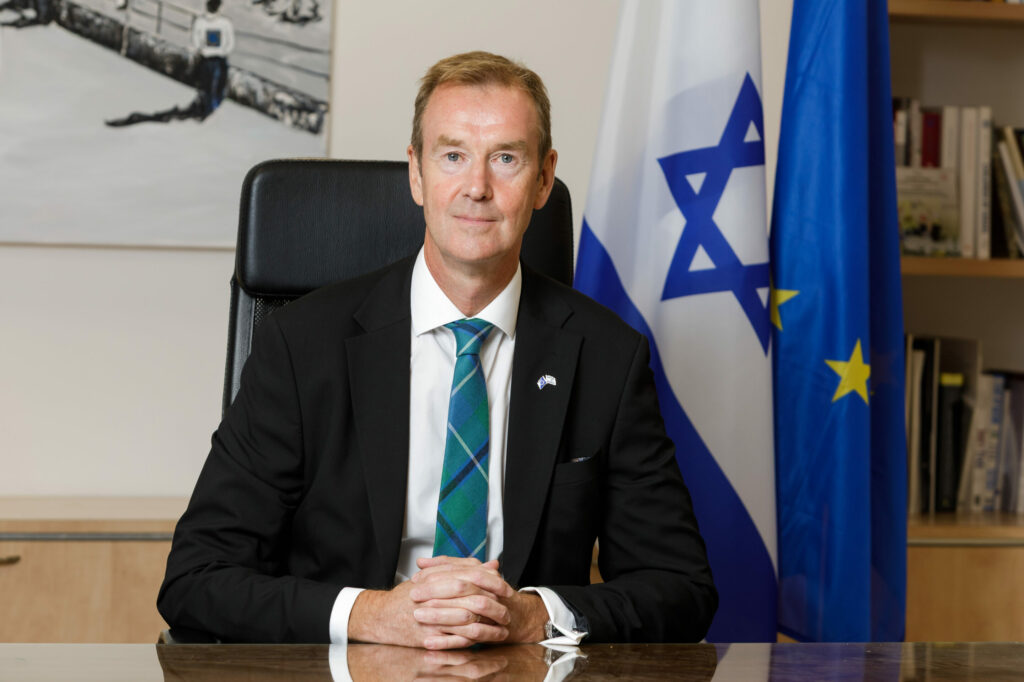
The parliamentary elections in Israel on Tuesday have been described as the most crucial in its history. The vote matters not only for its own citizens but also for the EU.
The last elections polls and the exit polls directly after the polling stations were closed predicted a tight race between the incumbent government and the opposition bloc. The biggest opposition party Yashar, led by former chief of staff Gadi Eisenkot, was holding a narrow lead over Prime Minister Benjamin Netanyahu's Likud party.
The polls, however, turned out to be misleading. Once the first votes started to be counted during the following night, a different trend emerged showing Likud as the biggest party. The real results shocked the part of the electorate that had hoped for a change in government after the 7 October 2023.
By Thursday morning over 85 % of the votes had been counted. According to the Central Election Committee (CEC), Likud was predicted to win 26 seats in 120-seat parliament (Knesset), well ahead of Yashar with 21 seats.
The final figures on early Friday morning evening added one more seat to Likud at the expense of one of its ultra-orthodox partners but did not change the total number of seats per bloc. Voter turnout reached a record-high of 80%. The high voter turnout brought two other parties, that were likely to support Netanyahu, below the 3.25% electoral threshold.
Neither bloc can form a majority government on its own. Netanyahu’s current far-right coalition government, which includes ultra-orthodox (total 13 seats) and nationalist-extremist parties (total 13 seats), received together 53 seats – a big loss compared to their current total of 68 seats.
The opposition bloc, made up of three right-center parties and one left-wing party, received 48 seats. That leaves the two Arab-Palestinian party groups as kingmakers if they want to remove Netanyahu from power and support a new government. The two parties received 19 seats, compared to their current number of 10 seats.
Together the Jewish-Arab opposition against Netanyahu’s government has gained a majority of 67 seats. If this outcome can be described as expressing the “will of the people”, his government should immediately admit defeat. But things are not that simple in Israel.
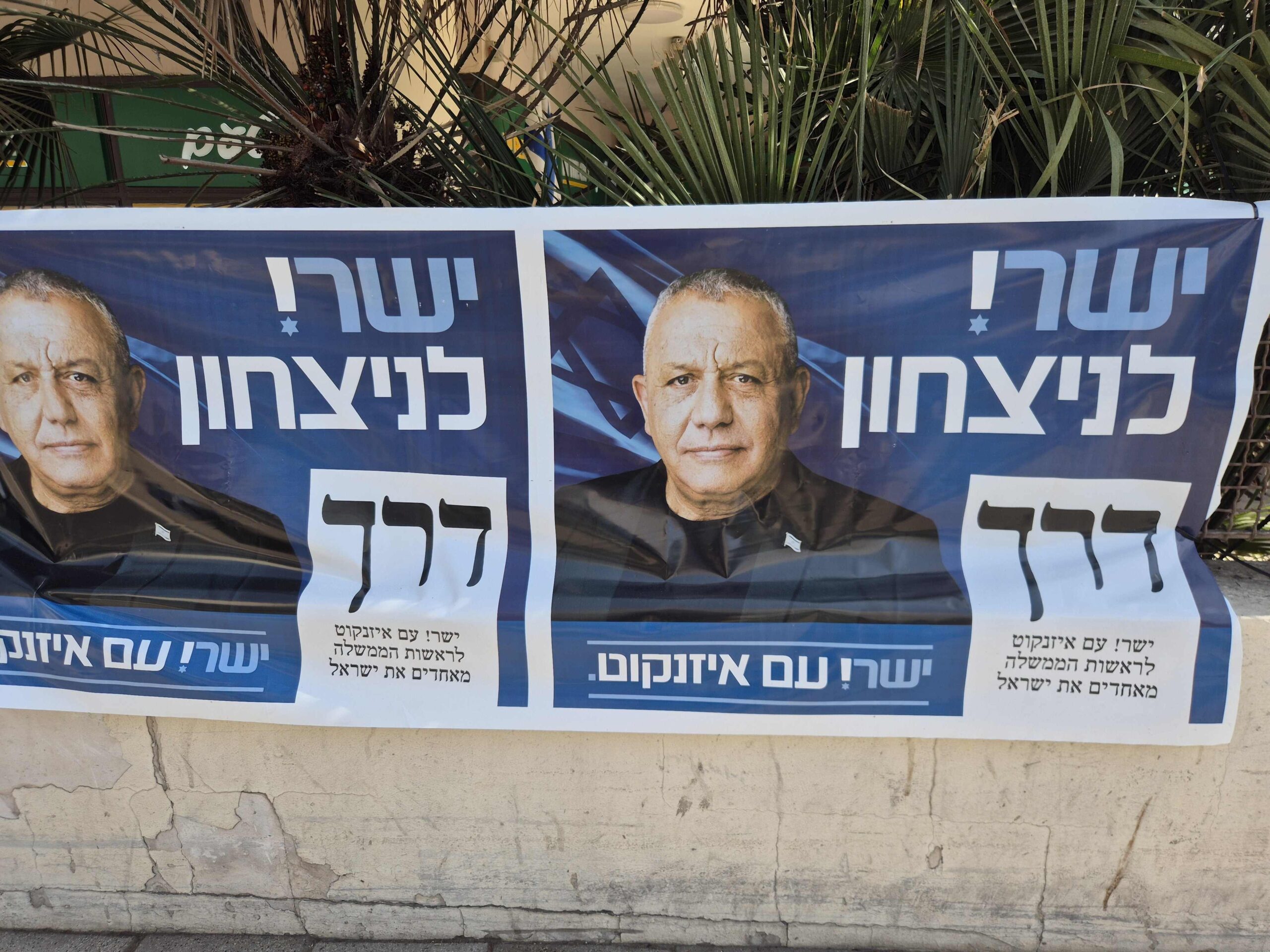
Election poster for Gadi Eisenkot, leader of the biggest opposition party Yashar. ‘Straight to victory’
Diplomatic EU statement
The EU reacted to the mixed outcome of the Israeli elections on Wednesday afternoon with a statement issued by its foreign affairs spokesperson Anouar EL Anouni. In the statement, “the EU congratulates the Israeli people on yesterday’s elections, which saw a high voter turnout, reflecting Israel’s vibrant democracy”.
There now begins a period of political negotiations to form the next Israeli government, the statement continues. “The EU looks forward to engaging with the next government on the basis of our longstanding relationship and commitment to democratic principles and common values, as well as to further advancing people-to-people contacts.”
It concludes with stating that “the EU approach will continue to be based on a frank and open dialogue in view of advancing our bilateral cooperation, addressing all issues of concern and working together to promote regional stability, security, and a just and lasting peace”.
The Brussels Times talked with Michael Mann, EU’s ambassador to Israel since September last year, about EU’s approach. In a previous interview after his appointment, he described the main challenges facing him in his post in Tel Aviv - how to improve the EU’s tense relations with Israel and how to use its leverage to contribute to the implementation of US President Trump’s peace plan.
Mann described the EU statement as carefully drafted and the only one for the moment. “We cannot comment on seats in the new Israeli parliament as long as the final results have not been announced. When and if there is a new government, we’ll make our position clear.”
He admitted that the statement on the elections in Israel differs from the congratulation statement on the presidential elections in Serbia on Sunday that also reached a record high voter turnout (70%). That statement was issued by High Representative Kaja Kallas and Enlargement Commissioner Marta Kos. The Serbian elections resulted in the ouster of Aleksandar Vučić, another longtime authoritarian ruler.
“What happened in Serbia was totally different,” Mann explained. "In Serbia, there was a clear winner with an orderly handover of power. The outcome should allow the country to return to track in the accession process. In Israel the outcome is still uncertain and there is no winner yet to congratulate.”
He added that despite the close and regular cooperation with Israel on trade, science, culture and people-to-people contacts, EU and Israel disagree on several issues such as the political path to a two-state solution, the non-enforcement of the rule of law against extremist settlers and the lack of progress in the implementation of the peace plan for Gaza.
Even the two EU-supported early recovery projects in Gaza have not started yet despite a political agreement between the EU and Israel. They could have started by now by the implementing UN agencies but the Israeli authorities have not greenlighted them over disagreement on technical issues such as the use of “dual goods”.
Cautious EU approach
Mann declined to comment on the emerging outcome which handed the opposition, including the Arab parties, a clear majority in the next Knesset but ended in a deadlock on the formation of a new government.
“It’s clear that the voter turnout was impressive and that it’s important that as many citizens and parts of society as possible can make their voice heard and will be represented. We’ll observe with great interest what happens next but we’ll not interfere in the political process after the elections.”
The EU was not invited to send any election observers mission to Israel. What is your impression of the conduct of the elections?
“We only send election observers to countries around the world where the integrity of the elections is threatened and problems are expected. Those of us at the delegation who observed the elections or passed by polling stations have not noticed any irregularities.”
On Thursday, media reported about foreign interference through funding provided by Qatar. Netanyahu was quick to claim that the election had been “stolen” and to request that the vote on a new speaker of the parliament should be cancelled.
In a statement, the acting director of the Central Elections Committee dismissed the allegations. “Reports published throughout the day are entirely unfounded. The investigation will not affect the final results submitted to the president, nor does it concern any particular sector of the population.”
The allegations were reported to the internal security agency, whose new director is a Netanyahu appointee, already before the elections without being investigated. Unless voter buying at a large scale can be proven the election results cannot be invalidated. Political party and campaign funding are normally audited by the State Comptroller’s Office after the elections.
Can we expect that the EU will make any further statements or decide on any measures in the period leading up to formation of a government or to snap elections if negotiations to form a government would fail?
“I'm not aware of any plans to propose any additional measures at this time."
The EU sanctions are still on the list. Which options does the EU have, depending on the development after the elections, to send signals to the Israeli parties and the Israeli public without damaging the political dialogue with any future government?
“It would be pure speculation to discuss sanctions now.”
From your meetings with the opposition parties, do you think that they would welcome some form of political signals already now?
“We met people and parties from all the political spectrum before the elections but we aren’t talking with anyone for the moment and are letting them do their work.”
How would you describe the development of the EU-Israeli relations since you became ambassador here last year?
“The relations have not been in a good place since the State of Union address in September last year when the Commission announced a package of sanctions. But there is still a big amount of cooperation going on between the EU and Israel. Besides targeted sanctions against some entities and extremist settlers in the West Bank, no other sanctions have been imposed.”
Do you think that EU-Israel relations can be restored to where they were before the 7 October 2023?
“I really hope that our close cooperation will grow because we basically share the same values, visions and interests.”
When the EU-Israeli relations were as closest in the past, could they be described as a form of ‘associate’ membership in the meaning of what now is offered to Canada?
“This concept is still work in progress and no decision has been taken yet. The label itself is less important. We have already a close partnership with Israel and there is no need for something more. There is an association agreement with Israel. It’s also an associate member of the Horizon research programme. Our relationship with Canada is different.”
In her speech on Thursday on the first day of the EU-Canada summit in Montreal, Commission president Ursula von der Leyen described ‘associate membership’ as an association without membership but closer to EU membership than everything else in the past.
Uncertainty about next steps
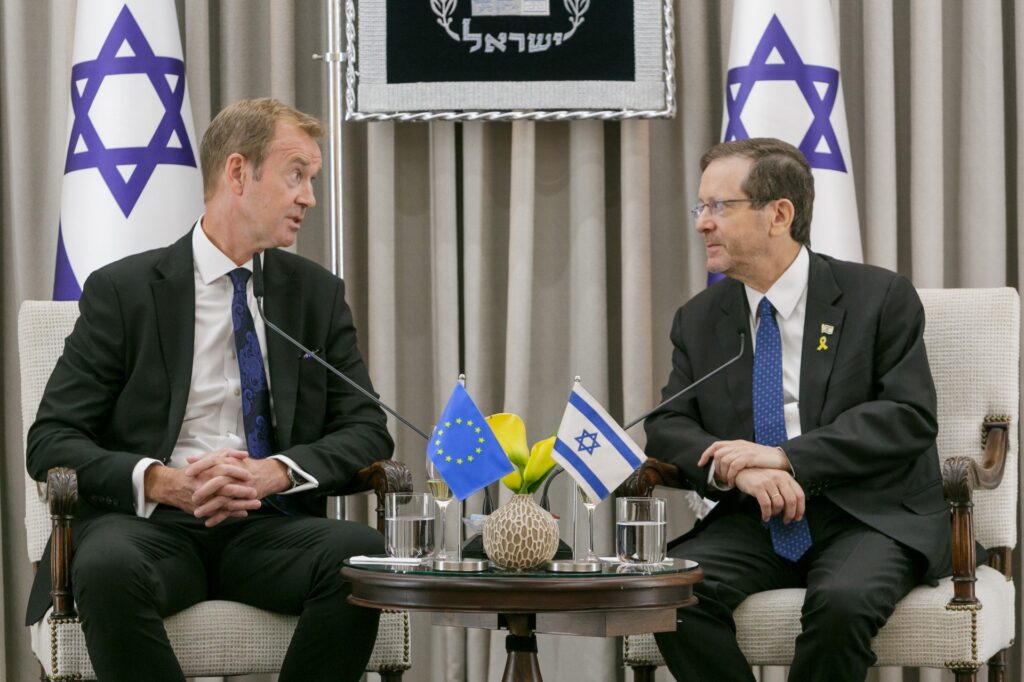
Michael Mann meeting Israel’s president Isaac Herzog, credit: GPO
Israel and the EU will have to wait and see. What will happen until the swearing in of the new parliament on 10 November is uncertain. Netanyahu will do his best to cling to power by pressuring Knesset members who were elected on behalf of the opposition parties to defect to his side.
He continues to delegitimize the Arab vote and the opposition bloc has been playing into his hands. The bloc was reluctant to speak out about cooperation with the Arab parties before the elections but the outcome of the elections is not what they expected.
Besides Yair Golan, the ex-deputy chief of staff and leader of the left-wing Democrats party, the other parties have so far been silent on how to achieve a just and lasting Israeli-Palestinian peace solution. One of them even called for the cancellation of the Oslo Accords.
The Democrats was the only party which addressed the issue in the elections, calling for an ”end to the annexation (of the occupied Palestinian territories) and the promotion of a regional-political-security agreement which would ensure the perspective of two national states”.
To keep its election promises not to join or include Netanyahu in a “national unity government” the opposition bloc would have to accept the support of the Arab parties to form a minority government or to form a majority government with them. That could work sufficiently long time to prevent Netanyahu from provoking new wars, return Israel to normality and undo the undemocratic legislation of his government.
The opposition bloc including the Arab parties must therefore act quickly and rally behind Eisenkot when they are asked next week by the Israeli president whom they recommend as prime minister with the biggest chances to form a new government.
