
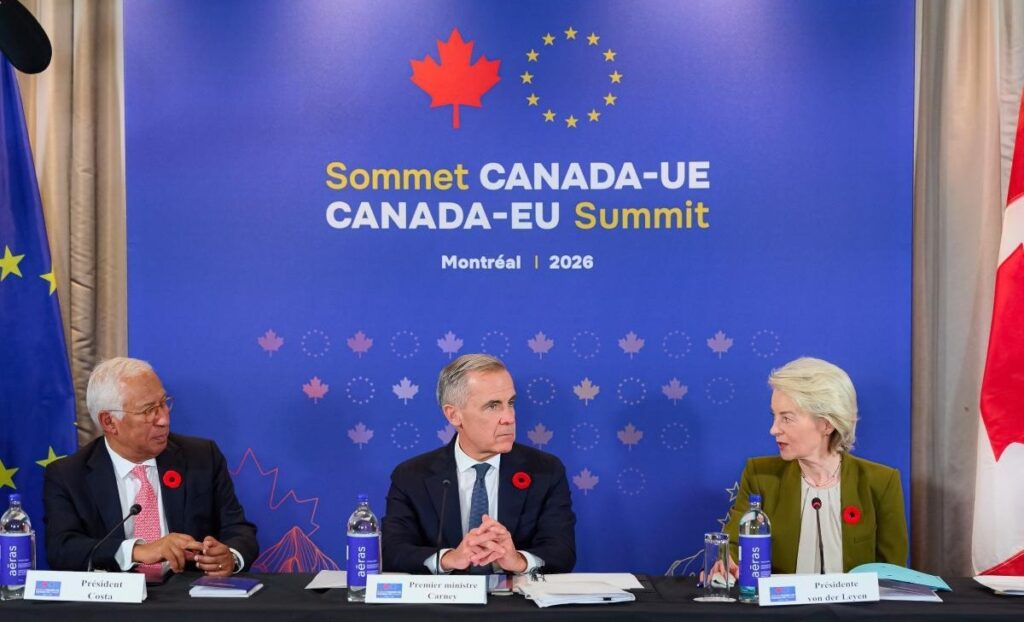
The EU and Canada hold a bilateral summit on 29 – 30 October in Montreal. It was not their first bilateral summit but was described by both sides as a unique and historic moment in EU-Canada relations.
The summit followed European Commission Ursula von der Leyen’s state of the union address in September when the concept ‘associate membership’ was mentioned for the first time. The Prime Minister of Canada, Mark Carney, was invited to the European Parliament to listen to her speech.
Von der Leyen said that his presence symbolised “the enduring friendship between our people” and “the cultural, historical and personal links run deep within the fabric of our societies”. History, trade and security concerns play an important role in her push for developing the relations further more.
She highlighted the free-trade agreement between Canada and the EU, the Comprehensive Economic and Trade Agreement (CETA,) and forecasted that it will move to an “Alliance for the Future” to create a “common prosperity and economic security space”.
CETA entered provisionally into force in 2017 and has increased the trade in goods. Full enforcement, conditional of the ratification of the agreement, will eliminate practically all customs duties and tariffs on goods. Until now 18 of the 27 EU Member States have ratified it. The countries left are Belgium, Bulgaria, Cyprus, France, Greece, Hungary, Ireland, Italy and Poland.
She then dropped what some felt was a bombshell: “I would like to work with you on opening the door for Canada to be the first associate member of the EU. We share one ocean, one set of values, one way of seeing the world. And we will now build our shared future as well.”
The meaning of associate membership
What she meant by “associate member” was not clear. Did for example her vision of associate membership for Canada include freedom of movement – one of the four pillars of the EU single market, besides movement of goods, services and capital? It has also been the most sensitive freedom in EU’s enlargement rounds.
It turned out that the Commission did not know and needed to put flesh on the idea which its spokespersons described a ‘big, bold and beautiful”. The details have been added in a surprisingly short time and were specified in a joint statement ahead of the summit. For an overview of the key deliverables in the statement, click the factsheet.
“Associate membership” can be implemented in three ways. First, policies - shaping policies together with closer alignment, from climate, energy to AI, innovation and security. Second, programmes - bringing Canada into EU programmes, such as Horizon Europe and Erasmus+. As regards participating in EU programmes, Canada is still lagging behind other non-EU countries.
The third way is governance, bringing EU and Canadian institutions such as governments, parliaments and courts much closer together. It started with a meeting during the summit between ten European Commissioners and the Canadian government. It reminded about the meetings between the College of Commissioners and the member state government at the start of each rotating EU Presidency.
In a world of rising uncertainties, security is mentioned almost 50 times in the joint statement. Canada is seen as a strong ally to the EU because it has dared to defy the Trump administration and is committed to multilateralism, democracy and the rules-based international order. It is already an active member of the Coalition of Willing against Russia’s war of aggression against Ukraine.
Canada is the only non-European country to join the European Union’s Security Action for Europe (SAFE). Canadian defense firms and products are granted a unique exemption, allowing them to bid directly on EU-backed military contracts. It is also the only non-European country which has been invited to the European Political Community (EPC).
According to the joint statement, the concept of an “ever-closer association of Canada to the EU, short of full membership itself”, needs to be worked out at next EU-Canada summit in 2027. In her keynote speech before the start of the summit, President von der Leyen explained for the first time the meaning of “associate membership” and how it applies to Canada.
“Canada and the European Union are two complementary systems. Of course, Canada cannot become a full-fledged member of the EU because of geography, but we both want to bring our relationship to the highest level possible. This is why we are discussing the idea of Canada becoming the first associate member of the EU.”
“Our idea is simple: it is an ‘association without accession'. But we can replace accession with a ‘common ambition and vision'. We can build a partnership that comes closer to membership than anything we have done before. This is why we will build an Alliance for the Future, and we start with Canada.”
This new association is “open only to our closest partners outside of Europe, who are ready to open a new frontier together – and to chart the course together, to think beyond the terms of our partnership today, towards the most ambitious version of what we can build. And I must say: I can think of no better partner than Canada to embark on this journey with us.”
“Together, we want to create a common space for growth and prosperity, resilience and economic security. In a world of growing rivalries, sovereignty and independence are no longer just the freedom to act alone. It is the capacity to act together.”
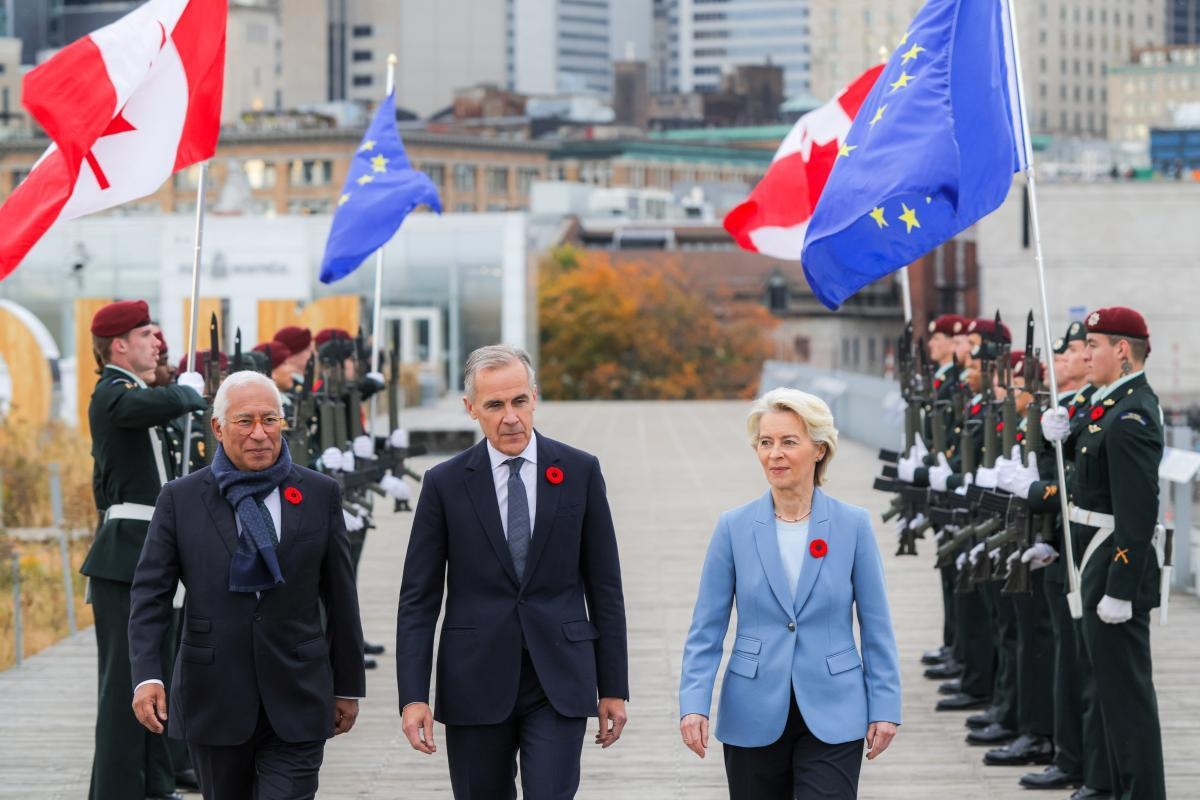
Credit: EU
Rosy picture of history
In her speech, von der Leyen highlighted the visit in Canada of a young Frenchman, Jean Monnet, one of the future founding fathers of the EU. Monnet, who was there to sell cognac, was impressed by what he saw. Struck by the sense of dynamism and possibility he found here, he wrote that “No one thought about limits”.
“That would later help to the course of European history,” von der Leyen said. “Because it was here that Monnet discovered that people from different backgrounds and regions would cooperate where interests aligned, or where the scale of a task required it”.
Was Monnet aware of that Canada was founded as a European colony which mistreated its indigenous people? Apparently not because he viewed North America through Eurocentric lenses. Coming from Europe where neighboring countries could not leave in peace and occasionally fought wars, he was impressed by how the British and French in Canada managed to get along.
Indigenous populations were ignored in his assessment of the country. What fascinated him about Canada was how people who had migrated from rival European nations cooperated in a single federal government. He would remember that when he in 1951, after two devastating world wars, designed the predecessor of the EU as a peace project which would prevent future wars in Europe.
Did Monnet discover any tolerance towards other religions in Canada? The vast majority of the population in Canada were Anglo-Saxon Christian and French Catholic. There were no Muslims. The Jewish population, which was fleeing persecution in Europe, was still relatively small but antisemitism was widespread.
The Canadian government enforced a "White Canada" immigration philosophy. In 1939, it turned away the MS St. Louis, a ship carrying over 900 Jewish refugees. Canada changed its immigration laws and lifted the limits on Jewish immigration only after the Holocaust. Still a small minority, the Jewish community is a target of most hate crimes in Canada.
Conflict over natural resources
Over 1.8 million people in Canada identify as indigenous, making up approximately 5.0% of its total population. The tragedy, which Monnet could not know, is that it took long time for Canada to come to terms with its discrimination and suppression of indigenous people. The process is still unfinished and systemic inequalities continue to exist.
A Truth and Reconciliation Commission (TRC) concluded its work in 2015. The Commission labeled Canada's Indian Residential School system—which forcibly separated over 150,000 Indigenous children from their families—as "cultural genocide”. Only a small part of the Commission’s calls to action have been completed so far.
A crucial issue concerns the control of land which the colonial government confiscated as “crown land” – about 90 % of Canada’s territory - by imposing treaties on the indigenous people (First Nations) or simply stealing the land. The indigenous people were forced into reserves which account for less than a percentage of Canada’s total land mass.
Indigenous peoples are mentioned once in the joint statement, in connection with EU-Canada collaboration in the Arctic. There the collaboration will include engagement with indigenous peoples and identify mutually beneficial areas of cooperation.
Indigenous people in Canada are now claiming ownership or control over land in regions where they never signed any treaties or legally ceded their land. Ownership of the land would also include influence over how the environment, water, and natural resources are managed. This is something which the EU in its eager to diversify supply chains of critical raw materials and natural gas seem to have overlooked in the joint statement with Canada.
Because of the huge size of the crown lands, most of the natural resources that the EU wants to buy from Canada are located on lands that the indigenous people claim as theirs. The extraction of resources in them will not only trigger legal disputes but threaten also the environment and the green transition towards renewable energy.
The European Commission did not reply immediately to a request for comment to the above issues. According to a senior Commission official, Canada exports most of its LNG to the US but has a potential to export some of it also to the EU. Currently there is no export infrastructure on the east-coast of Canada and a joint feasibility will first have to be carried out.
