
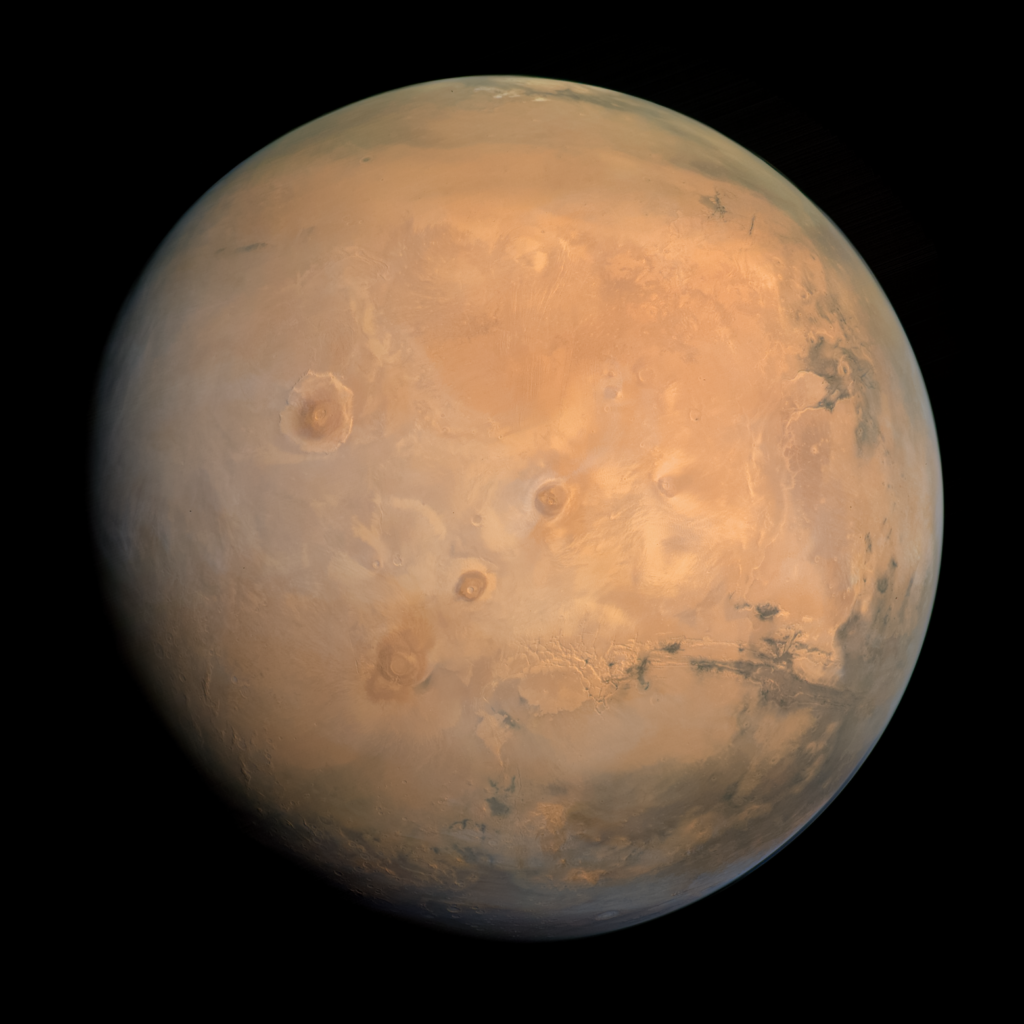
An international team of researchers led by the University of Bern has discovered evidence of ancient river systems on Mars, confirming the existence of a vast ocean in the planet’s past.
The discovery was made using images captured by cameras aboard Martian orbiters. The researchers identified structures on the planet that closely resemble river deltas found on Earth.
The study estimates that the highest water level on Mars dates back around three billion years. The findings provide strong indications that Mars may have once had conditions suitable for life.
Fritz Schlunegger, the study’s director, described the identified structures as the mouth of a river flowing into an ocean. These deltaic formations, though now partially covered by wind-formed dunes, still retain their original shape.
The structures are situated at similar altitudes, which allowed the researchers to reconstruct the ancient sea level and coastline. Their analysis revealed that the ocean was at least as large as the Arctic Ocean and stretched across Mars’s northern hemisphere.
Previous research had suggested the presence of an ocean on Mars, but it was based on less precise data or indirect evidence. This new reconstruction relies on clear and definitive indicators.
Ignatius Argadestya, the lead author of the study, noted that this discovery highlights Mars’s past as a “blue planet.” He added that understanding the type of geological changes that occurred there is crucial, reminding us of the vital role water plays on a planet and the possibility of its eventual depletion.
