
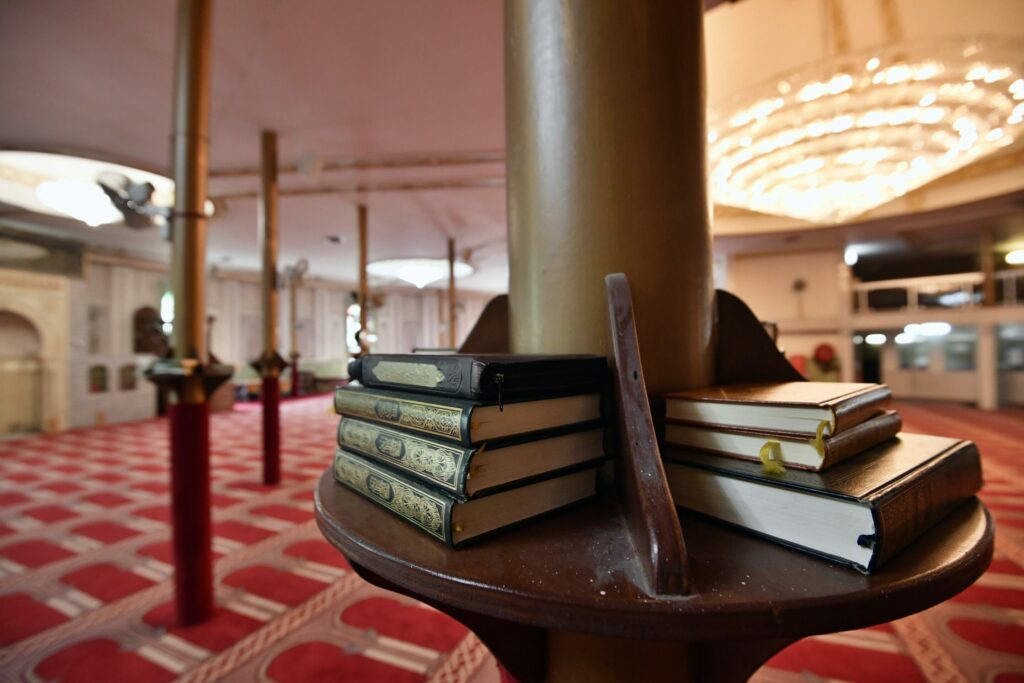
At least 14 mosques across Brussels are planning to expand to cope with overcrowding during prayers, forcing some worshippers to spill out onto the streets.
According to Bruzz, Islamic places of worship across the capital are stepping up fundraising efforts to meet growing demand. Many rely almost entirely on donations from believers to finance projects, such as adding extra floors or purchasing entire buildings.
At the Al Firdaws Mosque, plans for a new site are already reportedly underway. The expanded space is expected to include separate prayer areas for men and women, as well as classrooms for Quranic and Arabic teaching, Bruzz reported.
Elsewhere, El Chatibi Mosque has reportedly raised €1 million towards the purchase of a 1,400-square-metre complex, with further funds still needed. Their goal is to ease pressure on existing facilities while generating income by renting part of the space.
Similar projects are emerging across Brussels. Bruzz reported that Al-Jadid Mosque is seeking €1.1 million to acquire a neighbouring building, while Centre El Hikma hopes to add an extra floor to support its growing activities.
Why do mosques want to expand?
Overcrowding is the driving force behind the expansion plans. At the Assouna Mosque, representative Karim Abbas told Bruzz that capacity is regularly exceeded.
"On Fridays and during religious holidays, the prayer room is completely full," Abbas explained to Bruzz. "Four to five hundred worshippers sometimes cannot find a place."
In such cases, the mosque must request permission from local authorities to hold prayers outdoors.
The situation is similar at Al-Azhar Mosque, where demand during Ramadan and on Fridays can double the normal capacity.
A growing community
Bruzz reported that experts point to a combination of demographic growth and evolving practices within Brussels' Muslim community.
According to Corinne Torrekens, many mosques were originally set up in small residential buildings decades ago and were never designed to accommodate today's numbers.
Speaking to Bruzz, she also highlights changing social dynamics. Funeral ceremonies are now more often held locally rather than abroad, and women are playing an increasingly prominent role, despite often being confined to smaller, less suitable prayer spaces.
Donations drive expansion
Unlike other religious institutions, mosques in Brussels depend heavily on community funding. Donations, including zakat, remain the primary source of funding, Bruzz reported.
"We rely entirely on the faithful," Abbas tells Bruzz. "Without donations, nothing would be possible."
