
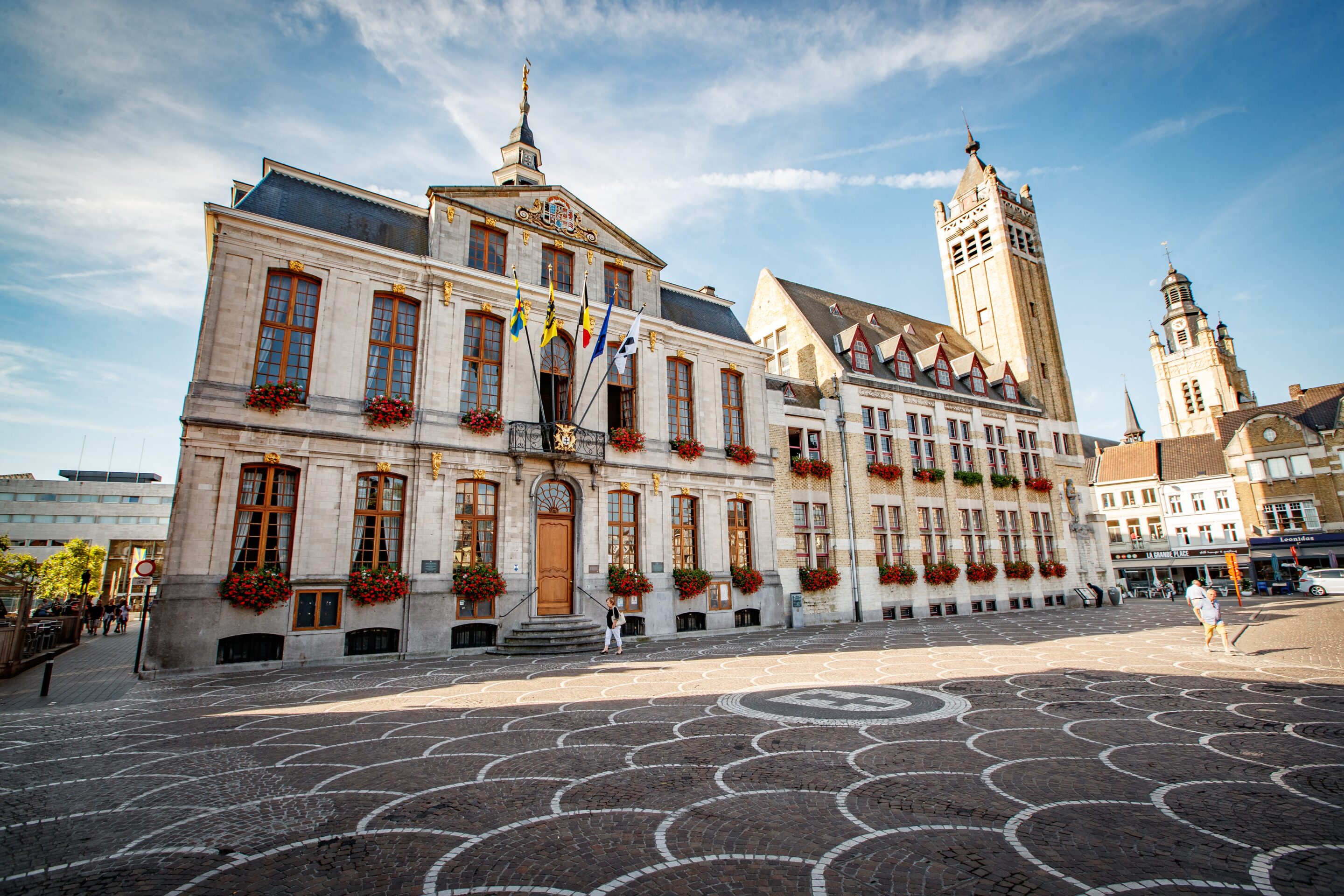
Best known for cycling and Rodenbach beer, Roeselare is a small West Flemish city with an unexpectedly broad repertoire. Beyond the world champions and breweries lie ambitious restaurants, unusual museums, a strong shopping culture and reminders of a turbulent past. Angela Dansby spends a weekend exploring a city that has long punched above its weight.
Roeselare has long combined industry with an appetite for the good things in life. Cycling champions are commemorated on its streets, cafés spread across its squares, and food and shopping are serious business. Surrounded by some of Belgium’s most productive farmland, the city has grown on agriculture, manufacturing and commerce – but it has never defined itself by work alone.
There is more to Roeselare, however, than bicycles and beer. Belgian art fills a former church; a Second World War communications bunker survives on an otherwise ordinary residential street; and one of the country’s oldest Renaissance castles stands just outside the city. A carillon guild still rings bells by hand, while a market first established more than a millennium ago continues to occupy the centre every Tuesday.
That mix reflects a city accustomed to making the most of what it has. Roeselare grew from a medieval market town on the Mandel River into one of West Flanders’ most productive centres. Wool and linen drove its early prosperity; later came railways, textiles, bicycles and food processing. Today it remains at the heart of Belgium’s agri-food economy.
History in brief
Roeselare has repeatedly had to rebuild. After centuries of warfare and fires, it was devastated during the First World War, when an estimated 70% of the city was destroyed. Much of its present-day architecture dates from the reconstruction and modernisation that followed.
The city also played an outsized role in the Flemish linguistic and cultural movement. In 1875, students at the Klein Seminarie (Minor Seminary) staged the Groote Stooringe (Great Disturbance), a protest against the dominance of French in education.
Encouraged by local teachers and priests, the students included Albrecht Rodenbach, who became one of the movement’s leading young voices. The protest helped give rise to blauwvoeterij, a Catholic Flemish student movement whose influence spread well beyond Roeselare.
The Second World War brought further destruction before Roeselare was liberated by the First Polish Armoured Division under General Stanislaw Maczek. Its industrial heritage, Flemish cultural legacy and wartime history remain conspicuous in a city that is now a prosperous regional centre.
Cycling
Cycling is inseparable from Roeselare. The city has produced several world champions and is home to major races, a velodrome and Belgium’s largest cycling museum. Four local legends – Patrick Sercu, Jean-Pierre (‘Jempi’) Monseré, Freddy Maertens and Benoni Beheyt – won six professional world titles between them.
Monseré, who died in a cycling accident in 1971 at the age of 22, occupies a particular place in local cycling lore. He is remembered across the city in a street-art mural, a sculpture and a professional race bearing his name – as well as a giant puppet made in his likeness.
At the centre of Roeselare’s cycling culture is KOERS Museum van de Wielersport, Belgium’s largest cycling museum. Its collection covers almost 200 years and includes more than 300 racing bicycles, alongside trophies, jerseys, memorabilia and temporary exhibitions.
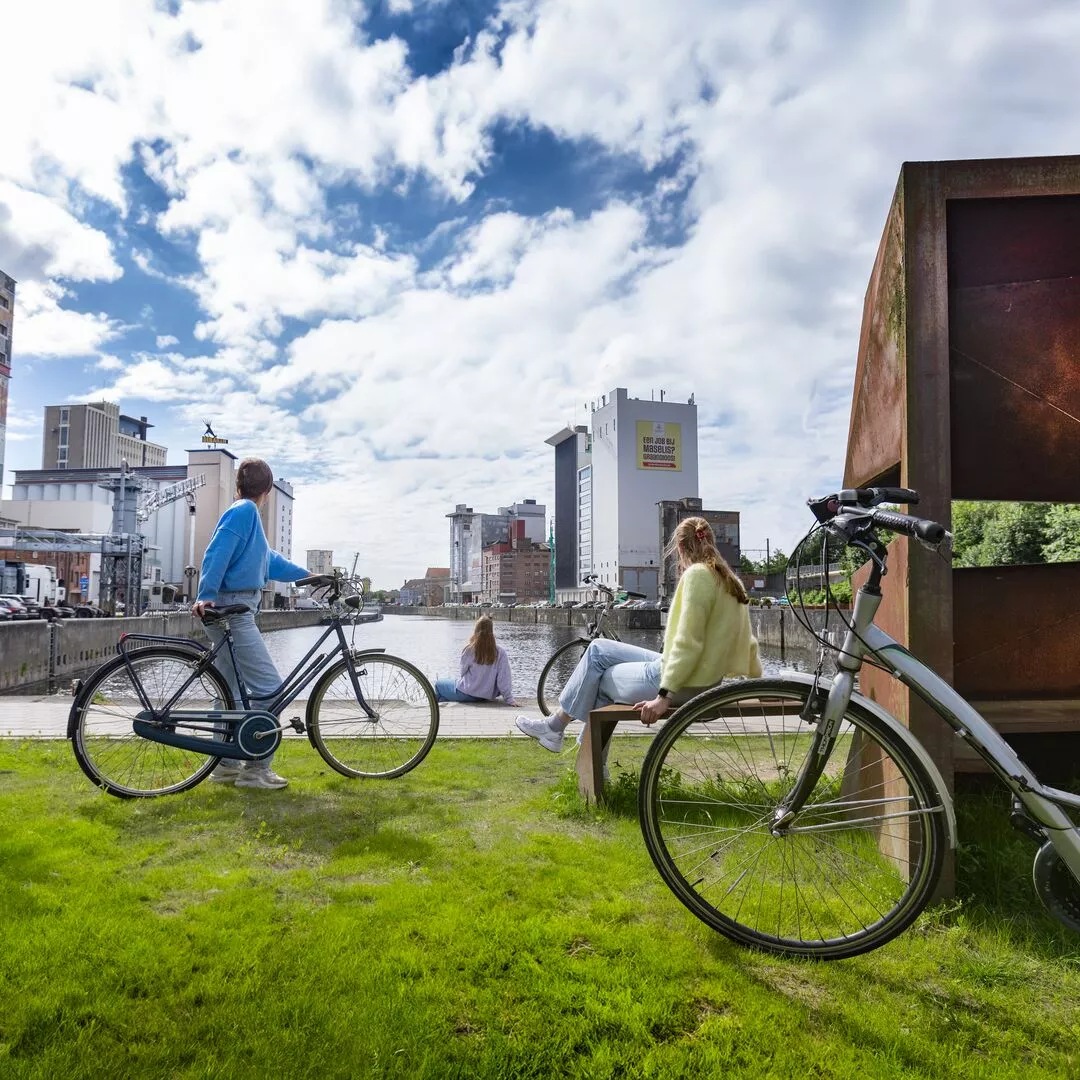
Roeselaere Kop van de Vaart. Credit: 2024 Jan D'Hondt Ateljé
The Hall of World Champions celebrates leading riders on film and in displays, including Belgium’s Lotte Kopecky, while murals outside depict Eddy Merckx, Yvonne Reynders, Kopecky, Maertens and Beheyt.
In nearby Rumbeke, the Defraeye-Sercu Velodrome lets amateurs try the track for themselves. Built in 1912 by Odiel Defraeye, the first Belgian to win the Tour de France, it was also where Patrick Sercu began racing. Groups of five to 15 can ride from March to October, except on Mondays.
Roeselare is also the annual starting point for Dwars Door Vlaanderen, a semi-classic on the UCI World Tour. Less competitive cyclists can follow numerous signposted routes in and around the city. The 43.6-km Groene Ronde can be divided into two loops; a map in four languages is available from Visit Roeselare, and bicycles can be rented from KOERS.
Food
Food is another product of Roeselare’s surroundings. The farms around the city supply a major food-processing industry producing everything from cereals, pasta and beer to frozen fruit and vegetables.
Brouwerij Rodenbach has been a local institution since 1821. Its distinctive red-brown sour ales are made with mineral water from the site, regional malted barley, corn and hops, and five types of yeast. Fresh beer fermented in steel tanks is blended with older beer matured for two years in oak casks. The brewery even makes its own 12-year-old beer vinegar.
Tours of Rodenbach include tastings and a sound-and-light show among the enormous wooden foeders, or maturation casks. Visitors can design their own beer label or, on the Vintage Tour, try blending a beer themselves.
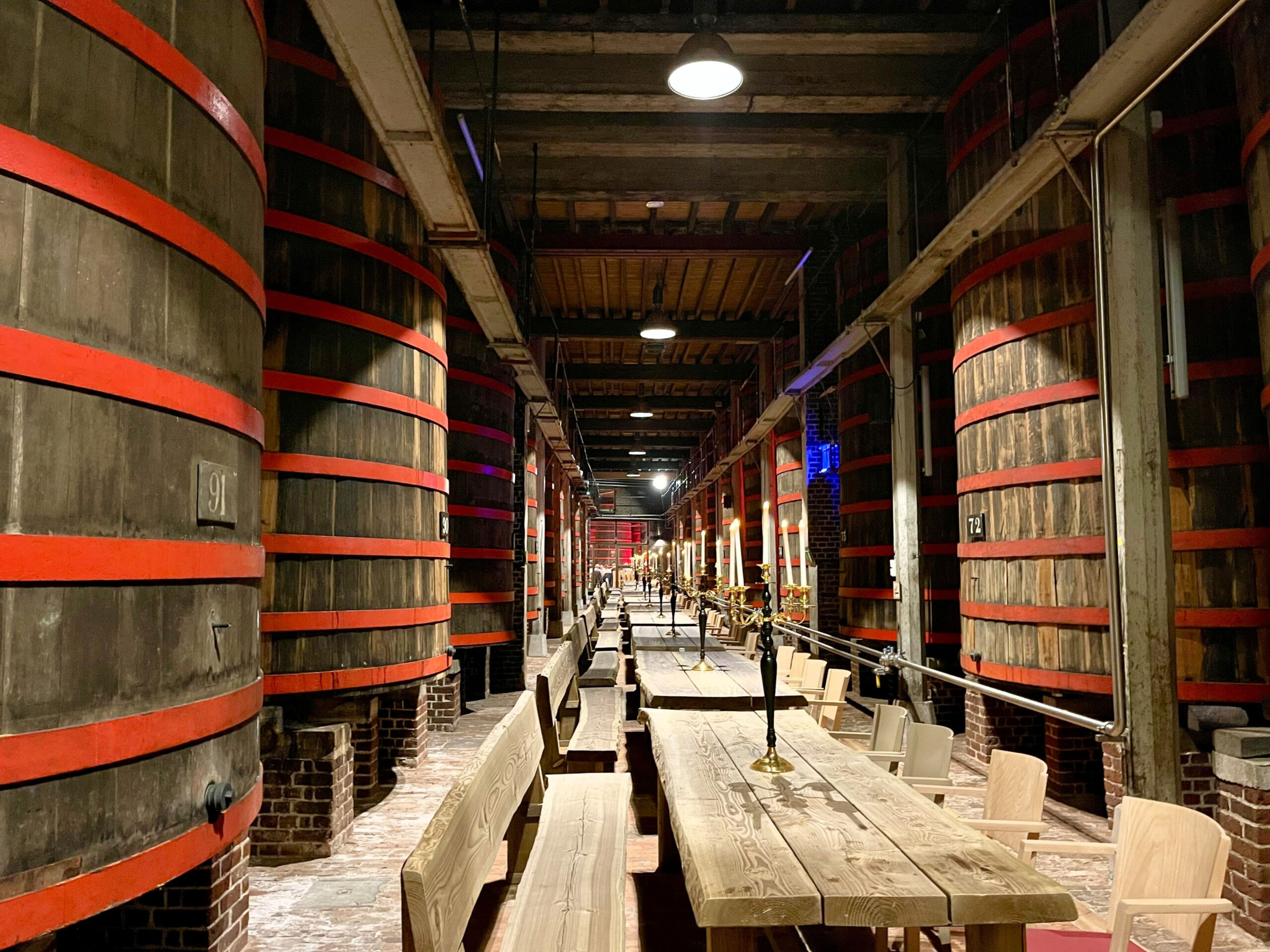
Rodenbach foeders. Credit: Angela Dansby
Roeselare also has one of Belgium’s two three-Michelin-starred restaurants. At Boury, chef Tim Boury uses Rodenbach beer and vinegar in some dishes and produces his own beer and spirits.
BOMBrewery and Mikken Urban Winery add to the local drinks scene. Other specialities include Elixir de Roulers, a bright yellow herbal liqueur made to a secret recipe since 1871; Marsel sea salt; and award-winning artisanal cheese from Kaasboerderij ’t Groendal, made with fresh cow’s milk from the farm.
In late October, Week van de Smaak brings together farmers, producers, chefs and diners for food tours, tasting menus, masterclasses, high teas, beer tastings and an amateur cooking contest.
Shopping
Roeselare also has one of the highest concentrations of shops among Belgium’s regional cities, with familiar chains and independent boutiques spread across several central streets.
Pedestrianised Ooststraat is the main shopping artery, punctuated by Art Nouveau architecture; Noordstraat, Brugsesteenweg and Westlaan provide further options.
Shopping has even acquired its own local rituals. Batjes, a four-day festival in June, combines pavement sales and entertainment with the opening of a giant barrel of Rodenbach beer, distributed free to the public. Winkelnacht (Shopping Night) in April brings another evening of late opening, promotions and events.
The Dinsdagmarkt is considerably older. First held in 957, the Tuesday market now spreads across several squares from 7am to 1pm, selling fresh produce, flowers, clothes, accessories and household goods. In December, the Kerstmarkt adds crafts and seasonal stalls.
World war memories
Roeselare’s wartime history turns up in unexpected places. On a residential street, Bunker 1944 occupies a well-preserved German communications bunker that opened as a museum in 2024. It recounts the liberation of Roeselare by the First Polish Armoured Division under General Stanislaw Maczek.
Photographs, testimonies and original objects cover both the liberation and the fate of Polish soldiers after the war, while a film tells Maczek’s story. Red-and-white Hot Lips flowers planted around the bunker echo the Polish flag. Visits are by group tour only.
Credit: Angela Dansby
Eight Polish soldiers killed on the eve of the liberation are commemorated elsewhere in the city, with plaques and information panels marking where they died. Their helmets are preserved at Bunker 1944.
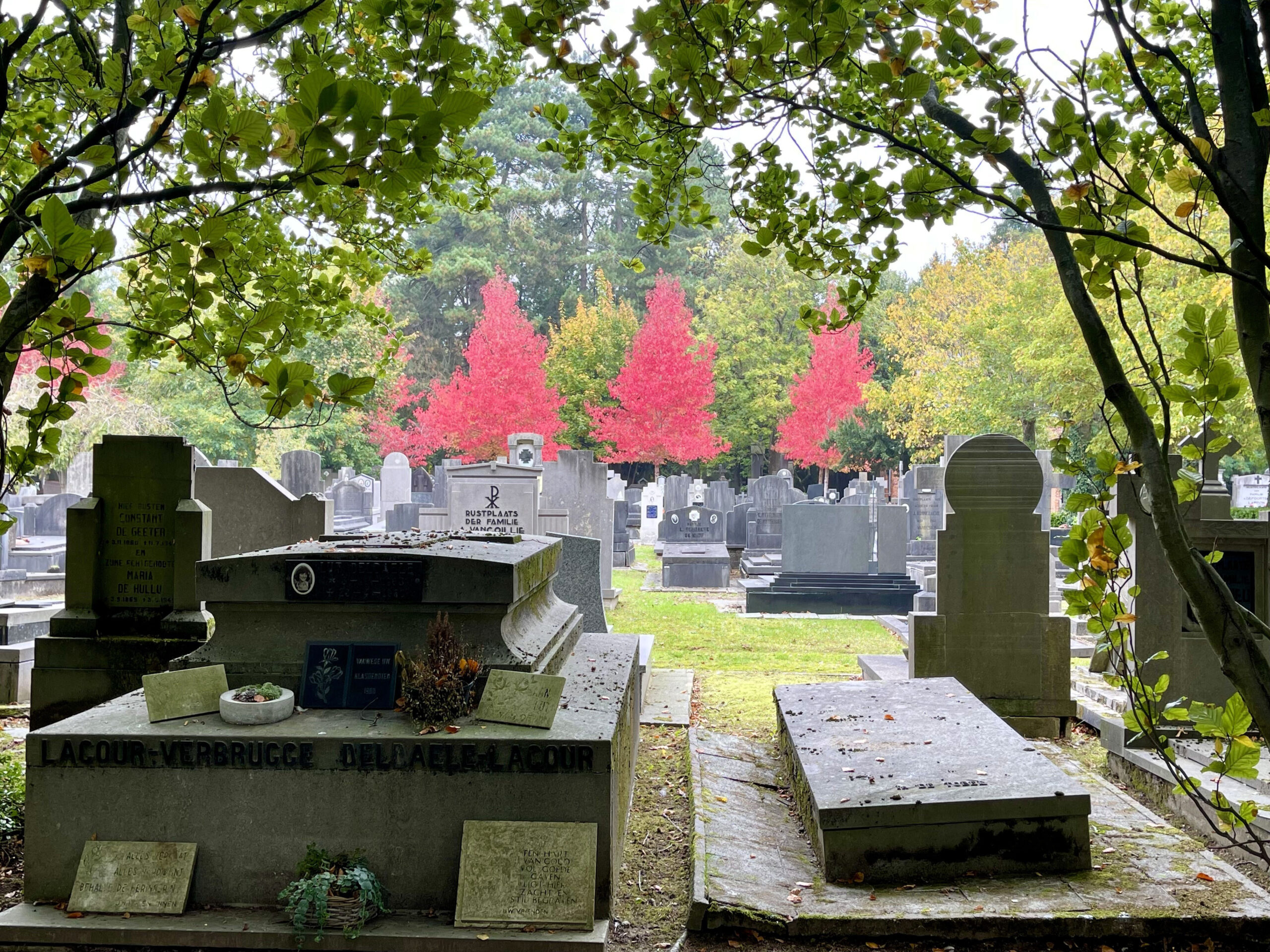
Parkbegraafplaats records the human cost of both world wars. The park cemetery contains the graves of French and Commonwealth soldiers and civilians, alongside the imposing tombs of notable local figures including Albrecht Rodenbach.
Art
The former bourgeois Sint-Amandskerk (St Amand’s Church) now has a very different purpose. It houses Het Kunstuur (The Art Hour), an immersive presentation of around 30 paintings by Belgian artists from 1850 to 1950. Well-known Flemish personalities explain their connection to individual artists or works, accompanied by music from Belgian composer Dirk Brossé. The selection changes each year.
Outside the church stands a statue of Albrecht Rodenbach, who campaigned for greater use of Dutch in education and culture. A grandnephew of one of the founders of the Rodenbach brewery, he died at 23. The bird perched on his hand symbolises the Flemish movement; a bullet hole in his right thigh is a remnant of the First World War.
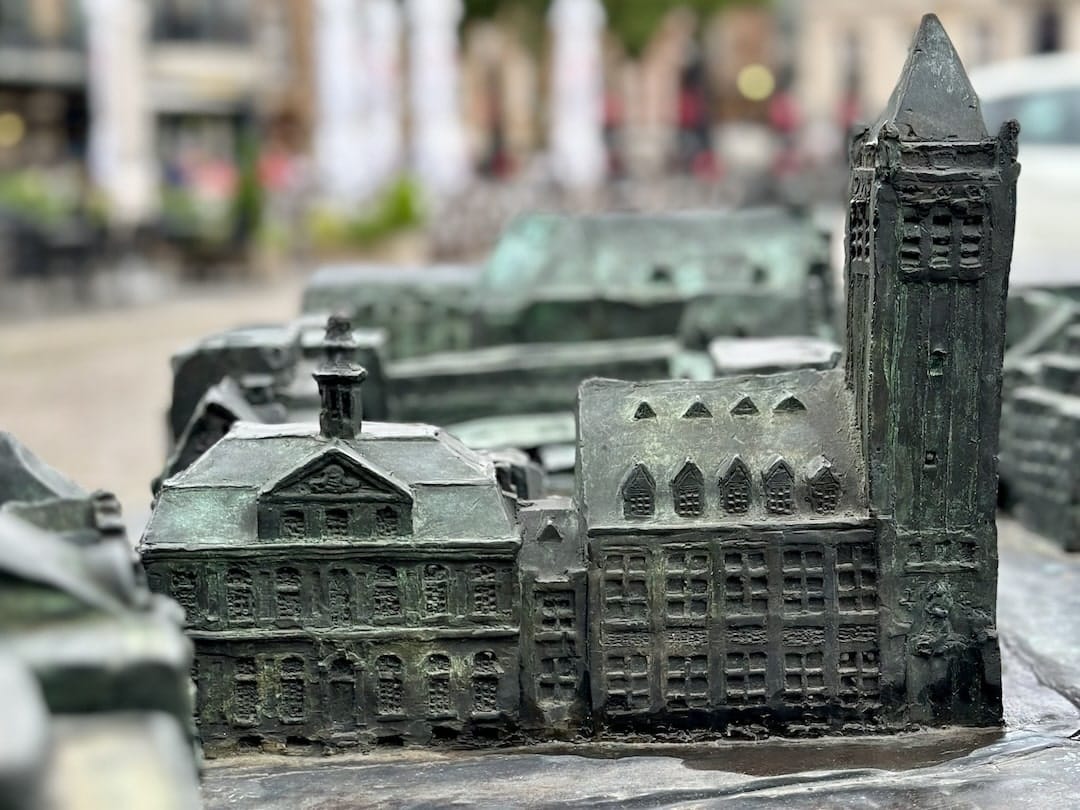
Belfort van Roeselaere.
Near Sint-Michielskerk (St Michael’s Church), a statue commemorates Adriaen Willaert, the Renaissance composer and polyphonist born in the area who pioneered antiphonal music – an early form of spatial or ‘stereo’ sound. A 5-km musical walking route uses QR codes to tell his story and introduce his work.
Tiny Citroenenstraat takes its name from a canopy topped by a sculpture of half a lemon. Contemporary art appears elsewhere on the city’s walls: the Visit Roeselare Street Art Tour takes in 14 murals, including an abstract portrait of Rodenbach and a caricature of Monseré. They are also listed on the Street Art Cities app. Roeselare’s family of giant puppets, meanwhile, appears at occasional local events.
Architecture
The Stadhuis (City Hall) brings together two periods of Roeselare’s history. The older section, built in the late 18th century, is an elegant example of Louis XV style; the newer part dates from the reconstruction after the First World War and includes an Art Deco belfry recognised by UNESCO, with a gilded bas-relief. Recent renovations have added an airy atrium, terraces, courtyards and rooftop gardens.
The nearby Klein Seminarie, a secondary school founded in 1802, was the scene of Rodenbach’s student protest in support of Dutch, an important episode in the Flemish movement. Poet Guido Gezelle, who taught there, is commemorated with a bust at the entrance. During the First World War, the school served as a hospital for German troops. Group tours are available.
Rodenbach’s name also lives on at ARhus – short for Albrecht Rodenbach House – a modern knowledge centre that locals call the ‘library of the future’. Behind its glass façade are digital facilities, teaching and meeting spaces, and an automated book-sorting machine.
Sint-Michielskerk and its 65-metre, 16th-century clock tower preserve another unusual tradition. The Roeselaarse Klokkengilde has rung the church’s carillon bells by hand every day for more than a century, a practice that survives in only a handful of Belgian towns. The bells mark almost every civic and religious occasion, including the start of the seasonal sales. Inside are historic paintings and an ornate Baroque wooden pulpit. Monseré’s funeral was held here.
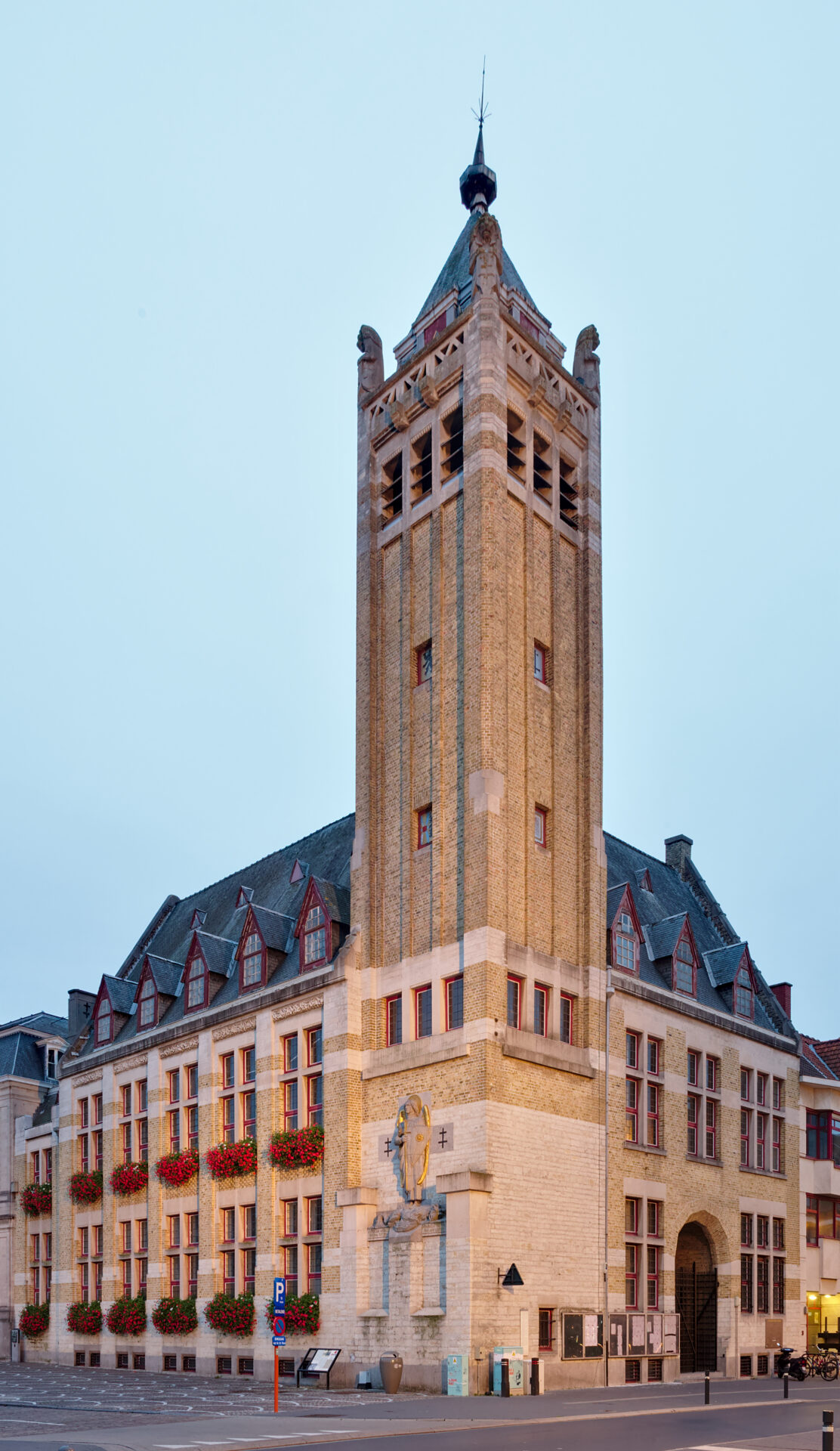
Belfry of Roeselare during civil twilight.
Just outside the city, Kasteel de Rumbeke provides an exception to Roeselare’s largely post-war architecture. One of Belgium’s oldest Renaissance castles, the 16th-century red-brick building has a distinctive black roof and is surrounded by a moat crossed by a small drawbridge. During the First World War it was occupied by German forces, including fighter pilot Manfred von Richthofen, the ‘Red Baron’.
Brass studs set into the pavement and bearing Rodenbach’s likeness mark an 8.7-km signposted route past many of the city’s main sights. Visit Roeselare sells a printed map in several languages, including English.
At the head of the Roeselare–Leie Canal, near Rodenbach Brewery, a 1933 grain silo is being converted into a lookout tower with panoramic views. Its first two floors will house an exhibition on Roeselare’s industrial history. The tower is due to open in 2027, with a nearby mural taking industrialisation as its theme.
Green spaces
Despite its industrial character, Roeselare is not short of green space. The Stadspark (City Park) links five green areas across four hectares and includes a pond, summer pedal boats, concerts and a pop-up bar.
Moermanpark, opened in 2025, makes more explicit use of the city’s industrial past. Its transparent black structures recall the paint factory that once stood on the site.
Outside the city, Provinciedomein Het Sterrebos surrounds Rumbeke Castle with 27 hectares of star-shaped woodland, its paths radiating through the landscape. The 34-hectare Bergmolenbos is another substantial green space and includes the Zilverberg orchard, with almost 100 varieties of fruit.
Experience
Batjes: A four-day shopping festival in June with sales, street entertainment, music, food and Rodenbach beer
Het Kunstuur: An immersive presentation of around 30 paintings by Belgian artists from 1850 to 1950, accompanied by commentary from Flemish personalities
Kerstmarkt: A December Christmas market with artisan stalls, live music, an ice rink, Ferris wheel and seasonal food and drink
Kunstenfestival Roeselare: Launched in 2026, a triennial January–March festival of contemporary art, performance, concerts, lectures and workshops
Paris MontmARTre: A September weekend fair during which Roeselare’s Grote Markt becomes an open-air artists’ studio
Rodenbachfeesten: A two-day cultural festival in September with music, circus and street performances inspired by the late Albrecht Rodenbach
Week van de Smaak: An October food festival with tastings, tours, workshops, masterclasses and special restaurant events
Savour
Alto: An intimate restaurant serving contemporary Belgian-inspired menus built around regional, seasonal ingredients
Boury: Tim Boury’s three-Michelin-starred restaurant, combining technically precise cooking with local ingredients
Brasserie Bellis: A friendly brasserie on the Grote Markt serving fresh, seasonal Belgian classics
Het Foederhuis: A brasserie inside the historic Rodenbach brewery, serving Belgian dishes and beer pairings beneath enormous oak foeders
KOERSkaffee: A relaxed café beside the KOERS cycling museum serving Belgian comfort food with a terrace overlooking the museum garden
Sanseveria: A relaxed café near the harbour serving simple food and Belgian beers
Sip & Snack
ARhus Café: A relaxed library café serving seasonal lunches, local products and cakes with books, newspapers and board games close at hand
Atelier Noisette: A pâtisserie run by two former Boury chefs, specialising in elegant pastries and inventive ice creams
Bar Giraf: A bar in the former rectory of Sint-Amandskerk, with small ‘living rooms’, a garden terrace and an extensive drinks menu
Barsista: A breakfast and lunch café serving creative dishes, homemade treats and Saturday brunch
Camillus Kookt: A café and eatery serving fresh lunches and desserts made with local ingredients, including vegan options
EuropArt: A brown café offering art sales, exhibitions and creative workshops
Louma: A casual restaurant and takeaway specialising in croquettes alongside Flemish classics
K-Trolle VZW: A relaxed pub combining drinks and art, with outdoor seating
Romen: An Art Deco café with a marble bar, original interior and garden terrace, serving Rodenbach on tap
Stay
Hotel Ter Zuidhoek: An 18th-century farmstead just outside the city, with spacious rooms, a garden terrace, breakfast and Hofstee restaurant
Hotel Vijfwegen: Near the city centre with modern rooms, breakfast, a terrace and cosy bar, plus Bistro Frogs restaurant
L’Inconnu B&B: A renovated 1941 townhouse near the Grote Markt, offering a spacious room, private living area, rooftop terrace and breakfast for two guests
Parkhotel: A modern three-star hotel opposite the railway station with 80 comfortable rooms and secure private parking
R&Breakfast B&B: A bike-friendly renovated townhouse in central Roeselare, with three spacious rooms, a private city garden and secure bicycle storage
Shop
Boost Moodshop: A four-storey design and gift shop selling functional objects, home accessories and furniture
Kaasboerderij ’t Groendal: A farm shop selling award-winning cheese as well as other dairy products
Rodenbach: The brewery shop, selling Rodenbach beers and branded merchandise
UNIEK Shop Gallery: Antique and decorative art, from paintings and ceramics to carpets and furniture
Visit Roeselare: Sells local, non-perishable food and beverage products
WANDL: An outdoor shop specialising in hiking clothing, footwear and equipment, with personal advice
