
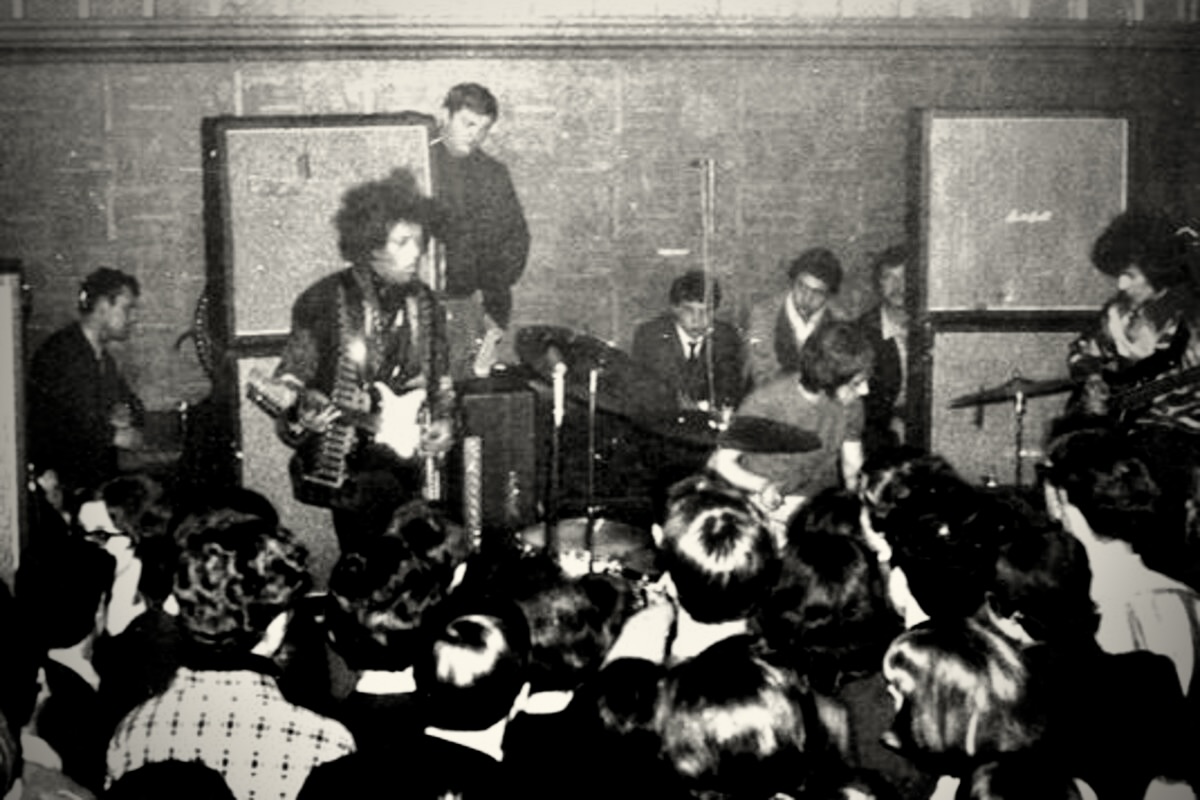
Before he became a rock god, Jimi Hendrix had a Belgian experience. In March 1967, the guitar hero turned up, tuned up and cranked the volume up a tiny upstairs club in Mouscron. Martin Westlake tells the unlikely story of a provincial music impresario, a future guitar legend and one extraordinary footnote in rock history.
Belgium has had more than its share of celebrity visitors, but few tales of big names in small places can rival what happened on Sunday, March 5, 1967.
That was the day Jimi Hendrix and his band, The Experience, played their first and only concert in Belgium before a live audience. Not in Brussels. Not in Antwerp or Liège. But in Mouscron, in Belgian Hainaut.
That’s right: Mouscron (the ‘s’ is silent).
Back in the 1960s, Jean Vanloo was a young Mouscron entrepreneur involved in a flurry of businesses around the fashionable boutiques of the Grand-Place. A former championship swimmer and member of the local water polo team, he had initially worked as a lifeguard and swimming instructor at the town’s old swimming pool.
But Vanloo’s real passion was modern music. Forever meeting musicians and organising events, he eventually abandoned swimming to pursue it full-time. The young impresario cut his teeth by organising Lille’s first rock festival in the old Palais des Sports. It was an encouraging success.
His father-in-law owned the Relais de la Poste restaurant at 18 Grand-Place in Mouscron and allowed Vanloo, who became his business partner, to transform its upstairs function room into a music venue.
Vanloo had spotted an opportunity. Mouscron was strategically positioned beside the French frontier and within easy reach of the industrial cities of Lille, Roubaix and Kortrijk. The town already had fashionable boutiques and clubs attracting young French and Belgian visitors in search of something new.
Billed as “un dancing jeune, pour les jeunes” – a young dance hall for young people – the Relais de la Poste flourished. One of Vanloo’s early catches was American rock ’n’ roll star Gene Vincent, who performed there in January 1963.
Twenty vision
In 1964, inspired by clubs such as Liverpool’s Cavern and London’s Marquee, Vanloo transformed the upstairs room into a proper music club, complete with a DJ booth for dancing nights.
He called it Le Twenty Club.
The business model was beautifully simple. Mouscron’s proximity to France meant Vanloo could tempt across rock singers and groups already touring there. Through a British contact, Rikki Stein, he could also approach up-and-coming British acts – many not yet widely known – happy to add performances in “Belgium” and “France” to their schedules.
It worked.
Le Twenty attracted an extraordinary roster of musicians, including The Moody Blues, Eric Burdon and the Animals, The Small Faces, the Yardbirds and the Kinks. A second Twenty Club opened across the French frontier in Lens, facilitating this improbable procession of future stars.
Its reputation has largely disappeared into the mists of time, but for a few years Le Twenty in Mouscron acquired something approaching mythic status.
And then Jimi Hendrix came to town.
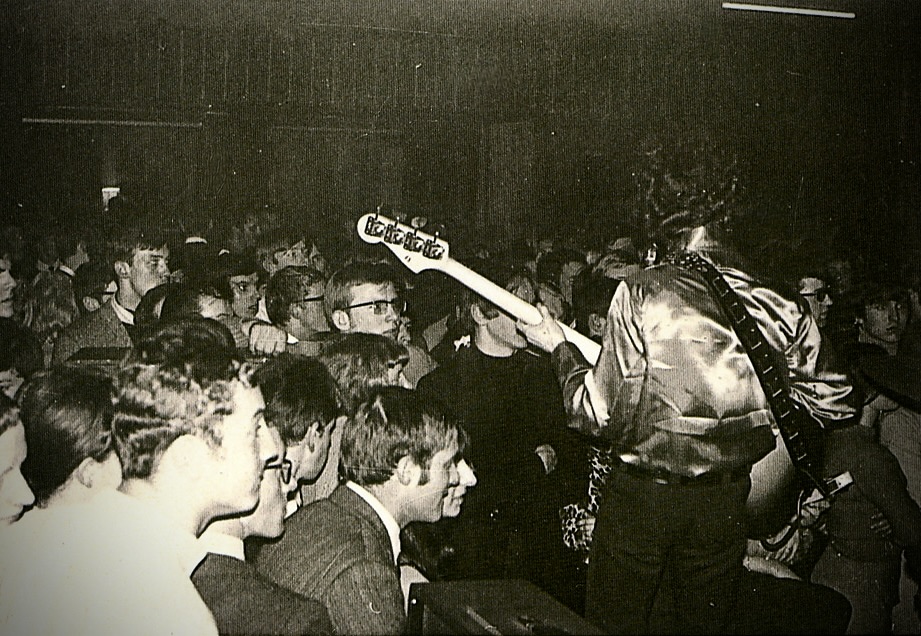
Jimi Hendrix.
Hendrix had arrived in London from New York in September 1966, brought over by former Animals bassist turned talent scout and manager Chas Chandler. His impact on Swinging London was almost immediate: on his first night in the city, he famously jammed with the house musicians at the Scotch of St James club.
Chandler soon assembled The Experience, with Noel Redding on bass and Mitch Mitchell on drums, to showcase Hendrix’s extraordinary talent. The group first performed together in France that October, supporting French star Johnny Hallyday.
By the end of the year, Hendrix’s reputation among British musicians was soaring, although he remained relatively unknown to the wider public. Then came the band’s version of Hey Joe, released in December 1966. It rapidly climbed the UK singles chart, reaching number six in early 1967.
The Experience returned to France early that year, this time supporting The Pretty Things.
Characteristically, Vanloo spotted his chance. He invited Hendrix and his band to Le Twenty.
They accepted.
No sleep til Mouscon
What happened next was recorded by the young French rock journalist Jean-Noël Coghe, who met Hendrix and The Experience in Paris and accompanied them to Belgium.
The musicians had managed barely three hours’ sleep before setting off for Mouscron.
Legend has it that when Vanloo’s wife Ginette saw Hendrix coming up the stairs, she initially refused to let him in. It is not difficult to imagine why he attracted attention. The 24-year-old was barefoot, dressed in red velvet trousers and a blue military jacket covered in brocade, with a bandanna around his long hair.
The set began at five in the afternoon.
The Experience played Killing Floor, Hey Joe, Like a Rolling Stone and Wild Thing.
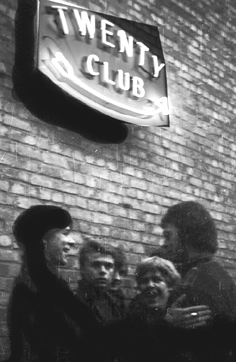
Jimi Hendrix in the Twenty Club in Mouscron.
Nobody present was likely to forget what happened next. Hendrix produced sounds from his guitar and amplifier unlike anything most of the audience had heard. The club owned a tape recorder, but, frustratingly for posterity, nobody thought to turn it on.
Le Twenty was packed to the rafters. Coghe later recalled the stunned reaction.
“He had a presence. He was tall, a little stooped, and had feline movements,” he said. “He went on stage, picked up his guitar, and struck his first chord. And then the audience took two steps back, even though we were already packed in tightly, because it was an incredible sound. Nothing like it had ever been heard before.”
There was little time to savour the moment.
Afterwards, the band packed up its equipment and headed across the border by back roads, fearing delays if customs officials stopped them.
At seven o’clock – just two hours after taking the stage in Mouscron – they were due to play their second gig of the day, at the Twenty Club in Lens.
Brussels calling
That night, the musicians stayed at a small hotel on Kortrijk’s Grand-Place. The following day, Monday, March 6, they drove to Brussels and checked into the Central Hotel opposite the Bourse.
The musicians and their entourage arranged to meet at the now-legendary Le Coq pub on Rue Auguste Orts, around the corner from their hotel.
While they waited, Hendrix doodled on a beer mat and left it on the table. After the group departed, Coghe picked it up.
“I discovered he had written three words, ‘Are you experienced?’”
They were prophetic. Are You Experienced would become the title of the band’s debut album, released just two months later. Coghe still possesses the beer mat, complete with Hendrix’s distinctive psychedelic lettering.
A photograph from Le Coq shows a smiling, relaxed Hendrix sitting in the bar. But that beer-mat doodle suggests that his mind was already on what came next.
The band’s destination that day was the French-speaking Radio Télévision Belge (RTB), which took the musicians to the Bois de la Cambre to film them lip-syncing to Hey Joe among the trees for the television programme Vibrato.
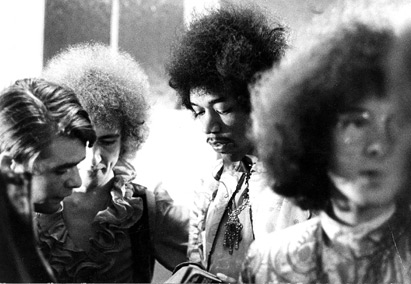
Jimi Hendrix.
The programme was broadcast on March 21. A few photographs survive, but the original film was not preserved.
Hendrix was also interviewed by Jan Waldrop for Humo magazine and by Coghe himself. That evening, the group ate at La Ligne droite, a now defunct restaurant on Petite Rue des Bouchers, before heading to the old Black and White club.
The following day, March 7, it was the turn of Flemish broadcaster BRT. Hendrix and The Experience travelled to its Waterloo studios to appear on the popular programme Tienerklanken.
Once again, Hendrix had to lip-sync.
This time, footage survives, albeit without the original soundtrack. There are no microphones or amplifiers and the guitars are not plugged in. An occasionally smiling Hendrix dutifully goes through the motions, but the musicians’ hearts are clearly not in it.
Later that day, the band flew back to London, while their equipment made the slower journey home via Ostend.
Born to be famous
Just over two months later, on May 12, Are You Experienced was released. The Jimi Hendrix Experience became a sensation.
The album spent 33 weeks in the UK charts and was prevented from reaching number one only by another epic record: The Beatles’ Sgt. Pepper’s Lonely Hearts Club Band.
The world Hendrix had inhabited in Mouscron was already disappearing. In June 1967, Le Twenty closed. The final band to perform there was the Yardbirds, with future Led Zeppelin guitarist Jimmy Page.
Vanloo, however, was far from finished with music. He moved into production and was later behind Patrick Hernandez’s enormous disco hit Born to Be Alive. In 1979, he spotted a then unknown 22-year-old Madonna auditioning as a dancer for a show he was producing in New York.
And, yes, he brought her to Mouscron too. She briefly stayed at his house.
Hendrix’s own extraordinary career was brutally short. He died in London on September 18, 1970, after taking sleeping tablets. He was just 27.
Noel Redding died in 2003, aged 57, and Mitch Mitchell in 2008, aged 62.
Vanloo died in 2000, also aged 62. During a remarkable career, he produced some 200 titles, sold more than 60 million records and opened several successful clubs. In 2018, his life was celebrated in the documentary Jean Vanloo: King of Clubs.
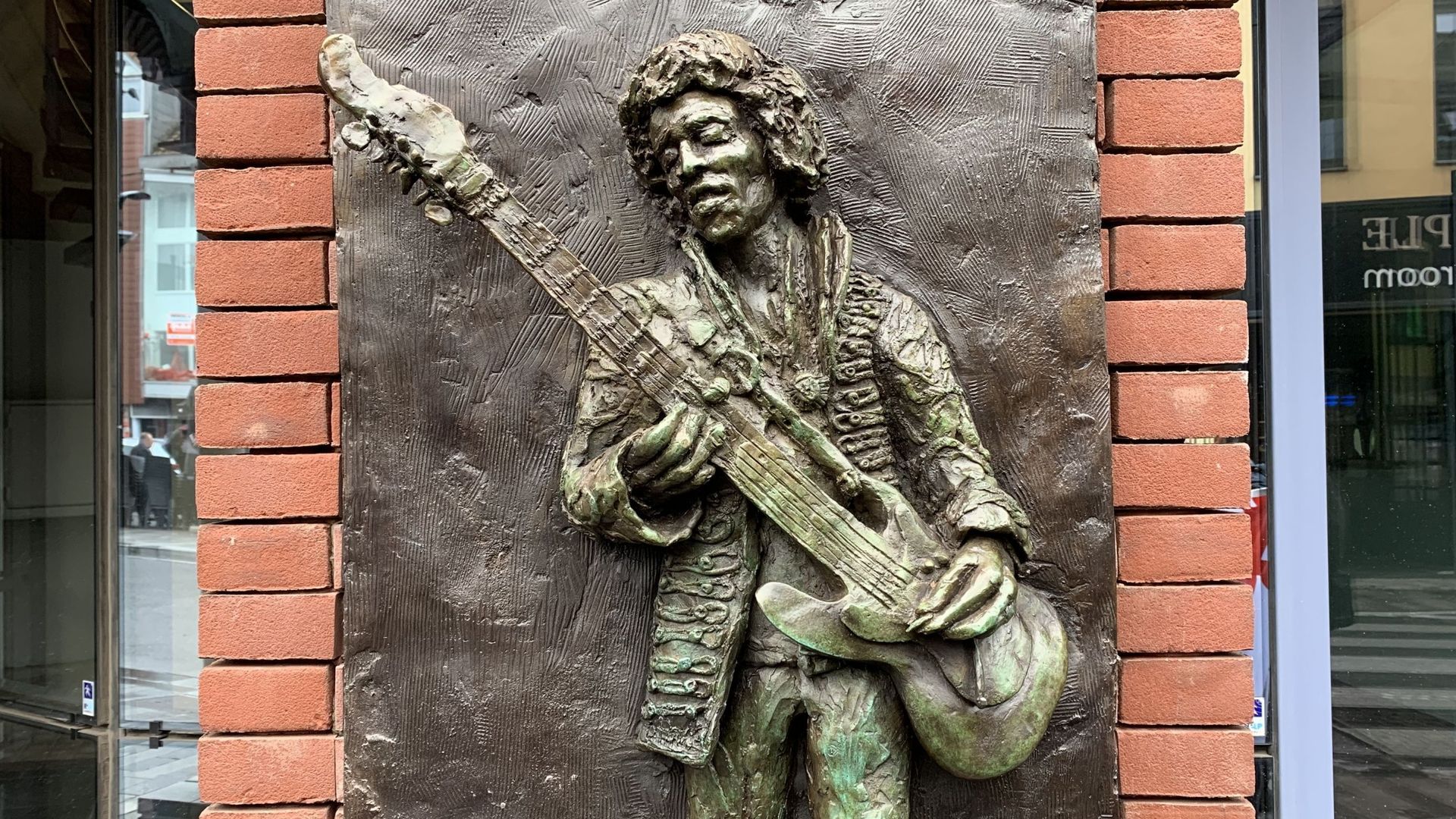
Jimi Hendrix relief.
Coghe, meanwhile, remains the proud keeper of his Hendrix-decorated Le Coq beer mat and a fragment of one of the guitarist’s straps.
As for Mouscron, today it is a town of some 60,000 inhabitants, a world away from the moment when a succession of young musicians who would soon become global stars climbed the stairs of Le Twenty.
The Relais de la Poste was eventually demolished and replaced by a bank. But the town has not entirely forgotten.
In March 2023, exactly 56 years after Hendrix’s performance, a bronze relief by sculptor Osvaldo Parise was unveiled on the wall of the bank standing where Le Twenty once welcomed Hendrix. It depicts the guitarist in full flight, eyes closed, electric guitar in his hands.
A permanent reminder of an improbable afternoon when one of the greatest guitarists in rock history came to Mouscron – and, for a few hours, a little club above a restaurant was one of the most electrifying places in Belgium.
