
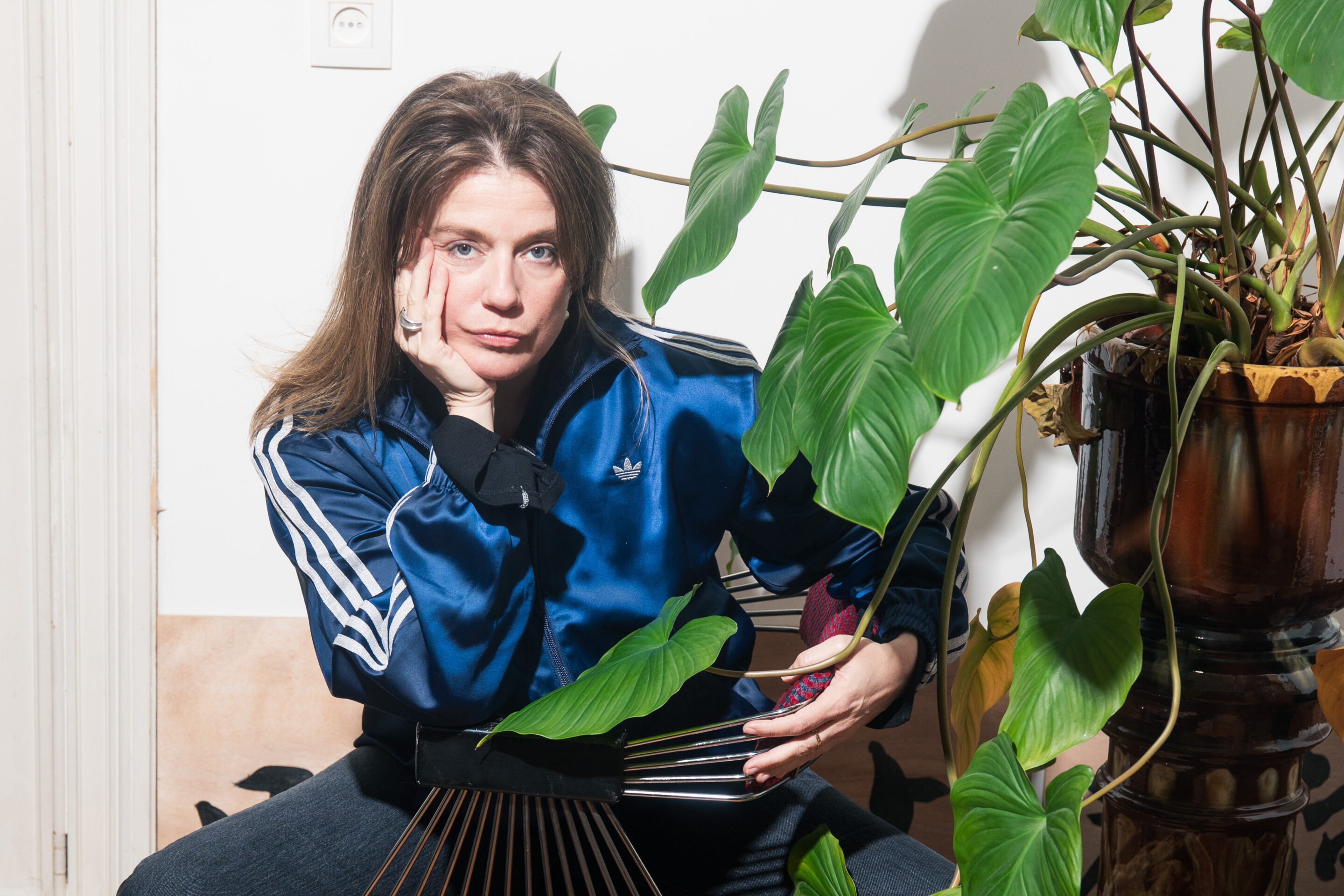
Miet Warlop has spent two decades making art that refuses to sit still – part performance, part sculpture, part controlled chaos.
Having represented Belgium at the Venice Biennale, the Brussels-based artist has reached a career high without losing her rebellious streak. She tells Sarah Schug about physical risk, creative freedom, unlikely collaborators and why performance should remain a “runaway place” outside the system.
I meet Miet Warlop at her home in Koekelberg, a Brussels maison de maître. Leaning against the wall on the ground floor, I recognise one of the plaster squares from her current exhibition-slash-installation-slash-performance in the Belgian Pavilion of the Venice Biennale, which runs until November 22.
To represent one’s country there is one of the biggest accolades an artist can receive. When we sit down at a large wooden conference table, she casually lights a cigarette. Later, we move into the lush garden to flee from what might be a hornet.
Warlop’s home is unlike a traditional painter or sculptor’s studio, surrounded by tools and completed works. She says her work, collaborative and conceptual, lives mostly in her head until she brings it to life in front of an audience. Turning those ideas into reality requires a team of performers, musicians and other collaborators, as well as the backing of theatres or other venues willing to take a chance on her vision.
That process has now brought her to Venice. Being selected for the high-profile international exhibition has also answered a question that has followed her throughout her career: where does her work belong?
Already at art school, her graduation piece brought living bodies together in a carefully arranged narrative. Since then, she has largely presented her genre-defying work in theatres, somewhere between contemporary art and the performing arts.
Her participation in the Biennale, however, places it firmly within the visual arts. She may not care much for labels, but “Venice kind of solved it for me. I don’t feel in between,” she says.
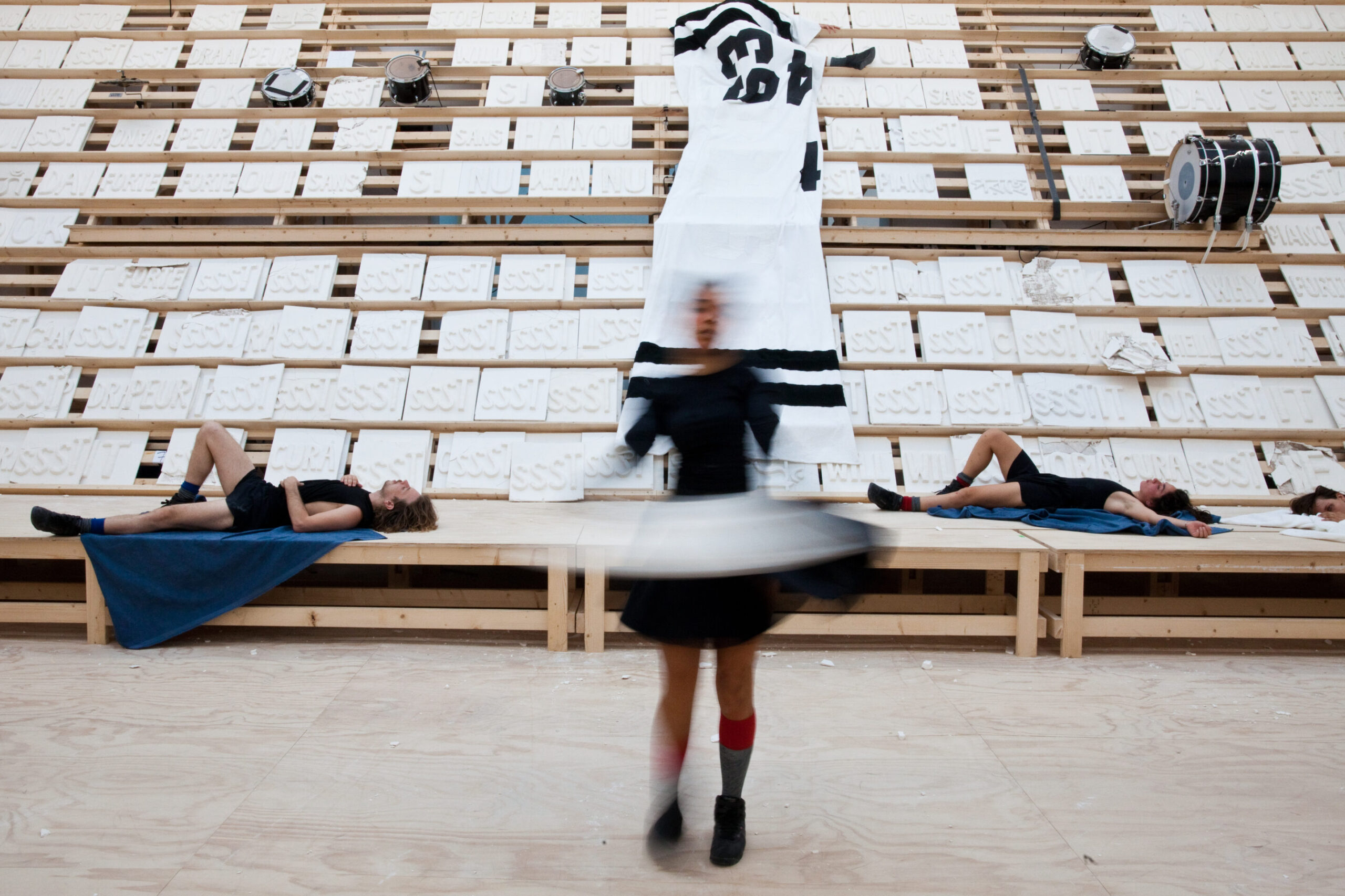
IT NEVER SSST - Miet Warlop
Titled “IT NEVER SSST”, Warlop’s Venice tour de force features a group of performers carrying dozens of heavy plaster pieces adorned with words (stop, sure, cura, if, …) that have been created on site, reading them out loud, and finally placing them on a bleacher-like wooden structure, all to the point of exhaustion and accompanied by a pulsating soundtrack.
It’s a collective work, where each person carries their own burden but ultimately connects with the others.
Blending sculpture, performance, music and installation, the ritual-like, repetitive and ever-changing goings-on in the pavilion evoke the chaos and overwhelm of today’s world that never stops (“IT NEVER SSST”), along with a longing for human connection. “I try to show something we kind of all deal with, but don’t really talk about. The condition of life, in a way,” she says.
The constantly-in-motion artwork has received acclaim from audiences and critics alike.
The response has surprised Warlop, and she has even watched people shed tears: “There is this big circus going on outside, and there are 120 people in the pavilion, queuing, bumping into the work, but it’s super silent, and I see Chanel glasses going up, people touching up their make-up. It’s this mega honest, naked moment. And I think, okay, at least something is felt.”
For her, it was also “a celebration of the last 20 years”. The multi-layered creation is a culmination of Warlop’s two-decade practice, where every work flows into the next. “It’s not like: I have an idea, let’s do it. In my trajectory, things are interwoven, and they have to grow on me. Everything is built on what came before,” she says.
Experimental nostalgia
Despite her credentials, she was apprehensive about how people would react. “You decide something behind closed doors, and then you don’t know if it will touch other people, if the hand that you stretch out is going to be taken. That’s the most frightening part,” she says.
Warlop describes her artistic path as a 20-year conversation with her audience that has evolved over time: in the beginning, she felt almost ashamed to ask people to sit down and give her their time. But not anymore. “I feel appreciated now,” she says.
Still, she can’t help feeling nostalgic for the start of it all: “The beginning years are much more exciting, because not everything is fixed yet. There were less rules, and more trust.” She was more rock and roll then, she says, but perhaps also less careful.
Warlop cherishes the experimental, playful, slightly wild element of the art form. Now, she has adjusted her position a bit, stepping away at times from the eye of the storm.
She had to learn how to let go – something you cannot avoid when a performance runs over several months and includes so many different moving parts and people.
“I cannot do everything anymore. I had to learn to be outside of the work and be constantly looking at it, while I had been used to making the work from the inside.”
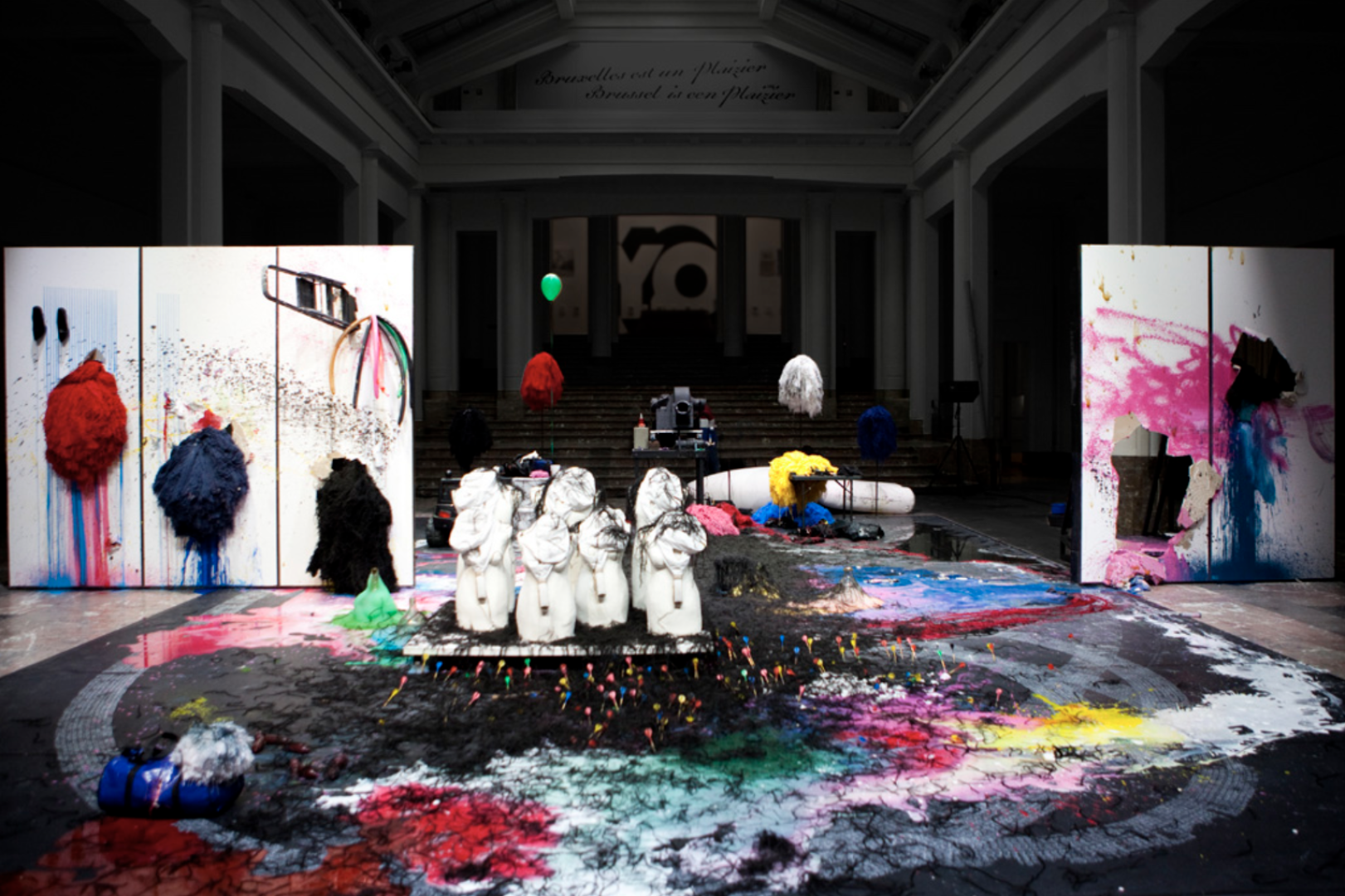
Mystery - Miet Warlop.
But sometimes, she needs to be back in the thick of it. In her view, performance is a shared outcome, but not a shared initiative. “I kick everybody out, I lock myself up for a weekend in the venue, and then I just reenact them, to see what they [the performers] actually have to do,” she explains.
Warlop believes in an active, involved directing style: “Before you ask somebody to do something, maybe just try it yourself once, to see how it feels.”
She has tried it all herself. Her neck is still making weird noises after she jumped through a G-block wall 200 times because nobody else would do it. “I almost broke my neck,” she says. “Many times. But you just do it because you believe in something.”
A lot of her working process is physical exploration, surrounded by a myriad of different objects and materials. “I start from: what is the weight of something? Can you hold it? Can you sit on it? What does it mean if you drop it? How does it bounce? What sound does it make? It’s a lot of experimenting,” she explains, adding: “I first figure out which material I want to use to express the inside of my head in an image.”
Casting characters
One recurring element is the use of plaster. “I like that it’s a very direct material, its reaction from calc to water, then it heats up, and it stiffens, and puts itself in the space,” she says.
She has experimented with it enough to know that even its sound changes with age. “If you drop a plaster sculpture, it makes a completely different sound after one week than after one month.”
But objects and materials are only one part of the equation. “I’m a crew person,” she says. Yet she is not interested in simply assembling the most accomplished people she can find. “What I like to do is to make unusual choices in who I work with. Because I don’t believe in a line-up of stars. I rather believe in putting characters together who lift each other up in a strange way.”
She looks for musicians and performers who understand her work, and she has many frequent collaborators. The result is something like a band, with Warlop as its leader. Unlike a classic visual artist whose work is made once and then exhibited, Warlop takes hers on tour, bringing each piece to life through the people who perform it night after night.
Not every movement can be planned, and not every detail can be controlled. One side needs trust – and the other conviction.
“The performers have to stand behind it completely. Because you don't want them to suddenly do something else, out of discomfort for example. People management is a big part of the job.”
A runaway place
Warlop says becoming an artist was never a conscious choice but rather something that happened organically. She chose art school for what she describes as its “mentality of resistance,” not because she particularly loved drawing or saw herself as an artist. “That was what was left over for me.”
It was only recently, she says, that she caught herself saying it for the first time: “I’m an artist.”
That mentality of resistance has remained deeply embedded in her mindset. She still sees performance as a kind of rebellion – one that she worries might get lost if the art form becomes too institutionalised.
“For me, performance was always a way out. A runaway place, outside of the system.” And when it’s taught, categorised and poured into a fixed mould, “maybe a very vital part of what performance is will be taken away,” she says.
And yet, this runaway place has brought her to Venice, where Warlop finds herself at the centre of one of the art world’s most established institutions, with a practice that was never supposed to neatly fit inside one.
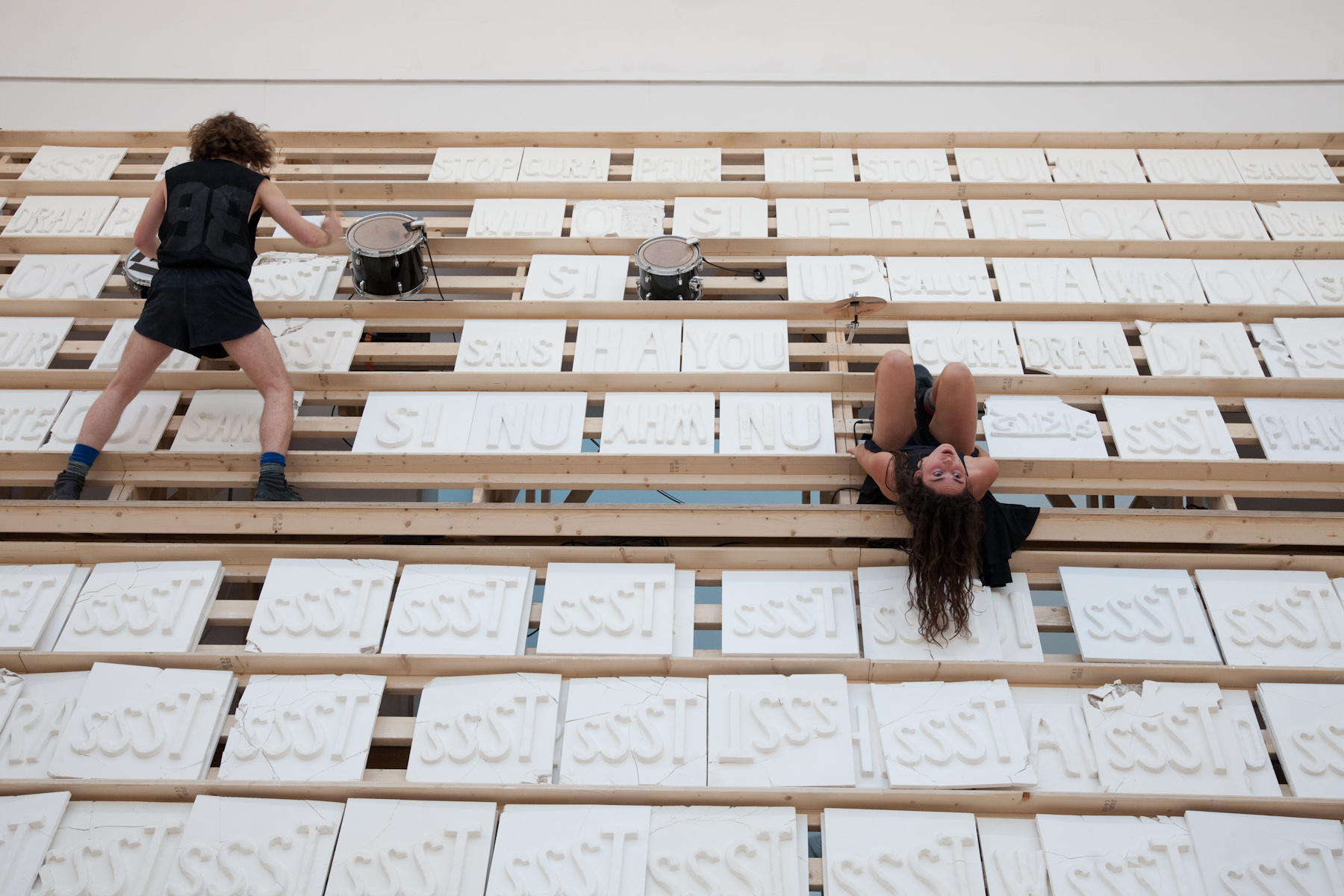
IT NEVER SSST - Miet Warlop
Venice may be a kind of arrival, but she has never seemed particularly interested in staying put. That may be part of what draws her to Brussels, where she settled relatively recently. In Flanders, she built a faithful audience and showed her work across the art circuit.
Now, she wants to conquer the Belgian capital.
After a while, she says, “you want to place yourself in a more realistic environment.” Brussels offers precisely that.
“You have like 300 different cultures coming together here, people that are coming and going, and there’s less of a village kind of mentality. It’s not a sweet cat, Brussels. You have to know how to move in it,” she says. “I would love to be more involved. This is my next step.”
Beyond that, there is no master plan. After such a high as the Venice Biennale, she is surprisingly unworried about what comes next. “I have a lot of fears, or anxieties sometimes, but I don’t have it with my work.”
She describes making art as a kind of addiction: “I learn so much through making a work that every day that I do nothing, I find myself poorer than the day before. Because I didn't learn or understand something new.”
So she keeps moving, without knowing exactly towards what. “There’s always a new door opening.”
Warlop presents herself as fearless in her art. But when it comes to hornets in the house, she draws the line.
