

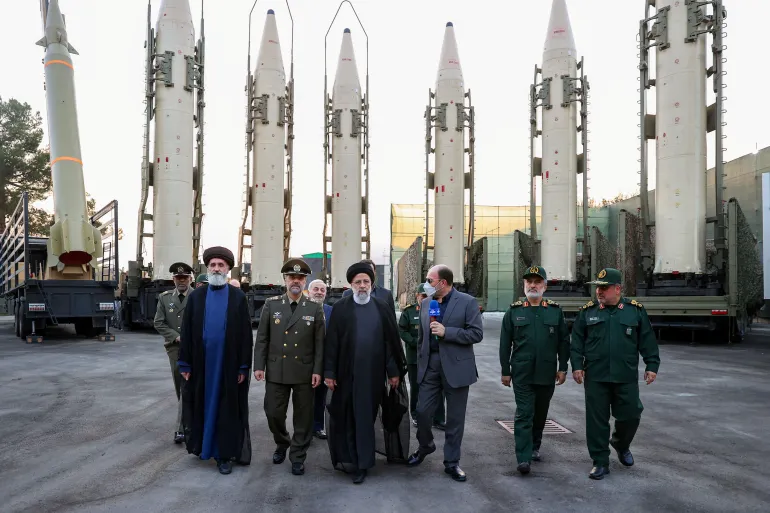
In a strongly worded statement on Friday, Josep Borrell, High Representative for EU’s Foreign Affairs and Security Policy, condemned the recent transfer of Iranian-made ballistic missiles to Russia.
“This transfer is a direct threat to European security and represents a substantive material escalation from the provision of Iranian UAVs and ammunition, which Russia has used in its illegal war of aggression against Ukraine,” he says on behalf of the EU in the statement. The G7 Foreign Ministers of Canada, France, Germany, Italy, Japan, the UK and the US have also condemned Iran’s missile export.
The evidence of Iranian missile deliveries comes in the midst of a critical phase in the war when Russia is escalating its air attacks against Ukraine with ballistic missiles and drones. Half a month ago, at the informal foreign affairs council meeting in Brussels, Borrell said that the EU had no proof of missile deliveries.
During the meeting he had been in contact with the new Iranian foreign minister, Abbas Araghchi, expressing his concerns about Iran providing ballistic missiles to Russia. The minister replied that it was false information. Recent media reports, however, disclosed that Iran is shipping some 200 close-range missiles of the Fath-360 model. They can be used by Russia within weeks close to the front lines in Donbas.
According to the statement, the recent Russian attacks prove its “clear determination to continue its brutal war of aggression against Ukraine and its people, notably targeting critical energy infrastructure, trying to cause the highest possible loss of civilian life and inflict large-scale devastation. Iranian ballistic missiles could now be used to cause further suffering and destruction in Ukraine.”
Iran’s deliveries of drones to Russia have been known since Autumn 2022 but the EU was slow to admit it and decide on sanctions against Iran for its military support of Russia. Until now, these sanctions have not been very effective and have been circumvented with Iran continuing its production of drones.
In the beginning of the war, European companies played an important role in Iran's supply chain for the production of the military drones that had been delivered to Russia. By now, engines have already been reverse-engineered and are being manufactured in Iran which found ways to circumvent the European embargo.
The EU says that it will respond swiftly and in coordination with international partners, including with new and significant restrictive measures against Iran, including the designation of individuals and entities involved with Iran's ballistic missile and drone programmes. It is also considering restrictive measures in Iran’s aviation sector.
Iran is not only supporting Russia's war of aggression. It also destabilizing the Middle East by supporting terrorist organisations in the region that act as its proxies. On Sunday, a ballistic missile was fired at Israel by the Iran-backed Houthis in Yemen. Hezbollah in Lebanon is heavily armed with Iranian drones and more than 120,000 rockets and missiles, including hundreds of Fateh – 110 missiles with a range of 300 km.
In fact, the Middle East reached a critical level directly after 7 October last year, when Hezbollah started unprovoked strikes against Israel in solidarity with Hamas. The cross-fire has escalated again and can erupt to full-scale war by miscalculation if no diplomatic solution is found soon, with devastating consequences for both countries, especially if Iran would coordinate an attack with Hezbollah.
High Representative Josep Borrell was travelling last week to Egypt, including the Egyptian side of its border with the Gaza Strip at Rafah, and Lebanon. In his press remarks in Beirut, he stressed among others the need for a comprehensive peace in the region and urged the Lebanese government to work for the interests of the Lebanese people and no-one else, indirectly referring to Iran.
