
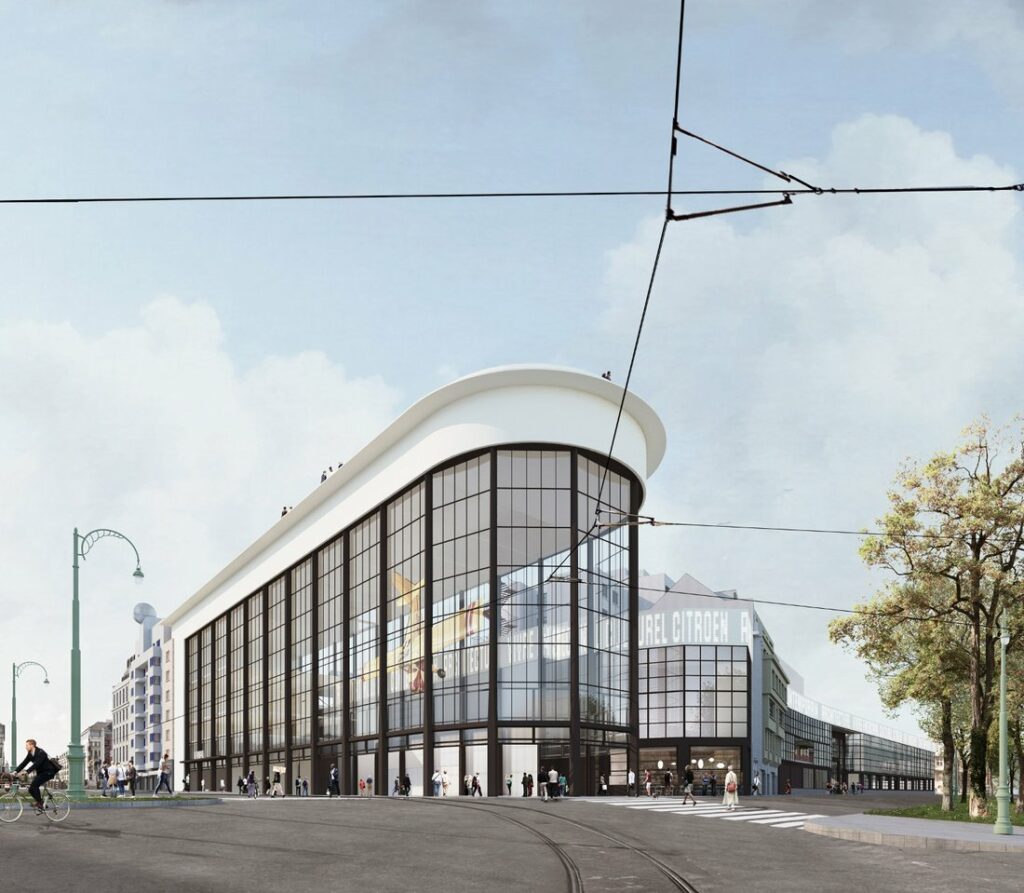
After years of anticipation (and a few delays), Brussels’ Kanal-Centre Pompidou is finally set to reopen in 2026. Positioned as the city’s new cultural epicenter, it promises to be more than a museum. But beyond the marketing and glossy renders, one question keeps coming up: who is this really for?
Because while it’s exciting to see investment in contemporary art and culture, the reopening of Kanal raises bigger questions about identity, access, and what kind of city Brussels wants to be.
From Car Garage to Cultural Giant
Kanal is housed in a former Citroën garage—a vast, industrial building on the edge of the canal, where the city’s north meets the center. The location is symbolic: right at the border of wealthy and working-class Brussels, French-speaking and Dutch-speaking communities, old power and new generations.
Transforming it into a museum is a bold statement. The space is raw, massive, and deliberately different from your average white-cube gallery. It’s meant to feel open, democratic, and inclusive.
But that’s the vision. Now it’s time to see how it plays out.
A Brussels Museum… with Parisian DNA?
Here’s where things get complicated. Kanal isn’t just a Belgian project—it’s built on a partnership with France’s Centre Pompidou, one of Europe’s most powerful art institutions. That means some of its collection, curatorial approach, and cultural logic are imported.
And while having the Pompidou name might help attract tourists and legitimacy, it also raises questions: can you build a truly Brussels museum with someone else’s voice at the core?
Brussels is not Paris. It’s messy, multilingual, underfunded, and often overlooked in cultural policy. If Kanal wants to be meaningful, it needs to reflect that complexity—not hide behind borrowed prestige.
Representation Matters: Who Gets a Seat at the Table?
One of the big promises made by Kanal’s leadership is accessibility. The idea is that it won’t just be a museum for the elite, but for everyone—especially those who live nearby, in one of the most diverse and overlooked areas of the city.
That means:
- Programs in multiple languages
- Affordable or free access
- Collaborations with local artists and communities
- Support for emerging and experimental work
In theory, this sounds great. But in practice, a lot depends on who’s in charge of programming and curation. Are decisions being made with local artists and residents in mind—or just with international prestige in focus?
This isn’t just about “inclusion” as a buzzword. It’s about shifting cultural power, making sure Brussels’ artistic future doesn’t look like its past: white, exclusive, and top-down.
The Stakes Are High—But So Is the Potential
Brussels is full of creativity. The city has no shortage of talent—it has a shortage of support and visibility. Kanal has the potential to change that, to become a platform where artists from all backgrounds feel seen and heard.
But that depends on more than just architecture or exhibitions. It depends on trust, transparency, and real investment in the communities that make Brussels what it is.
Because if the museum ends up being just another shiny place for tourists and international art collectors, then we’ve missed the point.
What Should We Expect?
Right now, it’s too soon to say how things will unfold. The opening is scheduled for 2025, and a lot is still in progress. But here’s what to look out for:
- Who’s being exhibited? Are we seeing Belgian and Brussels-based artists, or mostly imported names?
- Who’s leading the conversation? Are there curators and directors from underrepresented communities?
- Who’s being welcomed in? Are locals and young people actually showing up—or do they feel alienated by the space?
If Kanal gets it right, it could help redefine Brussels’ cultural identity—not as something centralized and polished, but as something vibrant, complex, and rooted in real life.
But if it misses the mark, it risks becoming another institution that looks great on paper, but says little to the people it’s meant to serve.
Culture should reflect the city it lives in. And in a place like Brussels, that means doing more than just opening the doors. It means letting new voices take the mic.
