

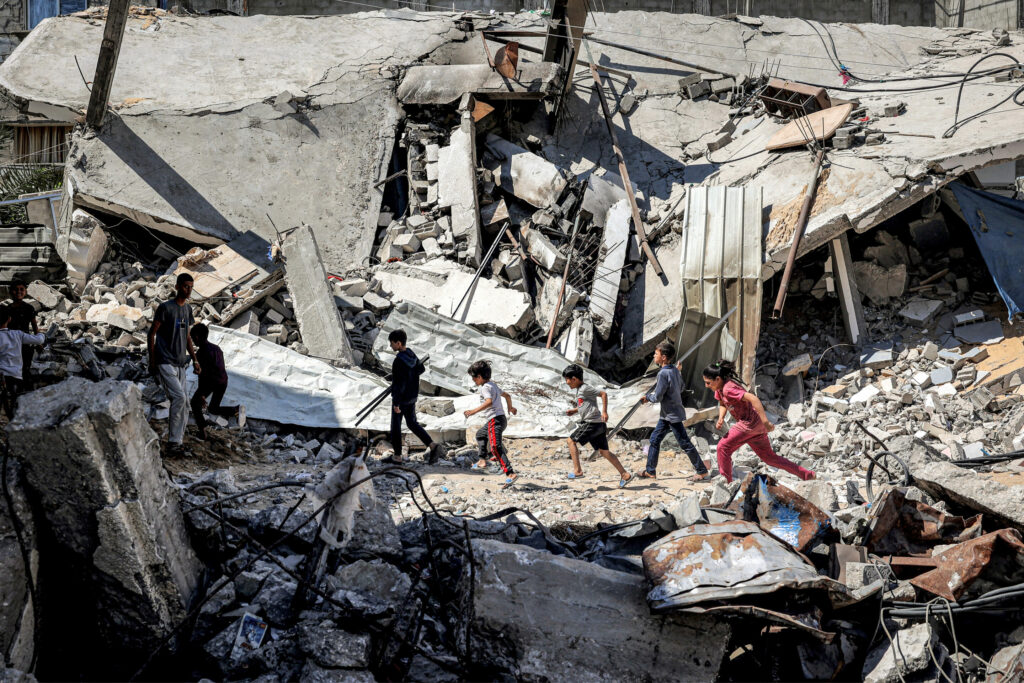
Expectations are high that Israel’s Prime Minister Benjamin Netanyahu and US President Donald Trump at their meeting in Washington on Monday will announce a ceasefire-hostage deal after Hamas responded positively to the proposal and said that it was prepared to enter talks immediately on how to implement it.
The new proposal by Trump’s Middle East envoy Steve Witkoff has been modified or mediated by Qatar. It is a version of previous proposals which could have been implemented in the past if it were not for Israel’s objections.
Hamas still holds 50 Israeli hostages, of which 20 are believed to still be alive. The Israeli chief of staff has warned that their lives are endangered if the war, which already has exhausted its goals, continues.
The deal would see the release of 10 living hostages and the remains of 18 hostages in return for Palestinian security prisoners during a number of occasions over a 60-day long ceasefire. The families of the hostages have consistently demanded the release of all hostages at one occasion without leaving any behind and an end to the war.
Hamas has reportedly requested some changes in the proposal. After Israel broke the previous ceasefire and resumed the fighting in March, it wants ironclad guarantees that the talks on a permanent ceasefire ending the war will continue until such an agreement is reached. Trump has this time announced that he will personally guarantee this and put pressure on Israel. Other countries might also do it.
The Palestinian civilian population has been displaced to about 20 % of the Gaza Strip during the still on-going Israeli offensive. The Israeli army controls most of the rest of the territory. Israel is expected to withdraw from all of the Gaza Strip to pave the way for a political solution the “day after” but it seems not clear to which positions it will withdraw during the first phase of the ceasefire.
A crucial amendment raised by Hamas is an end to the distribution of humanitarian aid by the American Gaza Humanitarian Foundation (GHF) and a return to the UN agencies and international humanitarian organisations that previously were in charge of providing and distributing humanitarian aid. In this way, aid would be distributed in line with international humanitarian principles.
Since the GHF took over, the aid distribution has become chaotic at the few distribution centres in place in the southern part of the Gaza Strip. The Israeli newspaper Haaretz reported recently that starving people are risking their lives when coming to collect aid packages and are being shot at by Israeli soldiers. The security guards employed by GHF have lost control of the distribution centres.
Humanitarian aid distribution crisis
The Israeli Prime Minister seems vacillating between closing a deal with Hamas or jeopardizing it with imposing new conditions after his far-right ministers in the government are threating again to break up the government if he stops the war and allows humanitarian aid into Gaza while Hamas still in power. The ministers from his own party continue to believe in “military” pressure until “total” victory.
His office issued a contradictory statement at midnight Saturday. On the one hand, it says that the changes that Hamas is seeking to make in the proposal are unacceptable to Israel. On the other hand, Netanyahu directed that the invitation to proximity talks be accepted and that the contacts for the return of the hostages to be resumed. An Israeli negotiating team travelled to Qatar on Sunday.
A new condition raised by Netanyahu for accepting the proposal is that Israel keeps control of the Morag corridor which intersects the southern part of the Gaza Strip. A similar condition concerning the Philadelphi corridor between Gaza and Egypt served as a pretext not to end the war and derailed the ceasefire talks last year.
The impression is that he is prepared for a partial deal and temporary ceasefire but reserves the “right” to resume the war after two months. This will satisfy his electoral base and the extremists in the government and enable him to keep his government intact over the summer recess of the Israeli parliament until October.
It cannot be excluded that he is not primarily caring for his political survival but believes that there is a historic opportunity to change the map and displace the Palestinians from Gaza to other countries. Whatever his motives, missing this chance for a ceasefire-hostage would be disastrous for both Israelis and Palestinians.
Continuing the senseless war will endanger the lives of the hostages still alive, cost the lives of tens of Israeli soldiers and hundreds of innocent Palestinian civilians, most of them children and women, and permanent an intolerable disastrous humanitarian situation in Gaza. Israel and the US would also lose an opportunity to expand the Abraham peace accords with more Arab countries.
Last but not the least it will continue to serve as a pretext for Iran to continue its intransigent policy of existential threats against Israel. New talks between the US and Iran on reaching an diplomatic solution to its nuclear programme and other issues are expected to take place in Oslo next week.
The EU finds itself again sidelined by the Trump administration in the current efforts to bring about a ceasefire-hostage deal which will result in the immediate delivery of humanitarian aid at scale to those in need in Gaza and likely result in a permanent end to the war.
The EU and its High Representative for EU foreign affairs, Kaja Kajas, are eager to play a diplomatic role and have open channels with the Israeli government. The EU has a clear policy on what is needed right now on the ground and how to solve the Israeli- Palestinian conflict. It has leverage and can also use it in talks with Iran.
An EU spokesperson for EU foreign affairs said last Friday that Kaja Kallas is vocal and has talked to the Israeli foreign minister. But her message has apparently not got through as the Israeli government continues to be in denial about the situation in Gaza and in the Westbank despite the credible reporting in media. Criticism of its policy is dismissed as antisemitism and support for Hamas.
