I’ll be honest. I was a disastrous driving student. On the last day of my lessons, I nearly killed myself and my instructor.
But I’m getting ahead of myself.
Let’s start at the beginning.
In the winter of 1976, I was 18, full of confidence and ready to get my Belgian learner’s permit. My father, ever enthusiastic, insisted on teaching me himself. In hindsight, that was a mistake. Just as a doctor shouldn’t treat his own family, a father probably shouldn’t teach his children how to drive.
One cold morning, we went to Rue de Bonne, near the tram depot at the border of Anderlecht and Molenbeek. He handed me the keys to his old blue Opel. I was excited and confident, but completely clueless.
“Alright,” he said. “She’s yours.”
I turned the key. The diesel engine roared. I pressed the clutch, shifted into first, and released it far too quickly. The car lurched forward and abruptly stalled. I did it again. My father’s face turned crimson. He threw up his arms, shouting contradictory orders.
“The clutch. No, the accelerator. Not so much. What are you doing! Stop!”
That was the end of our lessons.
A few days later, when I timidly asked for another go, he just shook his head.
“I care too much about our health to go through that again.”
So I enrolled in a proper driving school in Anderlecht. That’s where I met Meneer B, my unfortunate instructor. I call him unfortunate because I was his student.
He was short and stocky, always in a suit and tie, never without his cigar. He smoked even in the car, filling the little Peugeot with thick, acrid clouds that clung to the fabric. It smelled like burnt leather.
“Have you driven before?” he asked, his voice tight.
I thought back to the Opel disaster and mumbled, “Once.”
“Good,” he said, lighting another cigar. “Then you know how dangerous it can be.”
We drove down a quiet road near Scheut, where informal gardens and scattered allotments stretched not far from Prince de Liège. Meneer B gave instructions through a haze of smoke.
“Press the accelerator gently. Release the clutch slowly. It’s a balance. Slowly.”
I tried. The car jerked. I turned on the wipers instead of the indicator. Confused the brake with the clutch.
Meneer B let out a weary sigh, drove us back to the office himself, and snapped at the driving school manager as he stepped out. “You got me another disaster. God help Belgium.”
To be fair, he wasn’t wrong.
Still, I came back. Maybe it was the embarrassment, or maybe because of it, but I wanted to prove I could do it. As a Moroccan teenager in a city that didn’t always embrace difference, I needed to believe I belonged.
I don’t think Meneer B or the manager understood that. To them, I was probably just another failed immigrant attempt.
But to me, it was personal.
And as the lessons progressed, I began to realize that my assumptions about these people, especially Meneer B, weren’t entirely fair.
Driving wasn’t just about gears and clutch. It was about finding space. About being seen in a place that often looked past people like me.
Over the next few weeks, I gave Meneer B every reason to retire early. I stalled often. His face turned red, his knuckles whitened, and his cigar burned down faster than usual.
But he endured me. Maybe because he had to. Or maybe, though I only understood this much later, because he chose to.
Beneath his natural gruffness, which I had mistaken for rudeness, there was something steady. Even kind. He never looked down on me. Never made me feel small. He treated me like any other inept student, no better, no worse.
That might sound trivial, but back then a name like mine marked you as an outsider before you even spoke. With Meneer B, I never felt that. No prejudice. No condescension. He was brusque by disposition, but he treated everyone the same, even the driving school manager, whom he often dismissed with curt Flemish words.
Over time, things improved. Slowly, painfully, but surely. I learned to listen to the engine. To feel the clutch. To sense the Peugeot’s moods.
Eventually, I completed my hours and became eligible for the final road test.
I was nervous that day. Meneer B even more so. When stressed, he switched from hesitant French into rapid, razor-sharp Flemish.
It was just before nightfall. The sky was low and gray, heavy with the threat of snow. Meneer B was already waiting, coat buttoned, cigar in hand.
“Finally,” he said, sounding relieved. “My last lesson with you. Test day. Get in and drive.”
We set off.
Meneer B guided me along Chaussée de Ninove, past the canal, the Belle-Vue brewery, and Le Petit Château, where two soldiers stood stiffly by a heavy wooden door. The Marché Matinal was winding down, shutters half-drawn, a few late shoppers haggling.
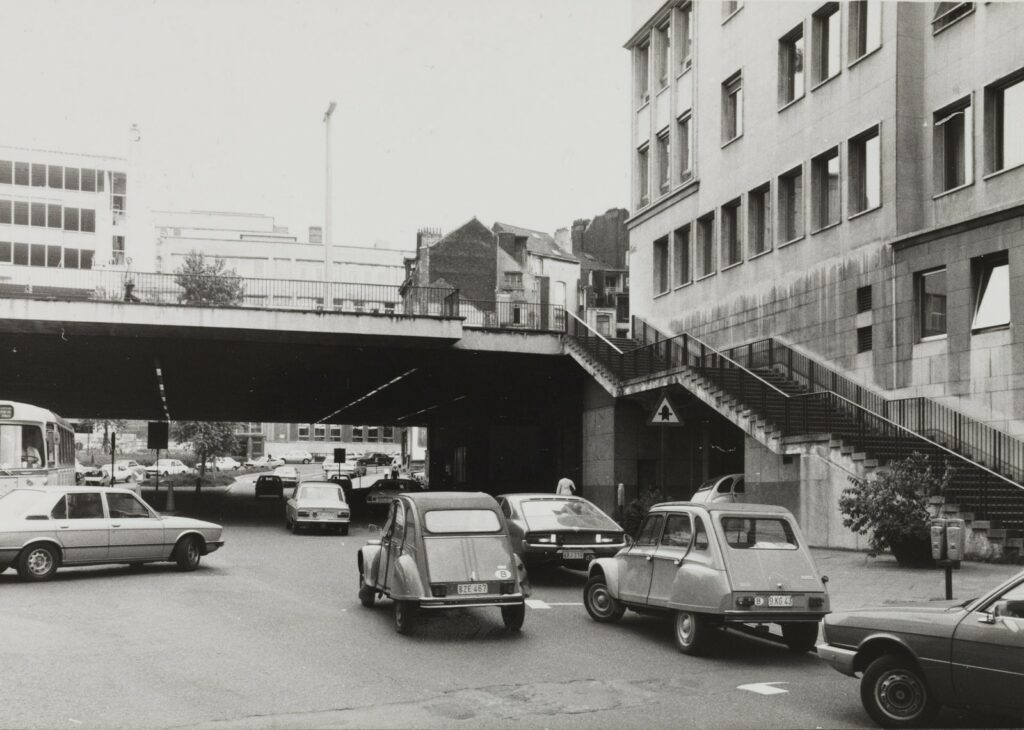
We entered the long shadow of the now-vanished Koekelberg Viaduct, that elevated artery that once shuddered beneath the weight of trams overhead. The structure trembled above us as we drove along Boulevard Léopold II.
Traffic thickened. Five o’clock. Rush hour in Brussels, winter 1976. Maybe January, but I’m not sure.
Brussels, like Belgium itself, felt divided. Beautiful and melancholic.
People in long, dark par-dessus coats passed fogged windows, their outlines blurred by the cold. The air was brisk, with snow lingering at the edges of a menacing sky. Streetlamps cast a pale, spectral glow over the streets, giving the city the feel of a late nineteenth-century painting. For a fleeting moment, Brussels seemed to belong to its surrealist painters, vaguely distorted, opaque, suspended between dream and reality.
We passed the famous Cinzano sign at Place Rogier, with Parc Botanique to our left.
And for once, I didn’t stall. I didn’t panic. Meneer B was calm. No chain-smoking. His voice was steady. He even smiled. It was the first real conversation we’d ever had.
I thought maybe I could make it through.
But the calm didn’t last.
As we climbed out of the Marolles district via Rue des Minimes, snow began to fall heavily, just as the green dome of the imposing Palais de Justice loomed above. It became hard to see. The cobblestones shimmered with ice.
My palms were slick with sweat. The wipers squeaked. I glided into the roundabout at Place Poelaert too fast.
I should have slowed. I should have checked for traffic.
I didn’t.
A truck roared past, missing us by mere centimeters. Horns blared. A bus hurtled toward us head-on. For a split second, my mind froze.
Then Meneer B slammed the emergency brake.
The car jerked violently to a stop.
“Godverdomme,” he shouted. “You nearly killed us.”
The rest came in rapid-fire Flemish. I didn’t need a translation.
We drove back in complete silence.
The car felt colder than it should have. The heat was on, the windows sealed, but the chill remained. Every so often, Meneer B closed his eyes, as if trying to breathe through the chaos I’d just unleashed.
Now that I’m about the age he was then, I wonder if he wasn’t simply calming himself. I find myself doing the same these days. Maybe he was meditating, not in the Eastern sense, but in a private inward way.
I knew I’d failed.
After the Place Poelaert incident, I never heard another word from him. Ever. My driving improved after that. But something else had shifted.
Back at the office, Meneer B handed in his report to the manager quietly. Then he left.
No handshake. No goodbye. No eye contact.
I sat alone, replaying the moment over and over. If only I had stopped. If only.
An unsettling thought crept in. I’d have to tell my family and friends I failed. One of those teenage moments where you wish the ground would open up and swallow you whole.
Then the manager called me over.
“Young man,” she said, smiling faintly, “you passed your road test with one of the lowest scores possible.”
I blinked. I was stunned.
“Based on what he told me about the events at Place Poelaert,” she said, “Meneer B clearly has hope in you.”
I liked the word, and still do. Hoop. Espoir.
I didn’t know what to say. My hands were still trembling. I think I said merci and dank u, but I can’t be certain. Nearly fifty years have passed. The memory feels distant, and yet somehow still vivid.
Meneer B and I came from different worlds. Me, a Moroccan teenager. Him, a Flemish man nearing retirement. We had little in common.
But that winter evening, in that smoky little Peugeot, something passed between us.
Not in words. In silence.
And I’ve carried it ever since.
I was a teacher for many years. And whenever I think back to the young people I guided, whether in the classroom or on the soccer field, I always try to remember Meneer B.
His silence. His steadiness. The way he placed his foot on the brake when I couldn’t find mine.
He quite literally saved our lives.
But he also taught me more than how to drive.
He taught me how to show up for someone, even when it’s hard. Especially when it’s hard.
And for a teacher, that’s everything.
Dank u, Meneer B, for giving me a second chance. For seeing me. For believing in me.
I sincerely hope your trust was not in vain.
And finally, though it’s long overdue, I want to say: I’m sorry for nearly getting us killed that winter evening so many years ago.
