

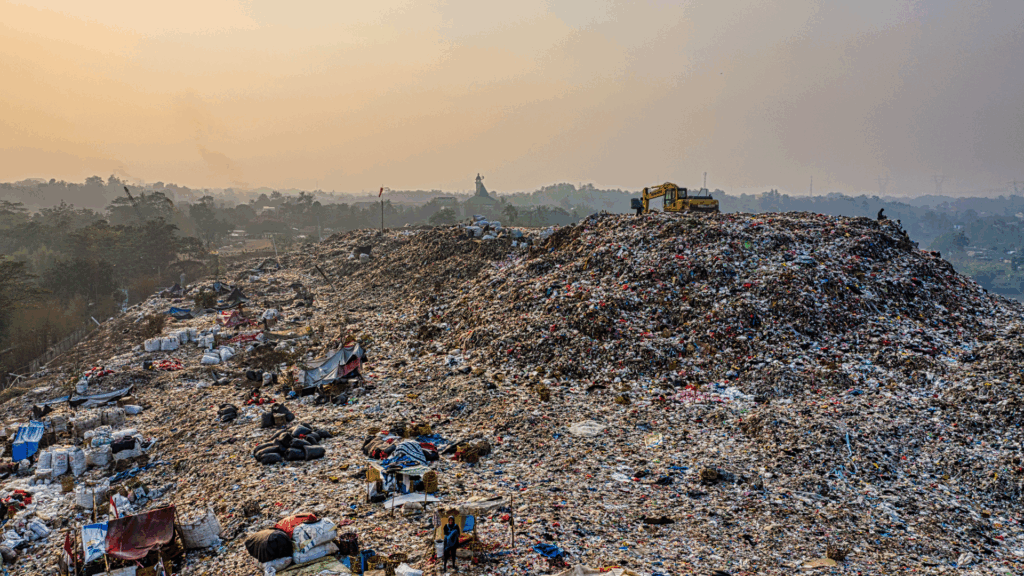
Waste from food and other rubbish in landfills accounts for around 10 per cent of all global greenhouse gas emissions, according to the UN’s Environmental Programme.
Although underreported in official accounts, that is more than five times the amount produced by the whole of the aviation industry.
This methane gas leaking from landfills traps 81 times more heat in the atmosphere than CO2 over 20 years and about 28 times more over 100 years. Over the shorter period, its emissions are estimated to cause roughly one-third of the global heating driving the climate crisis.
This gas is released as materials slowly decompose after they are dumped in landfill. Food, paper and other natural materials are the main culprit because they cannot properly break down without oxygen.
Scientists have warned that this problem could only get worse, with emissions from unmanaged landfills potentially doubling by 2050 with growth of population and wealth.
Every year, there are huge leaks – known as “super-emitters”- from landfills that are captured and recorded on satellite imagery.
These include sites in emerging economies – but also surprisingly in Europe. We don’t usually associate such high levels of pollution with western Europe, but they are still commonplace in so many countries.
For example, one study showed the Spanish capital, Madrid, to have had massive permanent leaks between 2021 and mid-2023. These pollutions were detected near huge landfill sites to the south of the city centre, where there were plans in place to capture methane.
The largest of these leaks emitted at one point in time 25 tonnes of methane an hour – the equivalent CO2 of 3.9 million cars with their engines running a year at the same rate.
It is clear that solving this issue is critical to fighting climate change. There is a desperate need to cut down food waste, reuse materials and increase recycling initiatives.
But there is always going to be municipal solid waste with a fraction of biogenic waste, including food waste, that cannot go through these processes.
One solution here is to thermally treat and compact the waste to produce energy - and recover resources in the process – now commonly known as ‘Waste-to-Energy’. This reduces waste going to landfill and consequently methane emissions, as well as a host of other associated risks – such as soil and groundwater pollution.
Thermal treatment also allows for the recovery of metals, which cannot otherwise be recycled, and provides energy to local communities.
‘Waste-to-Energy’ is a highly regulated industry, having to meet strict environmental standards under the EU Industrial Emissions Directive.
Many will use carbon capture technology during the process to minimise CO2 output -potentially to the point of reaching negative emissions - meaning environmental impact will be limited.
This technology is gaining traction as the EU looks to uphold very ambitious targets around landfill reduction; with goals of less than 10 per cent of municipal waste landfilled by 2035.
However, we are at a pivotal moment.
The EU is currently consulting on its Emissions Trading System and its expansion to include Waste-to-Energy companies. This will mean that plants will need to purchase emissions permits for thermally treating waste – pushing up costs to the point which renders it uncompetitive and, in some cases, unviable.
Politicians want to incentivise landfill reduction. But this rise in costs could lead to a huge increase and sharp hike in dangerous methane leaks across Europe. Inclusion in this system would also fail to take account of the circularity coming with Waste-to-Energy - which sees metals and materials such as aggregate produced when it would be otherwise lost.
The latest analysis of responses to the consultation shows that the majority group, including many of the industry’s key players, currently oppose the inclusion of Waste-to-Energy companies in the system. And for good reason - it would not only worsen our landfill crisis but also accelerate the damaging effects of climate change.
This is not mentioning the potential rise in criminal activity around illegal exports and dumping.
If the EU is serious about meeting its landfill reduction target, tackling climate change meaningfully, and improving people’s health, it must stop penalising the very solution that brings added benefits. Instead, it should accelerate efforts to end the landfilling of biogenic waste and increase recycling rates.
