
In twenty years, future generations may ask why European NATO members failed to use this period of astronomical defence spending to advance broader goals — including the energy transition. After all, there is a precedent.
On the eve of World War I, Winston Churchill led the British Navy away from burning coal to burning oil. The move, considered bold by many, ultimately benefited the British fleet by making its ships faster, quieter and safer, ushering in a new era of oil.
Historically, defence innovation has been beneficial for advancements in other sectors, too. GPS and the microwave, two technologies now acknowledged as indispensable, were initially developed for military purposes, before later being adopted for commercial use.
Semiconductors, biotech and cybersecurity are other examples of transformative innovations that originated in the defence sector but have since contributed to societal development.
Defence spending as a missed opportunity
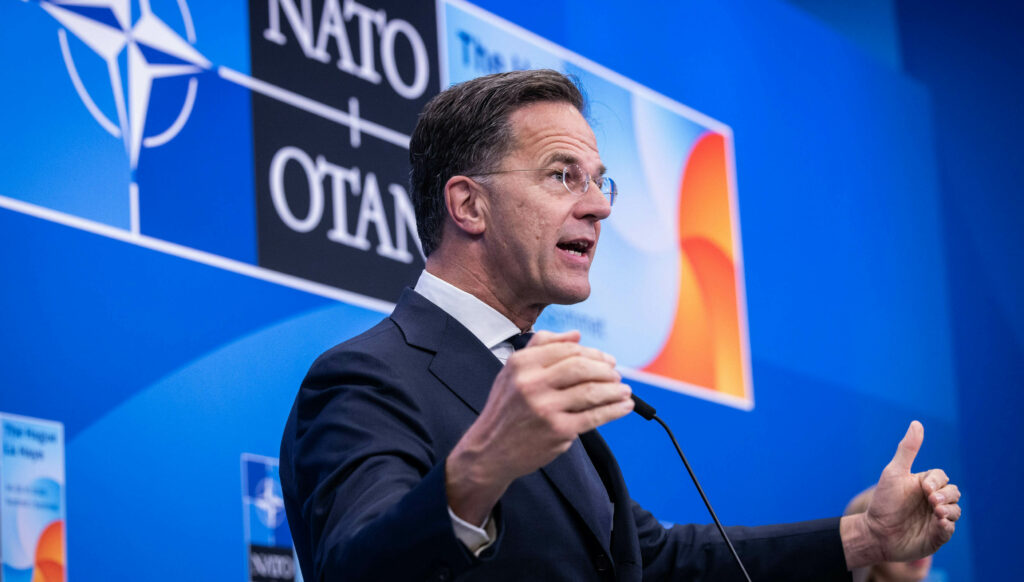
The 5% spending target, agreed by NATO member states this summer in The Hague, therefore risks becoming a missed opportunity to address non-military, yet equally critical, issues. This isn’t about using electric tanks or solar-powered missiles by tomorrow; it is about shoring up the continent’s long-term energy resilience through clean innovation.
The security imperative is clear. Supply chains for fossil fuels have already proven to be an operational vulnerability for militaries. Sustaining fuel supplies and their storage was one of Russia’s weaknesses in 2022.
For NATO troops, the logistics of securing and protecting diesel supplies during combat proved a challenge in Afghanistan and Iraq, with many lives being lost.
On top of that, Europe’s domestic liquid fuel refining capacity has been steadily declining. Relying on even more fuel imports to meet militaries’ growing demand in the coming years poses significant security risks, as highlighted by Europe’s most recent energy crisis.
How the defence sector can reshape Europe's energy future?
Any decision to invest in fossil-based infrastructure and fuel sources is thus strategically short-sighted. So how then could European NATO members optimise their spending? So-called dual-use technologies are a good place to start.
Research into sustainable fuels, for instance, shows that they could be cheaper, safer, quieter and less visible on foreign radars. The Netherlands, a frontrunner in the development of sustainable aviation fuel (SAF) capacity, just published its National SAF Roadmap to scale the production of SAF’s by 2035. Increasing demand by the Royal Netherlands Air Force, who already operated F-16 jets on SAF as early as 2019, could significantly boost this ramp-up in the decade ahead.
Elsewhere, the development of ultra-lightweight materials could help to reduce tank weight – a growing challenge for modern military logistics – which would be a boost for energy efficiency. At the same time, these materials might be adapted for commercial heavy-duty vehicles and aviation to facilitate the use of biofuels and electrification.
Another example might be the development of an integrated smart grid and battery storage system to help remote military bases withstand significant energy vulnerabilities. In civilian spaces, these kinds of micro-systems could also be deployed in natural disaster zones during power outages. It’s a clear ‘win-win’, given the environmental challenges that are already straining armed forces and public communities alike.
This will not be straightforward, but there is a path to take. To begin with, European policy makers must focus on reducing our fossil fuel dependency and carbon footprint. By directing resources, including some of NATO’s 5% pledge, toward clean innovation, militaries can herald a more strategic approach which strengthens Europe’s collective deterrence and its energy security.
An EU toolbox for clean defence
Attempts to build bridges between energy, climate and defence stakeholders will be key. Fortunately, work is already well underway: The continuation of the Consultation Forum for Sustainable Energy in the Defence and Security Sector (CF SEDSS), an EU-funded initiative run by the European Defence Agency (EDA) until 2028 is one such example and something which can be built on.
Attracting investments in clean innovation is another important step in putting the European Defence Industrial Strategy (EDIS) and its key piece of regulation, the European Defence Industry Programme (EDIP), into practice.
To support this, defence procurement criteria could include a life-cycle assessment of the costs of new defence systems with a premium on the costs of imported fossil fuels. This would likely lower the costs of military equipment that could be powered by more sustainable fuels in the long run. The planned amendment of the regulation on defence and sensitive security procurement, as recently proposed by the European Commission, could include such rules.
The EU could further consider a percentage for clean innovation in defence, scaling already existing programmes, such as those of the EDA. Research and development through the European Defence Fund might also be connected to Horizon Europe, which has a long tradition of funding innovation in clean technologies.
In addition, akin to industrial alliances such as the European Battery Alliance and the European Clean Hydrogen Alliance, a new public-private coalition could be set up to strengthen industry collaboration around dual-use innovation.
Future-proofing Europe’s defence
Lowering the military’s reliance on oil and gas will not be simple, and concerns about new insecurities linked to the raw materials needed for clean technologies are valid. Yet these challenges cannot justify short-sighted choices. Europe must avoid reactive decisions today that would lock its militaries into new fossil fuel dependencies tomorrow. The EU should invest not only in stronger defence capabilities but also in more sustainable, future-proof ones. History shows it’s a smart idea.
