

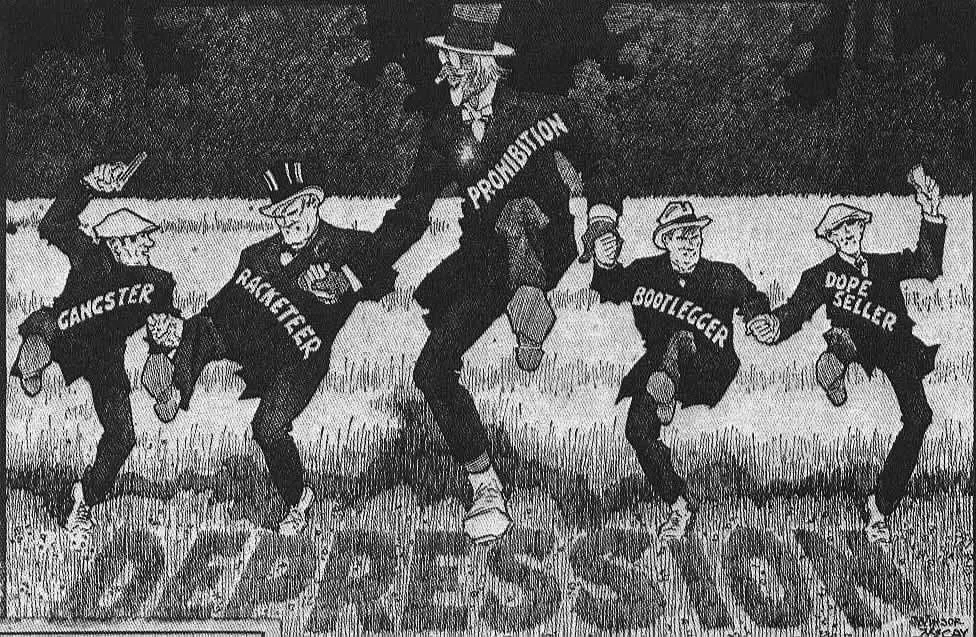
It has long been said that human desire is limitless, and where there is a want, there is a market opportunity. It seems, therefore, that we learned very little from the Prohibition era of the 1920s in the United States, which shifted the sale of alcohol from licensed establishments to violent, vertically integrated criminal networks.
Banning an activity, however well-intentioned, acts as a powerful catalyst for organisational restructuring. Prohibiting a substance inflates transaction costs so severely that only the most ruthlessly efficient, hierarchical enterprises can afford to endure.
Before the foundational work of Ronald Coase in 1937, conventional economic theory largely viewed the firm as a theoretical "black box". Economists assumed the company was merely a technical unit that mechanically transformed inputs into outputs. The entrepreneur was seen simply as an agent who maximised profit by choosing production levels, subject only to technical rules and market prices.
What occurred inside the firm—its internal organisation, management, and resource allocation—was considered outside the scope of economic inquiry, as if the entire process were perfectly efficient and frictionless.
Ronald Coase, in 1937, fundamentally challenged this static view by asking a deceptively simple yet profound question in his essay, The Nature of the Firm: "If the invisible hand of the market works so well, why do firms exist?". He wondered how, in an "ocean of transactions" that is the market, one finds these "islands" (firms) where resources are allocated not by price signals, but by "decisions that the entrepreneur takes".
He contrasted the market's decentralised, horizontal coordination with the firm's use of hierarchy and vertical relations of command and control to coordinate production.
The answer Coase discovered was the existence of transaction costs. He argued that using the market isn't "free"; it involves real expenses associated with the exchange itself. Coase identified these as the costs related to searching for information and suitable counterparties, negotiating and drafting agreements, and establishing confidence and vigilance to ensure work is delivered.
By formalising these costs, Coase suggested that the firm emerges spontaneously as an institution precisely to reduce the costs of transaction. The decision to use the firm (vertical hierarchy) over the market (horizontal coordination) is a rational economic choice, made whenever the market's transaction costs are higher than the firm’s management costs, thus setting the analytical boundaries of the firm.
Consequently, in highly competitive, low-risk environments, transaction costs are relatively low, favouring market specialisation, modularity, and fragmentation. This is the case of online platforms such as Etsy or Upwork, where freelancers connect directly with clients.
However, in an uncertain context with excessive regulation, information asymmetries, or the threat of opportunism, transaction costs skyrocket, making purely decentralised coordination inefficient or impossible. For example, companies like Toyota or Ford can't afford to rely on third parties for highly specialised components that could jeopardise the entire production line, so they have strong incentives to internalise these portions of the value chain.
Technology reduces transaction costs
Technology acts as a powerful external force that reduces key transaction costs, shifting the Coasean equilibrium away from hierarchy and toward the market, often eliminating intermediaries between counterparts.
The internet, in particular, and the emergence of modern applications and platforms, have dramatically lessened the cost and time required to search for suppliers, customers, necessary information, or the process of negotiation and contracting. The process of finding the optimal counterparty is nearly instantaneous, decreasing the need for a firm to maintain extensive internal departments for this purpose. Technology also provides tools for more effective and lower-cost monitoring. Algorithmic systems, ratings, reviews, and tracking mechanisms reduce the costs of establishing confidence and keeping track of compliance with the terms of the exchange.
OnlyFans perfectly illustrates how technology directly attacks the foundation of the traditional firm by eliminating the middleman through transaction cost reduction. For creators of specialised content, a traditional production company once performed essential, transaction-intensive services.
OnlyFans now automates these functions, drastically lowering the individual creator's transaction costs for marketing, distribution, and payment collection. The creator can now transact directly with the consumer, making the market the primary governance structure. This capability erodes the economic justification for the large, integrated producer company to exist as the primary organiser of that specific economic activity, demonstrating that when technology makes market exchange inexpensive, the firm's boundaries contract.
Prohibition increases transaction costs
Government prohibition also acts as an exogenous institutional force that significantly elevates all forms of market friction, thus making non-market, hierarchical solutions the only efficient means of conducting trade.
Oliver E. Williamson, in his 1971 paper The Vertical Integration of Production: Market Failure Considerations, established that the framework for an optimal governance structure—the mechanisms adopted by companies to manage exchanges—must adapt to the level of transaction costs and market hazards. When hazards are severe, the only defensive mechanism is vertical integration (hierarchy). Thus, if we consider prohibition an extreme form of market regulation, we should expect correspondingly large-scale vertical integrations.
In an illicit market, there is a higher information cost. Finding reliable and non-compromised partners is immensely difficult and costly. Due to the asymmetric distribution of information, operators must constantly contend with the risk of undercover agents or untrustworthy actors. Secondly, there are higher negotiation and contracting costs. Agreements in illegal trade are unenforceable in court; hence, formal institutions are rendered moot, demanding elaborate, non-legal "safeguards" or substitutes for contractual fulfilment. Third, higher monitoring and enforcement costs. The potential for opportunistic behaviour—seeking wealth through deceit or strategic disclosure of information—is acute. Any partner in the supply chain can betray the organisation to the authorities, constituting the ultimate form of contractual breach.
Therefore, the criminal cartel or organised crime syndicate emerges as the purest expression of efficient hierarchical governance in a prohibitively expensive market environment. They internalise the whole value chain—from production (cultivation, synthesis) to transit and final distribution—to eliminate dependence on high-risk external partners. The cartels’ hierarchy also replaces the formal legal framework (courts, police) with command, control, and coercion. Lastly, the assets used in illegal trade (clandestine labs, secret smuggling routes, specialised knowledge of criminal networks) are highly relationship-specific. Losing any single component or partner in the chain due to capture or opportunism results in a significant and unrecoverable loss of value.
Ross Ulbricht and the Silk Road
The Silk Road provides a digital example of these dynamics. Launched in 2011 by Ross Ulbricht under the pseudonym "Dread Pirate Roberts," Silk Road was an illegal darknet market that functioned until his arrest in 2013. It facilitated the trade in narcotics and other illicit goods and services. By offering anonymity, the site lowered search, negotiation, and enforcement costs relative to traditional criminal networks. The Silk Road temporarily bypassed some constraints of hierarchical criminal organisations, yet it remained subject to extreme legal risk. Ulbricht was arrested by the FBI in October 2013 and later convicted on charges including conspiracy to commit money laundering, computer hacking, and drug trafficking, receiving a life sentence without parole in 2015. Following years of appeals and public debate over the severity of his punishment, President Donald Trump granted him an unconditional pardon in January 2025, resulting in his release.
Unlike traditional black markets, the Silk Road eliminated nearly all direct human interaction between buyer and seller. The platform operated through a system of reputation and escrow that effectively mimicked the institutional safeguards of legal markets. Vendors were rated after each transaction, creating a feedback mechanism that reduced information asymmetry and built reputational capital in place of face-to-face trust. Payments were made in Bitcoin, and funds were held in escrow by the platform until the buyer confirmed receipt of the product, minimising opportunistic behaviour and disputes. The Silk Road temporarily replaced violence and coercion—the classic tools of hierarchical criminal organisations—with code and algorithms.
In conclusion, the organisational structure of any market—licit or illicit—is a mirror reflecting its institutional and technological environment. The logic of Coase and Williamson demonstrates that the size, scope, and vertical integration of the firm are directly proportional to the transaction costs imposed by the external environment. Prohibition, by inflating these costs to an unsustainable level, provides the most potent evidence for why the hierarchy—whether a legal corporation or a criminal cartel—exists and thrives.
