
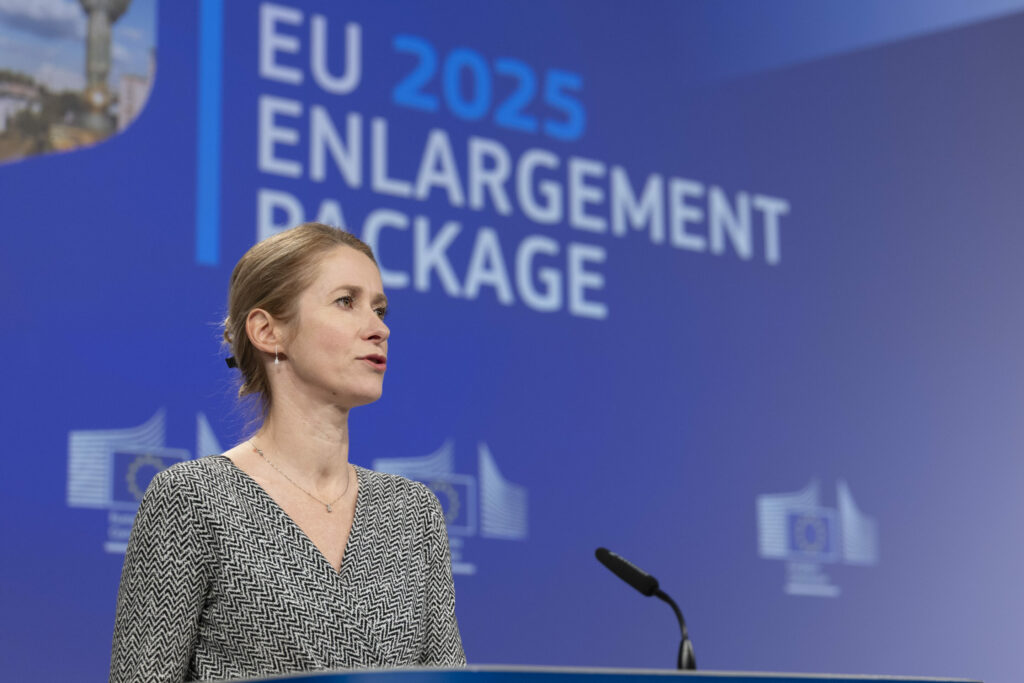
What began as a cautious enlargement process is now a test of whether the EU can reform, overcome vetoes, and lead in a rapidly shifting world order.
Last week, the European Commission unveiled its annual enlargement reports. Since Russia’s full-scale invasion of Ukraine in 2022, enlargement has ceased to be a rhetorical promise and has become a geopolitical necessity.
The reports provide a solid technical foundation for bringing several candidate countries closer to the Union. Between the lines, there is a clear sense of urgency – a recognition that the stakes are historic. Yet beyond the Commission’s measured prose, the political reality is murkier.
Hungary continues to block the opening of accession “clusters” with Ukraine and Moldova. Many EU member states say they will revisit the issue in April, after the parliamentary elections in Hungary. But what happens next is still quite uncertain.
The situation is fuelling concerns about the dangers of accepting new members. The Enlargement Commissioner Marta Kos put it bluntly: “I don’t want to go down as the commissioner bringing in the Trojan horses.” The fear is not abstract.
If the Union struggles to act decisively with 27 members, how will it function with over 30–especially when decisions in key areas can still be blocked by a single government acting in bad faith?
Balancing expansion and governance
This is why the debate about limiting veto powers in the EU has re-emerged with force. It is hardly new. Every previous wave of enlargement was preceded by a shift towards more qualified majority voting (QMV) and fewer national vetoes.
The Maastricht Treaty did so before Austria, Finland and Sweden joined. The treaties of Amsterdam and Nice paved the way for the 2004 and 2007 enlargements. Lisbon went further still. In the early 1990s, around 30% of Council decisions were taken by QMV; by the 2010s, that figure was closer to 80%.
The logic is simple: as the Union grows, unanimity becomes untenable. Reforming the voting system is therefore not a radical innovation but a precondition for successful enlargement.
A group of member states – the so-called “Friends of QMV in Foreign Policy” – has already formed. Belgium, Finland, France, Germany, Italy, Luxembourg, the therlands, Slovenia, Spain and, more recently, Romania have endorsed moving foreign policy decisions to QMV.
Taxation, sanctions, and aspects of defence policy are all areas where unanimity increasingly undermines the EU’s ability to act strategically. Concerns of national security order of individual member states should be explainable to others and trigger coalitions rather than vetoes.
The conversation about how to keep Europe functional after the next enlargement is, in that sense, a sign of seriousness, not scepticism. Some suggest accelerating the accession of a few countries that are making fast progress, but withholding their full voting rights for a period of time after accession until certain conditions are met.
There is also vague talk of creating a kind of second-class member state within the EU that has fewer veto or voting rights. Once again, there are talks of staged accession and a multi-speed Europe. Such conversations are both inevitable and potentially fraught.
Some ideas may serve as cannon fodder for anti-European sentiment, both inside and outside the EU, but others are not unreasonable, given that not all of the formal candidate countries are actually making a serious effort to join the EU.
Securing the Union from within
At the same time, Europe must strengthen the tools it already has to discipline internal spoilers. Article 7 of the Treaty on European Union – the mechanism that allows the suspension of voting rights for serious breaches of EU values – has proved to date too cumbersome and too political. It should be expanded and streamlined, allowing for automatic consequences when rule-of-law violations are confirmed.
Likewise, linking EU budget payments to respect for democratic standards and judicial independence must become not just a political choice, but a legal obligation.
Such measures are not about punishing dissent but about protecting the integrity of the Union itself. The EU cannot credibly act in global affairs while being paralysed on too wide a spectrum of matters which are not very strategic. That vulnerability has security implications far beyond Brussels. Europe’s immediate neighbourhood is increasingly unstable.
The recent revelations about individuals trained in Serbia to carry out drone attacks and violent provocations in Romania and Moldova underscore how uncertainty about Europe’s enlargement trajectory can be weaponised by external actors. Leaving a grey zone of fragile states between the EU and Russia serves no one – except Moscow.
A larger Europe, done right, will be a safer Europe. The choice is not between deepening and enlargement, but between paralysis and power. The EU cannot afford another decade of introspection.
Next year it must accelerate the twin tracks of reform and expansion: advance accession talks with Ukraine and Moldova, close negotiations with Montenegro and agree on the institutional adjustments necessary to make a Union of 30-plus states governable.
Five years ago, few imagined a global pandemic, a full-scale war on the continent, or the resurgence of great-power rivalry. The next five years could be equally transformative.
The EU’s geopolitical relevance will not be secured by communiqués or by waiting for veto-wielders to change governments. It will depend on its capacity to adapt – swiftly and decisively – to a harsher world.
Enlargement can be a strong instrument of influence, and making EU decision-making simpler and faster should make it even more so. That is something that current and future member states need – a strong and functional union.
